 G
G GPTZero
GPTZero is an AI detection tool best for educators, publishers, and content teams who need sentence-level identification of AI-generated text with plagiarism checking. It is not a writing or humanizing tool, and detection accuracy can vary on paraphrased or heavily edited content.
Quick answer
GPTZero is an AI detection tool best for educators, publishers, and content teams who need sentence-level identification of AI-generated text with plagiarism checking. It is not a writing or humanizing tool, and detection accuracy can vary on paraphrased or heavily edited content.
AI detection tools including GPTZero carry documented false positive risk — independent studies have reported elevated false positive rates on non-native English speakers and formal writing styles. Buyers should treat detection results as one signal rather than a definitive verdict and apply human editorial judgment before acting on flagged content. GPTZero's pricing sources show some variation across third-party listings; verify current plan names, word limits, and pricing directly on the official pricing page before subscribing.
What is GPTZero?
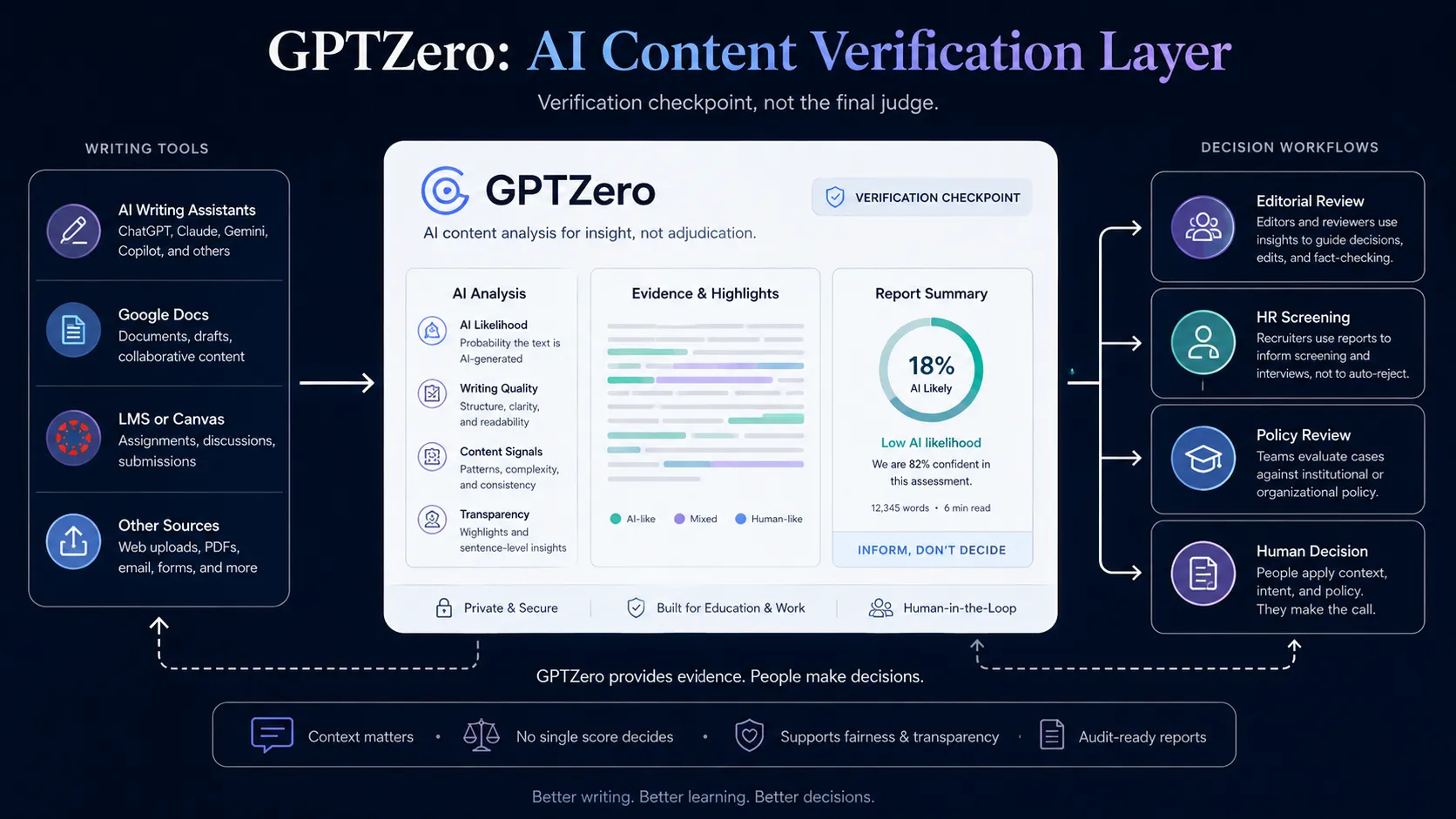
GPTZero analyzes submitted text and classifies it as human-written or AI-generated at the sentence, paragraph, and document level using perplexity and burstiness signals alongside a multi-component detection model. It supports batch file uploads, a Chrome extension, plagiarism checking on paid plans, and integrations with education platforms including Canvas, Moodle, and Google Classroom. GPTZero is widely used in academic institutions and reported to be used by over ten million teachers and students. The tool detects output from major AI models including GPT-4, Claude, and Gemini, though accuracy on paraphrased or heavily humanized content is lower than on clean AI-generated text.
Who GPTZero fits best
GPTZero fits best for educators reviewing student submissions, publishers verifying contributor content, and SEO content teams auditing AI-generated drafts before publishing, where detection accuracy and sentence-level granularity matter more than bulk API throughput or humanizing features.
- ✓Educators and academic institutions checking student submissions for AI-generated content
- ✓Publishers and editorial teams verifying contributor or freelancer drafts
- ✓SEO and content teams auditing AI-written content before publishing
- ✓Newsrooms and fact-checkers flagging AI-assisted drafts in their workflow
Not ideal for
- •Teams needing bulk API-scale processing at high volume — verify API plan limits and cost before committing
- •Workflows heavily dependent on non-English content where detection accuracy may be lower
- •Teams looking for a combined detection and humanizing or rewriting tool — GPTZero is detection-only
- •Buyers who need a definitive legal or compliance verdict — results require human editorial judgment
Main use cases
Academic Integrity Checking for Educators
Teachers and institutions submit student work to GPTZero to flag AI-generated content at the sentence level, supporting academic integrity review. GPTZero integrates with Canvas, Moodle, and Google Classroom for direct submission workflows. Educators should treat detection scores as one signal alongside other evidence — documented false positive rates on non-native English speaker writing and formal prose mean human judgment remains essential before any academic consequence.
Editorial and Publisher Content Verification
Publishers and editorial teams use GPTZero to screen contributor submissions and freelancer drafts before publication. Sentence-level highlights help editors identify specific passages that may have been AI-generated and require closer review or rewriting. GPTZero does not rewrite or humanize content; it is a detection layer that feeds into the editorial review process.
SEO Content Auditing Before Publishing
Content teams and SEO agencies use GPTZero to audit AI-drafted blog posts, product descriptions, and landing pages before publishing. Detection helps teams identify content that may not meet their editorial standards or platform policies. Pair with a grammar and style tool like Grammarly and a human editor for a complete pre-publish quality workflow.
API-Based Detection for Platforms and Tools
Developers and platform builders use GPTZero's API to embed AI detection into their own workflows — content management systems, hiring tools, or publisher platforms. API access is available on higher-tier plans; buyers should verify current API plan pricing, word limits, and rate limits before building production integrations.
Where GPTZero fits in the AI stack
GPTZero sits at the verification layer of a content production or review workflow. It receives text after drafting — whether by AI tools, freelancers, or students — and returns a detection assessment before editorial sign-off or publishing. It does not produce content, rewrite content, or make final publishing decisions; it provides a detection signal that feeds into human editorial judgment and policy enforcement.
Stack role
AI content verification and originality-checking layer
Best paired with
Grammarly, Originality.ai, ChatGPT
Strongest layer
AI-generated text detection
| Stack layer | Fit | What to know |
|---|---|---|
| AI-generated text detection | strong | Core strength. Sentence-level classification across major AI models with granular highlighting. |
| Plagiarism and source verification | medium | Plagiarism check included on paid tiers. Not a replacement for dedicated plagiarism tools like Turnitin for institutional use. |
| Batch file and bulk scanning | medium | Batch uploads supported on higher-tier plans. Verify word limits and file count caps before relying on this for high-volume workflows. |
| API and programmatic detection | medium | API available on higher-tier plans. Verify API pricing, rate limits, and word quotas before building integrations. |
| Non-English content detection | weak | Multilingual detection is included, but accuracy on non-English content and ESL writing is documented as lower. |
| Content rewriting or humanizing | weak | GPTZero is detection-only. It does not rewrite, humanize, or improve flagged content. |
Best stack combinations
Educator or academic institution
GPTZero + Google Classroom or Canvas + Turnitin
GPTZero handles AI detection at the sentence level integrated into the learning management system. Turnitin covers traditional plagiarism and source matching. Human review handles final judgment on flagged submissions.
Content team or SEO agency
GPTZero + Grammarly + WordPress
AI-drafted content passes through GPTZero detection, then Grammarly for grammar and style review, before being published via WordPress.
Publisher or editorial team
GPTZero + Originality.ai + Google Docs
Some editorial teams run submissions through both GPTZero and Originality.ai to cross-reference detection signals before making editorial decisions. Google Docs serves as the shared drafting and review environment.
What GPTZero can replace
- · Manual AI-content checking done by reading and guessing without a detection tool
- · Some plagiarism review steps when GPTZero's plagiarism check is included in the plan
- · Ad-hoc originality review processes for editorial and academic workflows
What it still needs
- · Human editorial reviewer: Final judgment on flagged content — detection scores are signals, not verdicts
- · Institutional plagiarism tool (e.g. Turnitin): Traditional plagiarism checking; GPTZero focuses on AI detection, not source matching
- · CMS or publishing platform: Content management and publishing after review is complete
- · Academic or editorial policy: Clear guidelines for how detection results are interpreted and acted on
Add it to your stack if
- · You receive content from freelancers, contributors, or students and need to flag likely AI-generated text
- · Your editorial or academic workflow requires a documented AI detection step before sign-off
- · You want sentence-level granularity in detection rather than a single document-level score
Skip it if
- · You need a humanizing, rewriting, or AI bypass tool — GPTZero does not provide those features
- · Your workflow requires bulk API-scale detection — verify API plan limits and cost before committing
- · You plan to use detection results as a sole determinant of academic or legal consequence without human review
Choose your next step
Pricing
→Compare GPTZero free, Essential, Premium, and team plans including word limits and features.
Alternatives
→See how GPTZero compares to Originality.ai, Winston AI, Copyleaks, and Turnitin.
Compare options
→Compare GPTZero and Originality.ai for AI detection accuracy, pricing, and use case fit.
Stack fit
→See how GPTZero fits inside a full SEO content production and review workflow.
Review
→See whether GPTZero is worth it for your detection workflow.
Pricing summary
This is a profile-level summary. Use the pricing page for deeper plan checks.
Starting path
Free plan available; paid from ~$8.33/mo (annual)
Free plan
Yes
Free trial
No
GPTZero offers a free plan with a 10,000-word monthly limit and no credit card required. Paid plans are reported starting from approximately $8.33/month on annual billing (Essential tier) up to higher tiers for teams and API access. Third-party pricing sources show variation in exact plan names and prices; verify current plan names, word limits, and billing terms directly on the official GPTZero pricing page before subscribing.
Best starting path: Occasional users checking a few documents per month should start with the free plan. Regular users — educators reviewing class sets or content teams auditing drafts weekly — should evaluate the Essential tier. Teams processing higher volumes should check the Premium or Professional tiers and verify word limits before committing.
Related stack page
Top alternatives
See all →Direct alternatives
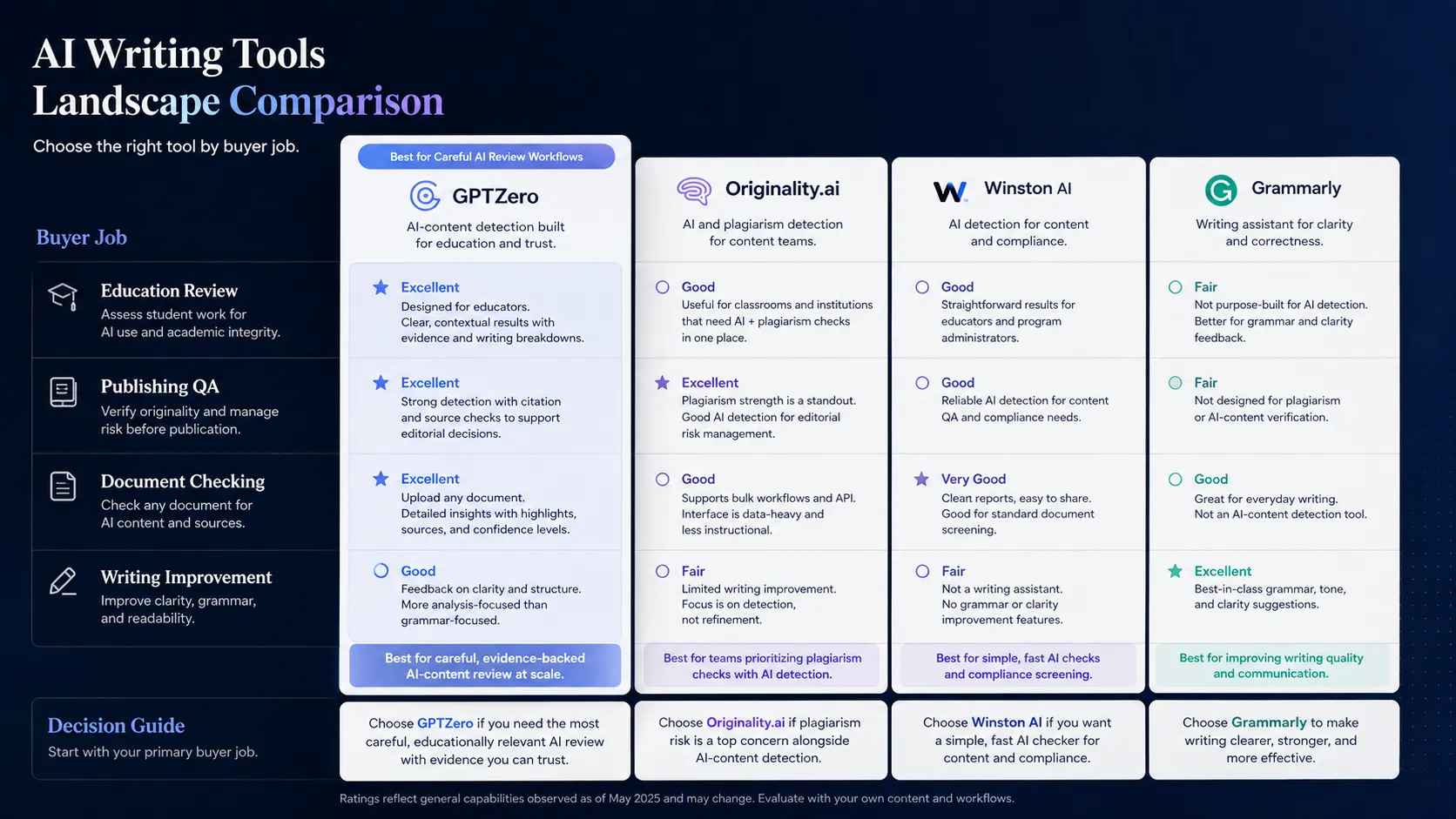
Most direct alternative for AI detection focused on web content and SEO teams. Originality.ai is stronger for bulk web content; GPTZero is more established in academic settings.

Direct alternative with OCR support for image and PDF uploads alongside text detection. Different accuracy profile — worth comparing for specific use cases.

Related comparisons
FAQ
What is GPTZero best for?
GPTZero is best for educators checking student submissions, publishers screening contributor drafts, and content teams auditing AI-written content before publishing. Its sentence-level detection and integrations with Canvas, Moodle, and Google Classroom make it particularly strong in academic settings.
Is GPTZero accurate enough to use as a sole verdict?
No. GPTZero provides a detection signal, not a definitive verdict. Independent studies have documented elevated false positive rates on non-native English speaker writing and formal prose styles. Results should be treated as one input alongside other evidence, with human editorial or academic judgment applied before acting on any flagged content.
Does GPTZero have a free plan?
Yes. GPTZero offers a free plan with approximately 10,000 words per month and no credit card required. It covers basic AI scans and is enough for occasional checking. Paid plans start from approximately $8.33/month on annual billing for higher word limits and plagiarism checking. Verify current limits and pricing on the official page.
What tools should I use alongside GPTZero?
Pair GPTZero with Grammarly for grammar and style review in a pre-publish content workflow. For academic use, Turnitin covers traditional plagiarism and source matching that GPTZero does not replace. Human editorial or academic review is always needed alongside detection results.
What is the best alternative to GPTZero?
Originality.ai is the most direct alternative, particularly for SEO and web content teams. Winston AI is worth comparing for workflows that include image and PDF uploads via OCR. Turnitin remains the institutional standard for academic plagiarism but operates differently from AI detection tools.
Who should skip GPTZero?
Teams that need a combined detection and content rewriting or humanizing tool should look elsewhere — GPTZero is detection-only. Buyers planning to use detection results as a sole legal or academic verdict without human review should reconsider the approach regardless of which tool they choose.
How TopAIStacks evaluates GPTZero
Tool Profile built from official GPTZero homepage and pricing page references supplemented by multiple third-party review sources verified in 2026. Pricing fields use cautious language because third-party sources show variation in exact plan names and prices — the most consistently reported figures across sources were used with buyer verification reminders applied throughout. False positive risk and accuracy limitations are noted based on documented independent research cited in third-party reviews. Stack role, workflow fit, and alternative classifications are based on product scope and buyer job analysis. Hands-on testing was not conducted by TopAIStacks.
Last checked: May 2026 · Source confidence: medium