Frase Review
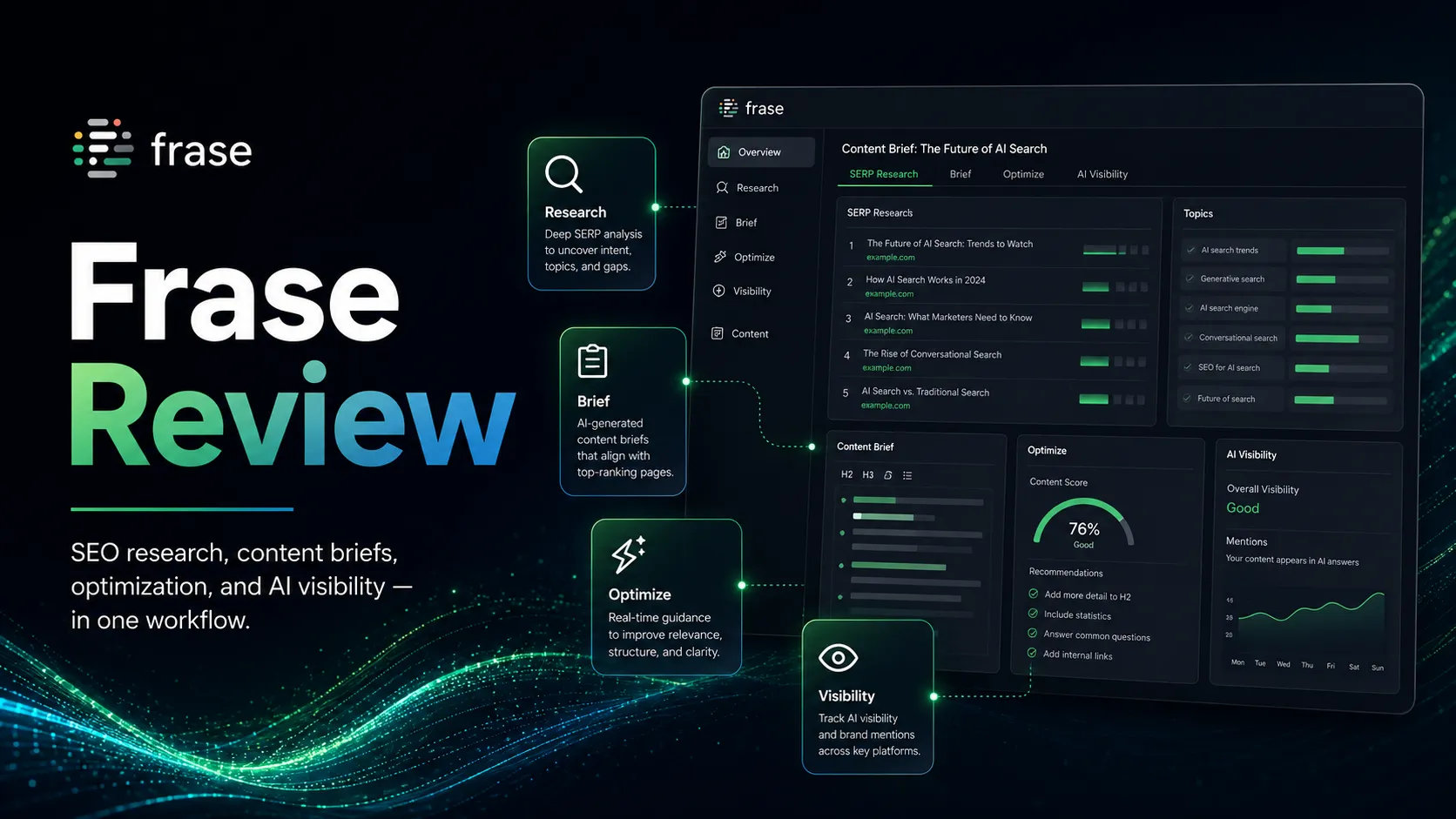
Frase review for SEO teams: research briefs, optimization, AI visibility, pricing, limits, alternatives, and when it deserves a stack slot.
Strong fit for SEO content teams that need faster briefs and optimization guidance, but not a full replacement for broader SEO strategy.
Use it if…
- ✓ Your content process gets stuck between keyword selection and a usable writer brief.
- ✓ You want one workspace for SERP research, content structure, optimization guidance, and AI visibility checks.
- ✓ Your team publishes enough SEO content that faster briefing and revision cycles would save real hours every month.
- ✓ You are comfortable treating AI output as a draft layer, not final editorial copy.
Skip it if…
- – You need all-in-one SEO data for links, rankings, deep site audits, and competitive research.
- – Your publishing volume is too low to justify another paid SEO tool.
- – You already have a disciplined content operations system and only need occasional AI help.
- – You want a tool that can replace human SEO judgment, expert review, or a real CMS publishing process.
Review scorecard
Scored by workflow fit, ease of use, value, and stack compatibility. Weights reflect importance for typical buyers.
| Criteria | Score | ||
|---|---|---|---|
| SEO workflow fit | 8.6 | ||
| Research and brief quality | 8.4 | ||
| AI writing usefulness | 7.2 | ||
| Pricing and plan clarity | 7.8 | ||
| Stack flexibility | 8.0 | ||
| Weighted overall | 8.1 / 10 | ||
On this page
Quick verdict
Frase is easiest to judge when you stop asking whether it is a general AI writer. The practical question is whether it can remove the slow middle of SEO content work: checking the SERP, collecting questions, building a brief, shaping a draft, and deciding what still needs optimization before publishing.
From that angle, Frase makes sense for content teams that publish often enough for research and briefing to become repeat work. It is less convincing if you only need a chatbot to draft copy, or if your SEO stack already handles research, optimization, audits, and reporting with a process your team follows consistently.
Who should use Frase
Frase fits the person who has already felt the pain of starting a new SEO article with twenty open tabs, a half-built outline, a keyword list, and no clear idea what the writer actually needs next. A solo blogger publishing one article per month may not feel that pain enough. A content operator planning ten pieces across a niche site probably will.
It is strongest when the buyer needs a repeatable brief workflow. The value is not only that Frase can produce content. The value is that it can help turn a search query into a structured writing direction using competitor structure, user questions, keyword intelligence, and optimization signals.
A small agency is a good example. If the team needs to hand clients consistent outlines, create writer-ready briefs, and check drafts before delivery, Frase can become a real workflow layer. If the same agency only needs occasional topic ideas, a cheaper writing assistant plus manual SERP review may be enough.
Who should skip Frase
Skip Frase if your main problem is not content briefing. If you need backlink analysis, technical crawl depth, keyword databases, rank tracking, or full competitive intelligence, Frase is not the center of the stack. It can sit beside those tools, but it should not be confused with them.
Also skip it if you expect the AI writing layer to remove editing. That is where buyers get disappointed with most SEO writing tools. Frase can make the first draft less painful, but it cannot decide whether a claim is true, whether the article deserves to rank, or whether the piece actually helps the reader better than the pages already on Google.
Real workflow fit
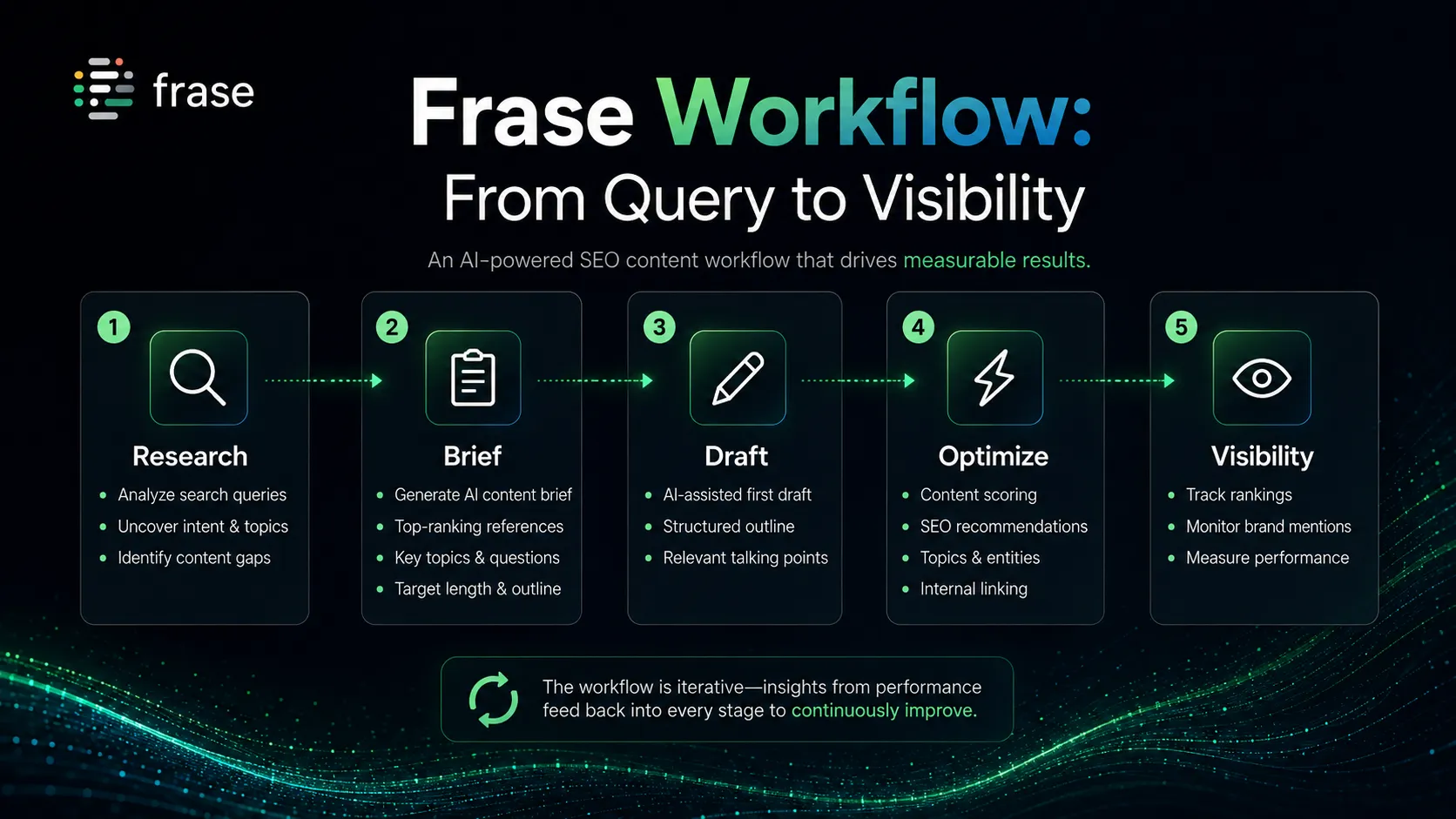
The strongest Frase workflow starts before writing. You enter a topic or query, let the system research the competitive landscape, turn the findings into a brief, and then use that brief to guide drafting and optimization. This matters because many content teams do the opposite: write first, then try to rescue the article with optimization after the structure is already weak.
Frase’s current public positioning has moved beyond the older idea of a simple SEO content optimizer. It now presents itself as an agentic SEO and GEO platform, with research, optimization, AI visibility tracking, site audits, publishing, API access, and MCP access on the public pricing page. That broader positioning is useful, but it also means buyers should be careful not to buy the story without checking the volume limits that matter to their workflow.
The feature that deserves the most attention is not the AI draft itself. It is the research and briefing path. Frase’s public Research Agent page describes SERP analysis, People Also Ask questions, competitor breakdowns, keyword intelligence, topic clusters, and a structured brief output. That is exactly the part of SEO content work where a repeatable process can save real time.
Where Frase fits in an AI stack
The right way to think about Frase is as the SEO content workflow layer, not as the whole SEO department. It belongs between your source-of-truth tools and your publishing process: Google Search Console, analytics, crawler data, editorial guidelines, AI assistants, and the CMS.
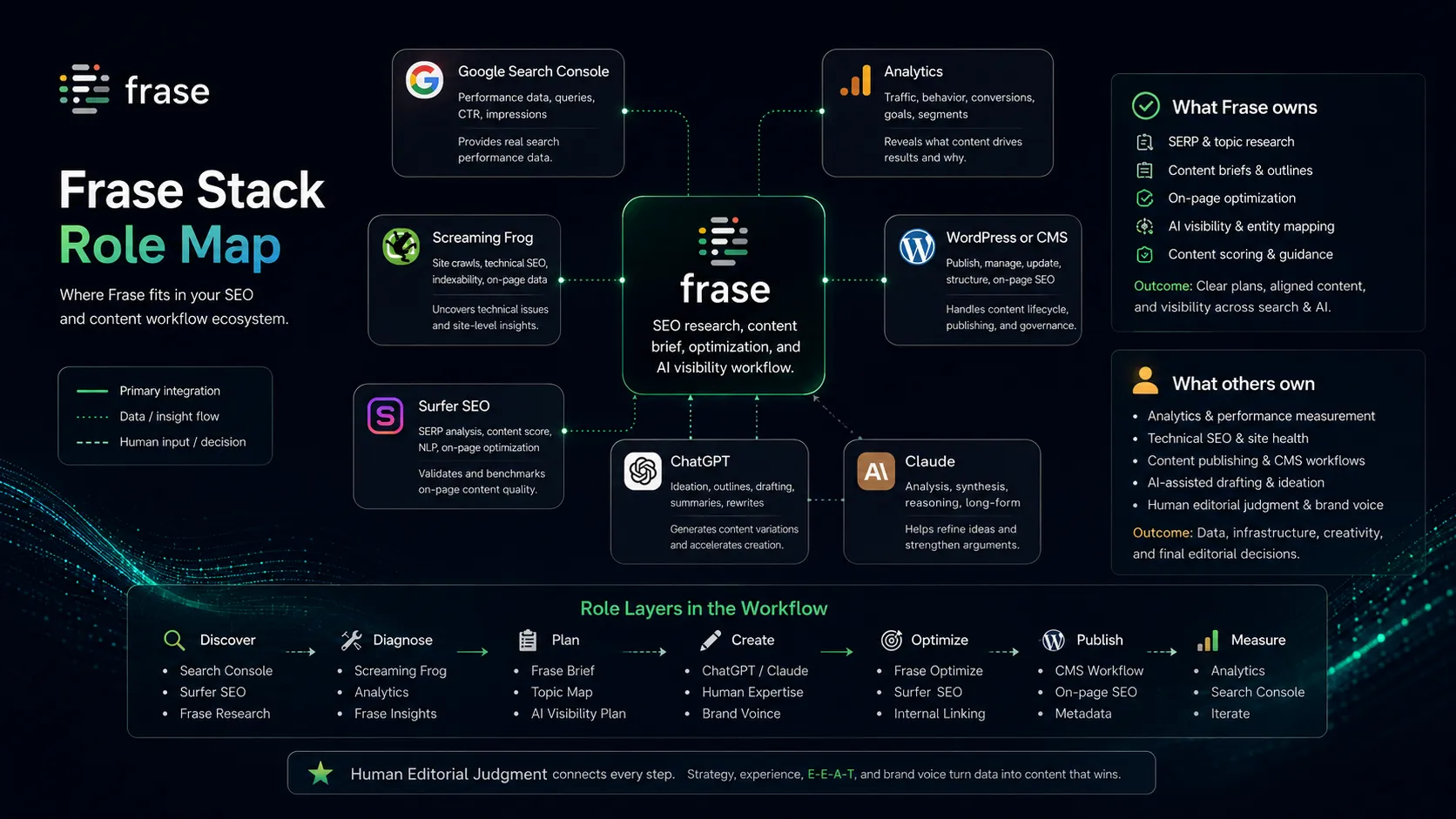
This is not a full replacement for Ahrefs, Semrush, Screaming Frog, or Google Search Console. It also does not replace a human editor. The better stack is Frase for brief and optimization workflow, a broader SEO tool for market data, an analytics layer for performance, and human review for quality and accuracy.
What Frase does well
First, Frase gives structure to the messy part of SEO content creation. The tool is useful when a writer needs more than a target keyword but less than a fifty-page strategy document. A good brief should answer what competitors cover, what readers ask, how the content should be shaped, and what gaps are worth addressing.
Second, Frase reduces the blank-page problem without pretending the draft is finished. That distinction matters. The safer move is to use the AI writing layer to create a first pass, then edit for accuracy, flow, examples, and brand voice.
Third, the platform is now trying to connect SEO and AI search visibility in the same workflow. For buyers thinking beyond classic Google rankings, that may be useful. The caution is that AI visibility tracking is still a fast-changing category, so the buying decision should focus on whether the current limits and platforms match your actual content program.
Fourth, Frase is practical for content teams that want repeatability. If every writer builds briefs differently, optimization becomes inconsistent. A shared workflow can reduce that friction.
Where Frase falls short
The first limitation is scope. Frase is not the tool I would choose as the only SEO platform for a serious site. It does not remove the need for keyword validation, technical checks, content pruning decisions, link analysis, or traffic review.
The second limitation is the AI writing layer. Public review summaries tend to praise time savings and ease of use, but some feedback also points to the familiar issue with AI writing: output can be irrelevant, generic, or structurally weak if the brief and editorial review are poor. That is not unique to Frase, but it matters because buyers may overestimate what the writing layer can do.
The third limitation is plan-fit complexity. Frase’s plans differ by articles, audit pages, tracked platforms, visibility history, domains, seats, brand voice profiles, reference documents, and other volume limits. The headline monthly price is not enough. The question I would ask before paying is: how many briefs, optimization passes, and visibility checks will my team actually run every month?
Pricing judgment
Based on the public pricing page checked on 2026-05-28, Frase lists Starter at $49 per month, Professional at $129 per month, and Scale at $299 per month on monthly billing. The page also says every plan includes a 7-day free trial with no credit card required, and that annual billing can save 20%.
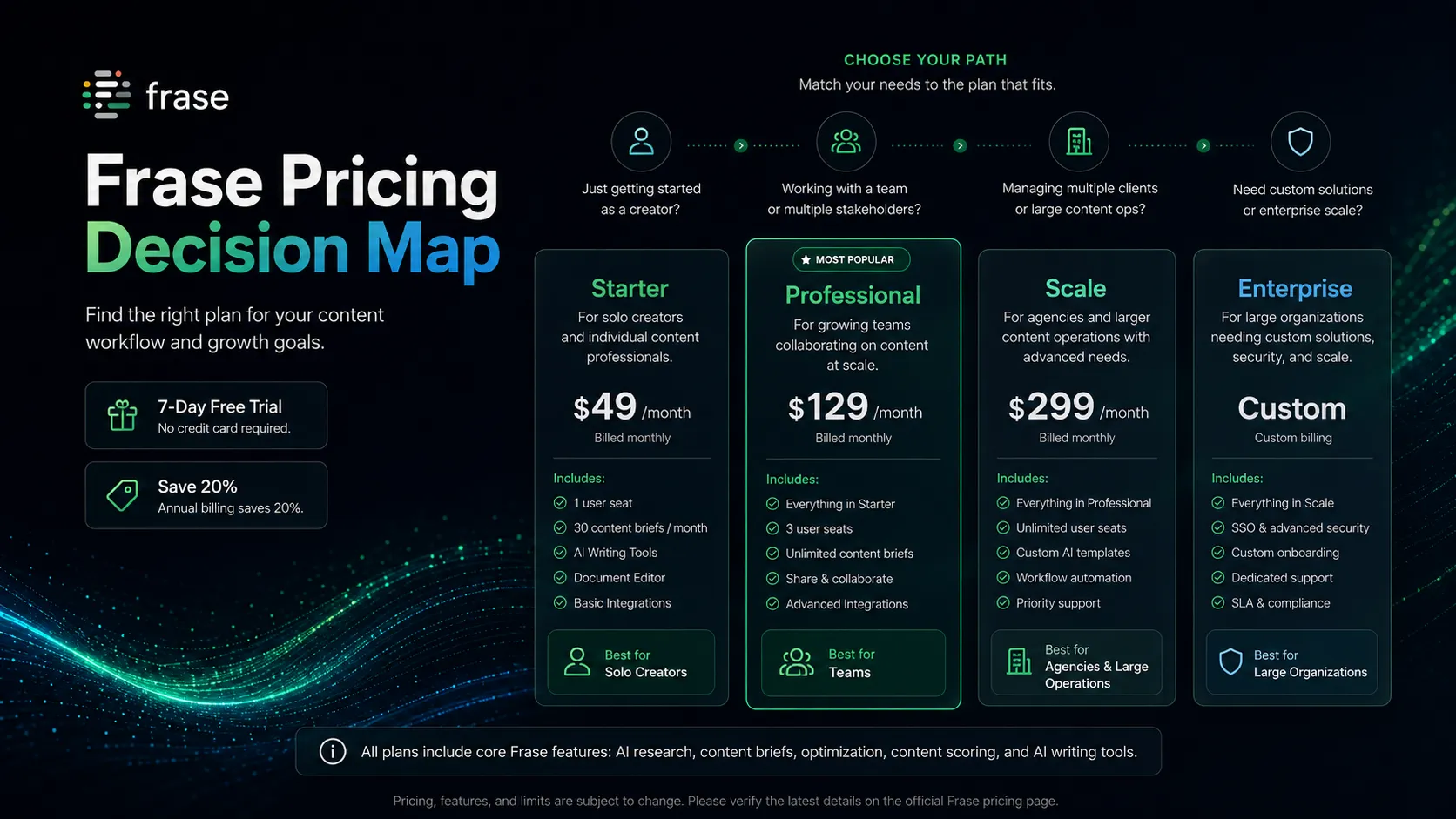
Pay for Frase when briefing, optimization, and content visibility checks are repeated enough to save real time. Stay on the trial or compare alternatives if you publish occasionally, already have a strong workflow, or mostly need broad SEO data. The main reason to pay is not the novelty of AI writing. It is the time saved across the research-to-brief-to-optimization cycle. Verify current pricing on the official pricing page.
Best alternatives to compare
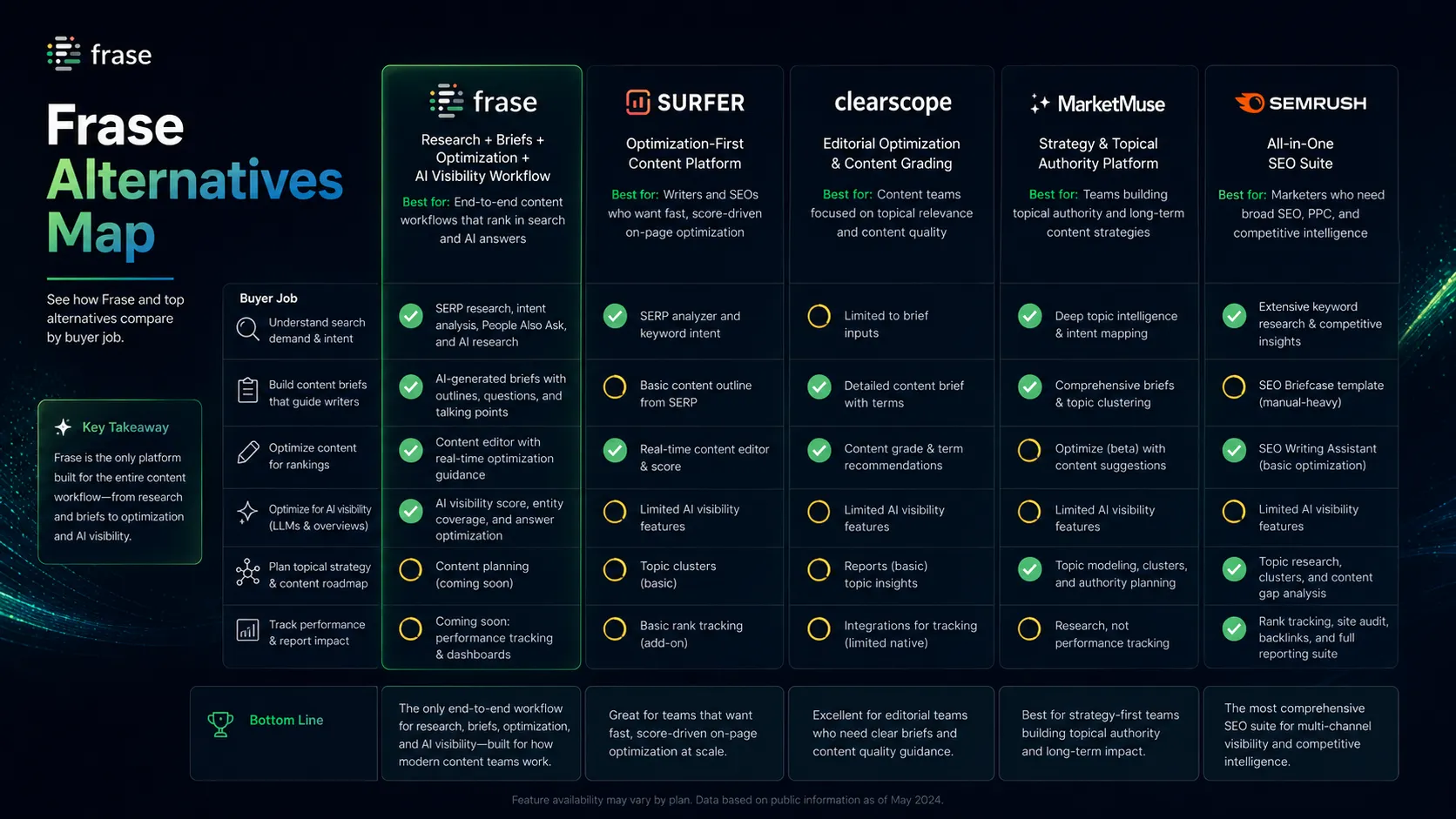
Surfer SEO is the first direct comparison. Compare Surfer first if your real buying reason is content scoring, topical coverage, and optimization guidance for existing and new articles. Frase is broader in workflow framing; Surfer is often easier to understand as an optimization-first tool.
Clearscope is the better comparison for teams that care about editorial consistency and content optimization without leaning too heavily into AI-generated drafts. It may be a better fit if your team already has writers and editors but wants clearer content quality guidance.
MarketMuse belongs in the conversation when the buyer is thinking at the strategy and content inventory level. If you are planning topic authority, content gaps, and long-term content depth, MarketMuse may be more relevant than a writing workflow tool.
Semrush is not a clean Frase replacement. It is the broader SEO suite to compare when your real problem is keyword research, competitors, rankings, technical data, or digital marketing visibility. Many teams would pair a broad SEO suite with Frase rather than choose only one.
Final decision
Add Frase to your stack if your team regularly turns search queries into briefs, drafts, optimization passes, and visibility checks, and the current plan limits match your publishing volume.
Compare Surfer SEO first if your main need is content optimization scoring and article improvement, not a broader research-to-visibility workflow.
Skip Frase for now if you only publish occasionally, need a full SEO suite, or expect AI drafts to replace real editorial and subject-matter review.
Frequently asked questions
Is Frase worth it for SEO content teams?
Does Frase have a free plan?
How much does Frase cost?
Is Frase better than Surfer SEO?
Can Frase replace a content writer?
Who should skip Frase?
Where Frase fits in a stack
SEO research, content brief, optimization, and AI visibility workflow layer
Does not replace
- – Google Search Console and analytics interpretation
- – Technical SEO crawlers
- – Backlink and keyword database tools
- – Human editing and subject-matter review
- – CMS governance and publishing judgment
Pairs well with
Head-to-head comparisons
Top alternatives to consider
If Frase is not the right fit, these are the most common alternatives.
Surfer SEO is the cleaner direct comparison if your priority is content optimization scoring, topical coverage, and SEO writing workflow rather than a broader AI Agent approach.
Clearscope is worth comparing if your team wants a more editorial, enterprise-friendly content optimization workflow with less emphasis on AI drafting.
MarketMuse is a better comparison for teams that care more about content strategy, topic authority, and inventory-level planning than individual article drafting speed.
Review methodology
Editorial review based on Frase's official homepage, pricing page, feature pages, current public review sources, and workflow-fit analysis. No hands-on testing was conducted.
This review is based on public product information and current research, not direct hands-on testing.
Not covered: Hands-on benchmark testing · Enterprise contract review · Private customer support evaluation · Long-term ranking outcome testing