 S
S Surfer SEO
SEO content optimization platform for search and AI visibility workflows
Quick answer
Choose Surfer SEO when your team already publishes SEO content and needs a structured optimization workflow. It is strongest for briefs, content scoring, audits, and AI visibility tracking, not for casual article drafting.
Surfer works best when the buyer has enough content volume to justify the plan. The current public pricing is not built for occasional use, and plan limits around documents, AI visibility prompts, workspaces, and advanced features can affect value. Verify the current pricing page before buying.
What is Surfer SEO?
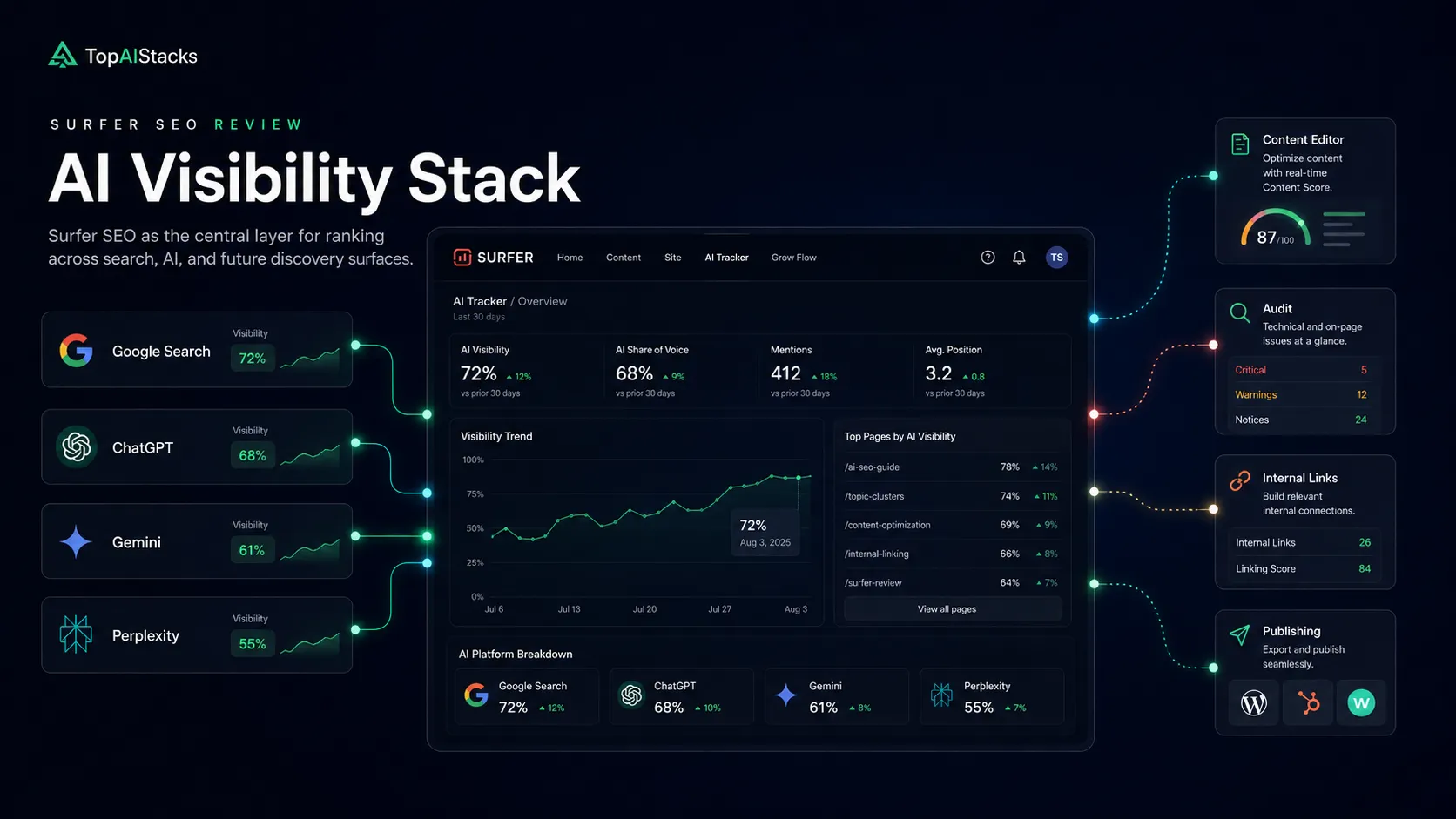
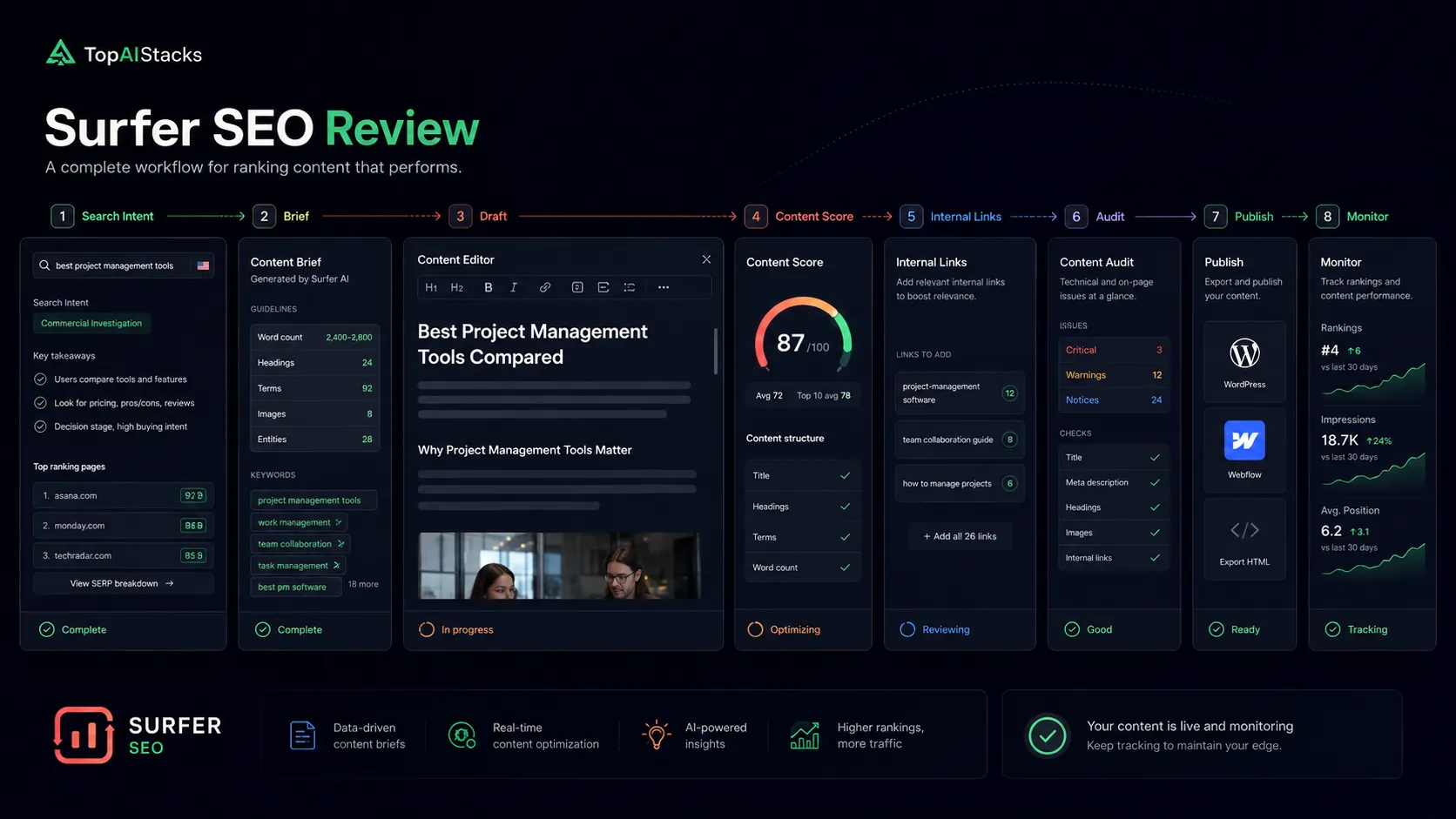
Teams use Surfer SEO to plan, write, optimize, and refresh search-focused content with SERP data. Its current public site positions the platform around content optimization, AI SEO guidelines, content scoring, internal linking, AI search visibility, brand knowledge, and team workflows. In a practical stack, Surfer sits between keyword research and CMS publishing, with Google Search Console, analytics, AI writing tools, and human editorial review still doing important work around it.
Who Surfer SEO fits best
Best for SEO writers, content managers, agencies, and affiliate site operators who optimize content every week, not once in a while.
- ✓SEO teams that need repeatable briefs and on-page optimization scoring
- ✓Affiliate marketers refreshing money pages and supporting articles
- ✓Agencies producing content plans and optimization reports for clients
- ✓In-house teams tracking Google and AI answer visibility across key topics
Not ideal for
- •Beginners who have not learned keyword intent, internal linking, or content quality basics
- •Writers who only need a low-cost draft generator
- •Teams that publish too little content to use the monthly allowance
- •Buyers expecting a single SEO tool to replace crawling, analytics, and editorial review
Main use cases
SEO content briefs
Surfer helps turn a target keyword or topic into a structured content brief using SERP-informed suggestions. It works best when the team still applies intent analysis and editorial judgment.
On-page content optimization
Writers can use Surfer's content score, optimization guidelines, and related terms as a quality-control layer before publishing or updating a page. The score should guide edits, not replace judgment.
Content refresh workflows
Affiliate sites and content teams can use Surfer to identify weak pages, improve existing content, and reduce gaps against current SERP patterns. Analytics and Search Console data still matter.
AI search visibility tracking
Current Surfer messaging includes tracking visibility across AI answer surfaces such as ChatGPT, Perplexity, Gemini, Google AI Mode, and AI Overviews. Buyers should verify limits by plan.
Where Surfer SEO fits in the AI stack
Surfer SEO belongs in the optimization layer of an SEO content stack. It can replace some manual SERP checking, content brief building, on-page term mapping, and content refresh spreadsheets. It does not replace keyword strategy, analytics, technical SEO crawling, human editing, or CMS publishing.
Stack role
SEO research and content optimization layer
Best paired with
Google Search Console, Google Analytics, Screaming Frog
Strongest layer
SERP-informed content optimization + AI search visibility monitoring
| Stack layer | Fit | What to know |
|---|---|---|
| SERP-informed content optimization | strong | Surfer is strongest when the workflow needs briefs, content scoring, optimization guidelines, and refresh direction from search data. |
| AI search visibility monitoring | strong | Current plans include AI visibility tracking features, with prompt limits and refresh cadence varying by plan. |
| Casual AI writing | weak | Surfer is too structured and costly if the buyer only needs basic drafting or rewriting. |
| Full SEO suite replacement | medium | Surfer can support content SEO, but teams still need analytics, technical crawling, backlinks, and strategy tools around it. |
Best stack combinations
Affiliate content team optimizing money pages
surfer-seo + google-search-console + chatgpt + wordpress
Use Search Console to choose update targets, Surfer SEO to guide optimization, ChatGPT to help with rewrites, and WordPress to publish the final edited content.
Agency creating SEO briefs for clients
surfer-seo + semrush + google-docs + notion
Use Semrush for broader keyword and competitor research, Surfer SEO for content briefs and optimization checks, Google Docs for collaboration, and Notion for client workflow tracking.
In-house team tracking search and AI visibility
surfer-seo + google-analytics + screaming-frog + claude-ai
Use Surfer SEO for content and AI visibility signals, Analytics for user behavior, Screaming Frog for technical checks, and Claude for long-form editorial review.
What Surfer SEO can replace
- · Some manual SERP analysis for content briefs
- · Some on-page optimization spreadsheets
- · Some content refresh checklists
- · Some search and AI visibility monitoring tasks
What it still needs
- · keyword-research: Topic selection, search demand validation, and intent grouping
- · analytics: Traffic, conversion, and content performance validation
- · editorial-review: Fact-checking, reader usefulness, brand voice, and final quality control
- · cms: Publishing, formatting, internal links, schema, and ongoing updates
Add it to your stack if
- · You publish or refresh enough SEO content to use the monthly plan limits.
- · Your team wants a repeatable content brief and optimization workflow.
- · You need visibility signals across Google and AI answer surfaces.
Skip it if
- · You only need occasional AI drafting or grammar polishing.
- · Your budget cannot support a paid SEO workflow every month.
- · You do not have keyword research, analytics, or editorial review in place.
Choose your next step
Pricing
→Check current plan limits, annual billing savings, AI visibility prompts, and document allowances before buying.
Alternatives
→Compare Surfer SEO with Frase, Clearscope, MarketMuse, Semrush, and Ahrefs based on workflow fit.
Compare options
→Use this comparison if you are deciding between Surfer's optimization workflow and Frase's briefing workflow.
Stack fit
→See how Surfer fits with keyword research, analytics, AI writing, CMS publishing, and technical SEO tools.
Review
→Read the full editorial review before making Surfer part of a paid content production workflow.
Pricing summary
This is a profile-level summary. Use the pricing page for deeper plan checks.
Starting path
Paid plans from $49 per month billed yearly
Free plan
No
Free trial
No
Surfer SEO currently appears to start at $49 per month billed yearly on the Discovery plan. Standard is listed at $99 per month billed yearly, Pro at $182 per month billed yearly, and Peace of Mind at $299 per month billed yearly. Enterprise is presented as a tailored package. Buyers should verify monthly billing, document limits, AI visibility limits, and renewal terms on the official pricing page.
Best starting path: Discovery is the safer test path for smaller teams, while Standard or Pro makes more sense when AI visibility tracking, team workflows, and larger content operations matter. Choose Peace of Mind or Enterprise only when scale, API access, onboarding, or custom controls are required.
Related stack page
SEO Content Stack
→Role: Content brief, optimization, and AI visibility layer
Surfer SEO fits the SEO content stack when content production is already organized around keywords, briefs, updates, and publishing checks. It adds structure to optimization but still depends on research, analytics, and editorial quality.
AI Writing Stack
→Role: SEO quality-control layer for AI-assisted drafts
Surfer works well beside AI writing tools when drafts need search-focused improvement before publishing. It should not be treated as the writer, editor, and SEO strategist at the same time.
Top alternatives
See all →Direct alternatives
Adjacent tools in the same stack

Semrush covers broader SEO research, rank tracking, competitor data, and site visibility, while Surfer focuses more on content optimization workflows.

Ahrefs is stronger for backlink research and competitive SEO data, but it is not a direct replacement for Surfer's content editor workflow.

ChatGPT helps draft, restructure, and expand content, but it does not replace Surfer's SERP-based optimization layer.
Related comparisons
FAQ
What is Surfer SEO best for?
Surfer SEO is best for teams that create or refresh search-focused content regularly. It helps with briefs, optimization scoring, content gaps, internal linking, and AI visibility tracking, but it still needs keyword strategy, analytics, and human editing.
Does Surfer SEO have a free plan?
The current public pricing page does not show a free plan for the main Surfer SEO platform. It lists paid plans starting with Discovery at $49 per month billed yearly, plus higher tiers for team and scale workflows.
Is Surfer SEO good for beginners?
Surfer can help beginners understand on-page optimization, but it is better for users who already understand search intent, keyword targeting, content quality, and publishing workflow. Casual writers may find it expensive for occasional use.
Is Surfer SEO better than Frase?
Surfer is usually stronger for structured optimization, content scoring, and AI visibility features. Frase may be easier for writers who mainly need SERP research and content briefs. The better choice depends on content volume and workflow depth.
Does Surfer SEO replace Semrush or Ahrefs?
Surfer does not fully replace Semrush or Ahrefs. It is more focused on content optimization and briefs, while Semrush and Ahrefs cover broader keyword research, competitor analysis, backlink data, and wider SEO operations.
How TopAIStacks evaluates Surfer SEO
Verified product positioning and pricing against Surfer's official homepage and pricing page. The current pricing page lists Discovery at $49 per month billed yearly, Standard at $99, Pro at $182, Peace of Mind at $299, and annual billing savings up to 17 percent. Public rating uses Surfer's linked review signals from G2, Capterra, and Trustpilot, weighted toward G2 because it has the largest linked review count.
Last checked: May 2026 · Source confidence: high