 A
A Ahrefs
Ahrefs is an AI marketing and SEO intelligence platform best for SEO professionals, content marketers, and agencies who need deep keyword, backlink, rank tracking, and AI search visibility data in one place. It is not designed for users who only need occasional keyword lookups or a simple AI writing assistant.
Quick answer
Ahrefs is an AI marketing and SEO intelligence platform best for SEO professionals, content marketers, and agencies who need deep keyword, backlink, rank tracking, and AI search visibility data in one place. It is not designed for users who only need occasional keyword lookups or a simple AI writing assistant.
Ahrefs is a high-investment platform. Even its entry-level Lite plan at $129/mo may be more than casual users need if they only want occasional keyword checks. The free Ahrefs plan and the $29/mo Starter plan are useful for light research but do not include the full keyword, backlink, and audit features available in Lite and above. Teams that need collaboration features, longer historical data, or API access should confirm exact per-user costs and data limits on the official pricing page before choosing a plan. AI visibility tracking via Brand Radar is an optional add-on from $199/mo and is not bundled into base plans. Ahrefs does not replace Google Search Console for verified first-party data, nor does it replace a CMS or a dedicated conversion analytics platform. Do not choose Ahrefs if your primary need is AI-assisted content writing, social media scheduling alone, or simple rank checking with no SEO research workflow.
What is Ahrefs?
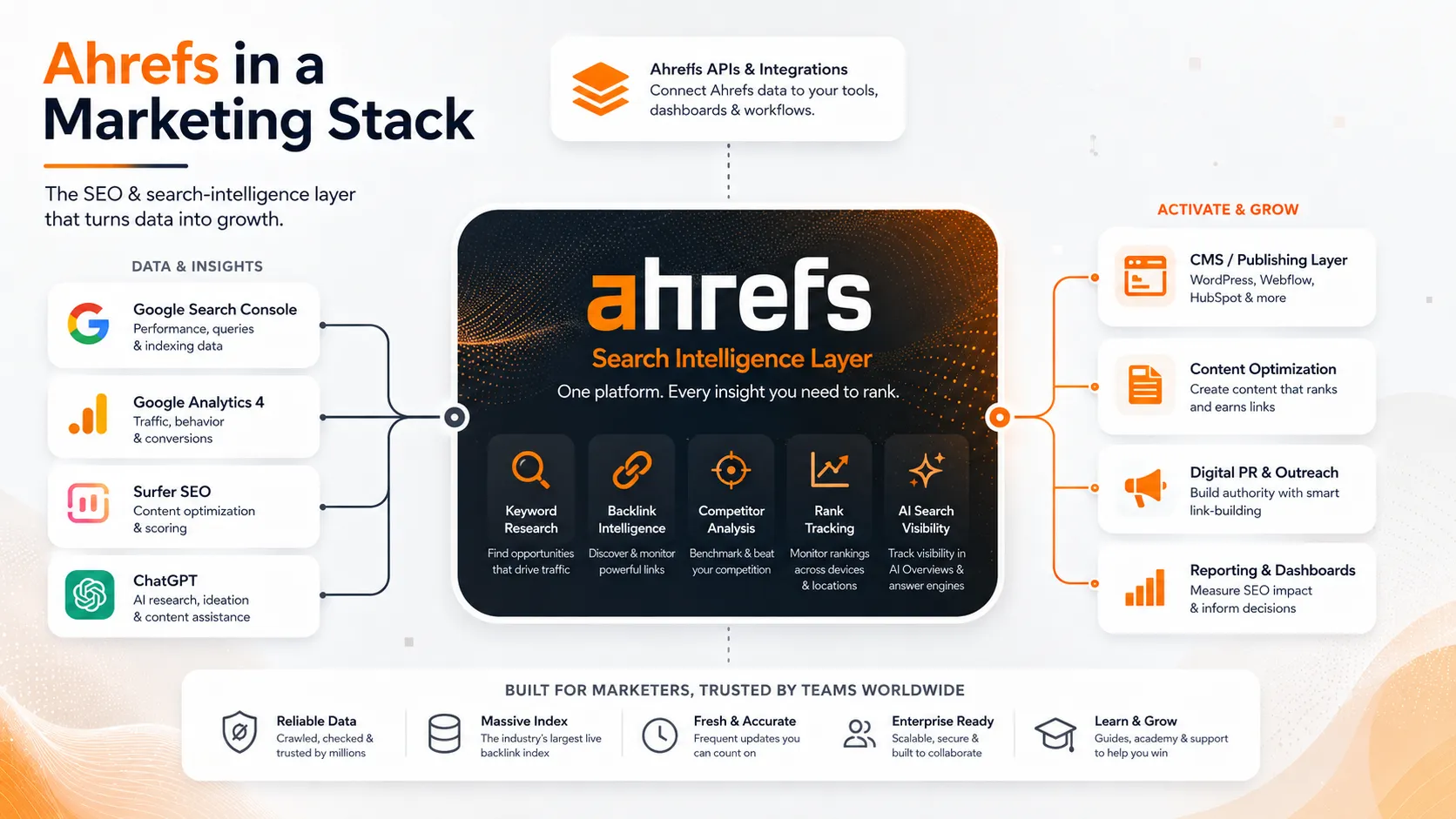
Ahrefs is a web-based SEO and marketing intelligence platform built on one of the largest web crawlers online, giving users access to keyword data, backlink indexes, competitive traffic estimates, rank tracking, technical site auditing, and—more recently—AI search visibility tracking through its Brand Radar and Custom Prompts tools. Unlike lightweight keyword tools or standalone AI writing platforms, Ahrefs combines multiple research functions—competitor analysis, link prospecting, content gap discovery, and site health monitoring—under a single workspace. Its AI layer now includes tracking how a brand or domain appears inside LLM responses such as ChatGPT and Perplexity, which makes it relevant for teams building AEO and GEO workflows alongside traditional SEO. Ahrefs positions itself as an AI marketing platform powered by big data, with tools spanning search marketing, website performance, content marketing, local SEO, and reporting. Buyers should verify current project limits, tracked keyword caps, crawl credits, historical data depth, export limits, and add-on costs for Brand Radar, Content Kit, and Report Builder before committing to a plan.
Who Ahrefs fits best
Ahrefs fits best for SEO professionals managing multiple client or brand projects, in-house content marketers who need keyword and competitive data to drive editorial decisions, and agencies or growth teams running recurring SEO workflows where search visibility, backlink growth, and AI search monitoring matter more than low-cost simplicity.
- ✓SEO professionals and consultants managing ongoing keyword, backlink, and rank tracking workflows
- ✓Content marketers building topic clusters and gap-based editorial strategies
- ✓Agencies running competitive SEO research and link building for multiple clients
- ✓AEO and GEO specialists who need to monitor brand visibility inside AI search responses
Not ideal for
- •Beginners or casual users who only need free keyword tools and do not run recurring SEO workflows
- •Teams looking for a standalone AI writing or content generation assistant
- •Small businesses with no SEO strategy who only want basic traffic estimates
- •Users seeking a low-cost all-in-one marketing suite with CRM, email, and social built in
Main use cases
Keyword Research and Content Planning
SEO teams use Ahrefs Keywords Explorer to identify search volume, keyword difficulty, click-through potential, and related keyword clusters across multiple search engines. The tool helps teams move from raw keyword lists to structured content plans by showing search intent, SERP features, and related queries. Standard and higher plans add AI keyword suggestions and topic clustering. Content writers still need their own CMS and a writing environment; Ahrefs provides the research layer, not the writing layer.
Competitor Backlink and Traffic Analysis
Site Explorer lets teams reverse-engineer a competitor's organic traffic estimates, top pages, and backlink profile. Link builders use this to find link prospects and identify content that earns external links. Content marketers use it to find competitor pages that rank for target keywords and then plan stronger alternatives. Traffic estimates are Ahrefs models, not verified analytics data; pairing with Google Search Console and Google Analytics gives first-party verification for your own site.
Rank Tracking and SEO Reporting
Rank Tracker monitors keyword positions across search engines and locations on a weekly basis. Teams use it to measure the impact of SEO work, catch ranking drops, and report progress to stakeholders. Report Builder (available as an add-on) and Looker Studio integration (Advanced and above) let teams produce polished reports outside the Ahrefs interface. Buyers should confirm tracked keyword limits and update frequency on the official pricing page before choosing a plan.
AI and LLM Search Visibility Monitoring
Brand Radar tracks how a brand is mentioned across LLM responses from platforms such as ChatGPT and Perplexity, using Ahrefs' database of over 271 million organic prompts. AEO specialists and brand marketers use this to understand where their brand appears—or is missing—in AI-generated answers. Custom Prompts lets teams track specific queries relevant to their brand. Brand Radar is an optional add-on priced from $199/mo and is not included in base Lite, Standard, or Advanced plans; verify current coverage and pricing before committing.
Where Ahrefs fits in the AI stack
Ahrefs occupies the research and intelligence layer of an SEO or content marketing stack. It provides the keyword data, backlink intelligence, competitive analysis, rank tracking, site audit diagnostics, and AI search visibility monitoring that inform editorial decisions, link building campaigns, and technical SEO work. It does not write, publish, or convert traffic; it tells teams what to target and how competitors are performing, so other tools in the stack can execute.
Stack role
SEO and Search Intelligence Layer
Best paired with
Google Search Console, ChatGPT, Claude
Strongest layer
Keyword and Topic Research + Competitor and Backlink Analysis + Rank Tracking and Performance Monitoring
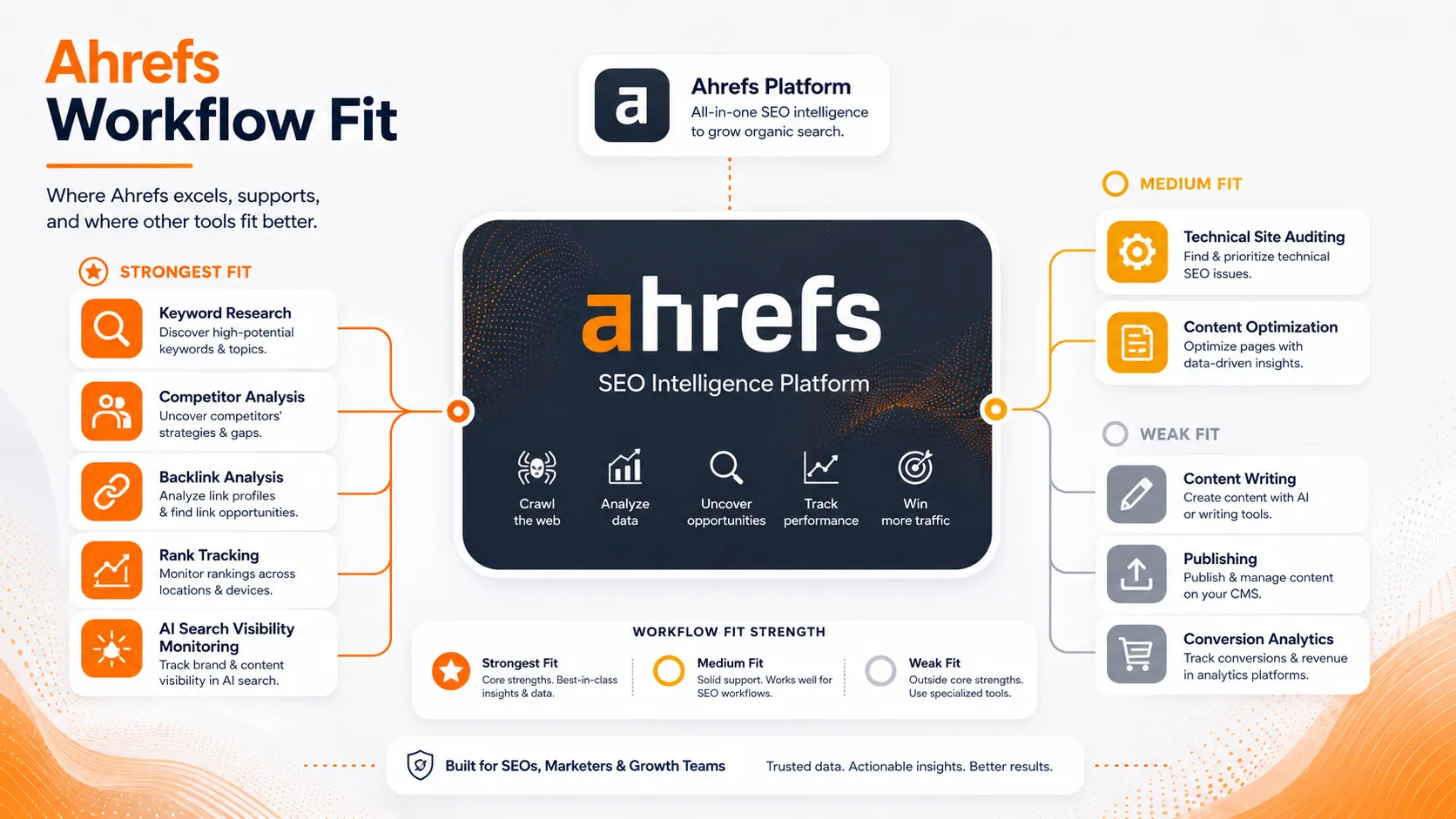
| Stack layer | Fit | What to know |
|---|---|---|
| Keyword and Topic Research | strong | Keywords Explorer with clustering, intent data, and AI suggestions is one of Ahrefs' core strengths |
| Competitor and Backlink Analysis | strong | Site Explorer and Content Explorer provide deep competitive intelligence and link prospecting |
| Rank Tracking and Performance Monitoring | strong | Rank Tracker covers search engines and locations; AI visibility tracking via Brand Radar adds LLM coverage |
| Technical Site Auditing | medium | Site Audit is capable for most teams; advanced crawl diagnostics may still need Screaming Frog alongside it |
| Content Writing and Optimization | medium | AI Content Helper and Content Grader (add-on) assist but Ahrefs is not a primary writing environment |
| Analytics, Conversion, and Revenue Reporting | weak | Ahrefs focuses on search visibility and traffic estimates; conversion and revenue data require dedicated analytics tools |
Best stack combinations
In-house SEO and content teams
Ahrefs + Google Search Console + Google Analytics + ChatGPT or Claude + WordPress
Ahrefs handles keyword research, rank tracking, and competitive analysis; Google Search Console provides verified search data; ChatGPT or Claude drafts content briefs from Ahrefs research; WordPress publishes the output. Google Analytics measures the traffic and conversion results.
SEO agencies managing multiple clients
Ahrefs + Screaming Frog + Surfer SEO + Looker Studio
Ahrefs covers keyword, backlink, and rank tracking across client projects; Screaming Frog runs deeper technical crawls; Surfer SEO scores and optimizes articles before publishing; Looker Studio assembles client-facing reports from multiple data sources.
AEO and GEO specialists
Ahrefs + Google Search Console + Claude or ChatGPT + Perplexity
Ahrefs Brand Radar and Custom Prompts monitor brand appearance in LLM responses; Google Search Console tracks traditional search performance; Claude or ChatGPT assists with structured content designed to appear in AI answers; Perplexity is used for manual spot-checking of AI search results.
What Ahrefs can replace
- · Manual keyword research spreadsheets and basic free keyword tools for teams with recurring SEO needs
- · Lightweight backlink checkers without historical data or index depth
- · Scattered rank tracking across multiple free tools
- · Basic competitor traffic estimation tools
What it still needs
- · Google Search Console: Verified first-party search performance, indexing status, and click data for owned sites
- · Google Analytics or a web analytics platform: Conversion tracking, user behavior data, and revenue attribution Ahrefs cannot provide
- · A CMS such as WordPress: Publishing and managing the content that SEO research informs
- · Surfer SEO or a content optimization tool: Scoring and optimizing individual articles for on-page relevance during the writing phase
- · Human SEO strategist: Prioritization, interpretation, and strategic judgment that data alone cannot replace
Add it to your stack if
- · You run recurring SEO workflows and need structured keyword, backlink, and rank tracking data
- · Your team does competitive analysis and needs traffic estimates and content gap data
- · You are building an AEO or GEO workflow and need to monitor brand visibility in LLM responses
- · You manage more than one website or client project and need project-level SEO organization
Skip it if
- · You only need occasional keyword checks and a free tool covers your current needs
- · Your primary need is AI content writing or social media management with no SEO research requirement
- · Your budget does not support $129/mo or more for a dedicated SEO platform
- · You already use Semrush and your current workflow is fully covered without switching
Choose your next step
Pricing
→Compare Ahrefs Free, Starter, Lite, Standard, Advanced, and Enterprise plans with current limits and add-on pricing on the official page.
Alternatives
→Compare Ahrefs to Semrush, Moz Pro, SE Ranking, and other SEO platforms to find the right fit for your budget and workflow.
Compare options
→See a direct comparison of Ahrefs and Semrush across keyword data, backlink index, pricing, and use case fit.
Stack fit
→See how Ahrefs fits inside a full SEO content workflow with Google Search Console, Surfer SEO, and a CMS.
Review
→See whether Ahrefs is worth it for your workflow and team size.
Pricing summary
This is a profile-level summary. Use the pricing page for deeper plan checks.
Starting path
Freemium — paid plans from $29/mo
Free plan
Yes
Free trial
No
Ahrefs offers a free plan for basic site data, a $29/mo Starter plan for light keyword and competitor research, and three core paid tiers—Lite at $129/mo, Standard at $249/mo, and Advanced at $449/mo—covering progressively more projects, tracked keywords, historical data, crawl credits, and user seats. Enterprise pricing starts from $1,499/mo with annual commitment and includes uncapped API access, SSO, and custom limits. Optional add-ons include Brand Radar AI from $199/mo, Content Kit from $99/mo, Report Builder at $99/mo, and Project Boost tiers at $20–$200/mo per project. Annual billing saves up to 17% on Lite, Standard, and Advanced plans. Buyers should confirm current plan limits, credit quotas, additional user costs, add-on pricing, and billing terms on the official pricing page before checkout.
Best starting path: Most individual SEO professionals and content marketers will find the Standard plan at $249/mo the most practical starting point for recurring SEO work, as it includes Content Explorer, Portfolios, and longer historical data. Verify current limits and features on the official pricing page before choosing.
Related stack page
SEO Content Stack
→Role: Research and intelligence layer feeding keyword targets and competitive insights to content planning and publishing tools
Developer Productivity Stack
→Role: Development teams building content-heavy products sometimes add Ahrefs to monitor search performance of docs and landing pages
Top alternatives
See all →
Adjacent tools in the same stack
Surfer SEO focuses on content optimization and on-page scoring for articles being written to rank. It complements Ahrefs keyword research but does not replace the backlink, rank tracking, or competitor intelligence Ahrefs provides.

ChatGPT is used by SEO teams to draft content briefs, outlines, and copy using Ahrefs research as input. It is an adjacent workflow tool, not a replacement for Ahrefs data.
Related comparisons
FAQ
What is Ahrefs best for?
Ahrefs is best for SEO professionals, content marketers, and agencies who need keyword research, backlink analysis, rank tracking, technical site auditing, and AI search visibility data in a single platform. It is particularly strong for teams running recurring SEO workflows and competitive intelligence research.
Is Ahrefs enough as a full AI stack on its own?
No. Ahrefs covers the SEO research and intelligence layer, but a complete workflow still requires Google Search Console for verified first-party data, a web analytics platform for conversion tracking, a CMS for publishing, and writing tools for content production. AI tools such as ChatGPT or Claude are often paired with Ahrefs to translate research into content strategy.
What tools should I use with Ahrefs?
The most practical pairings are Google Search Console for verified search data, Google Analytics for traffic and conversion measurement, Screaming Frog for deep technical crawls, Surfer SEO for content optimization, and ChatGPT or Claude for content planning using Ahrefs research as input. Looker Studio works well for combining Ahrefs data with other sources in custom reports.
What is the best alternative to Ahrefs?
Semrush is the most direct alternative, covering a similar range of keyword, backlink, rank tracking, and content tools. Moz Pro and SE Ranking are alternatives at different price points and with different data strengths. Buyers should compare plans and feature sets directly on each platform's official pricing page.
Who should not use Ahrefs?
Ahrefs is not the right fit for casual users who only need occasional keyword checks, beginners who only need free SEO basics, teams whose primary need is AI writing or content generation, or users seeking a low-cost all-in-one marketing suite with CRM and email tools included. If your workflow does not involve recurring SEO research, the cost is hard to justify.
Does Ahrefs have a free plan or free trial?
Ahrefs offers a free plan that provides basic site data and limited access to some tools. A $29/mo Starter plan is available for light keyword and competitor research. Ahrefs does not offer a standard free trial for paid plans. Verify current free plan features and Starter plan limits on the official pricing page before signing up.
How TopAIStacks evaluates Ahrefs
This profile was produced by researching Ahrefs' official homepage and official pricing page directly. Pricing, plan names, feature inclusions, per-user costs, add-on pricing, annual discount claims, and platform positioning are sourced exclusively from official Ahrefs pages as of the verification date. No third-party pricing, coupon, hands-on testing, screenshots, or speculative claims are included. Stack role, workflow fit, adjacent tool pairings, and alternative classification are based on Ahrefs' official product scope and standard market positioning. Buyers are advised to verify all plan limits, add-on costs, and billing terms on the official Ahrefs pricing page before committing to a subscription.
Last checked: May 2026 · Source confidence: high