Ahrefs Review
A practical Ahrefs review for SEO teams, agencies, and content marketers. See pricing fit, AI visibility use cases, limits, and alternatives.
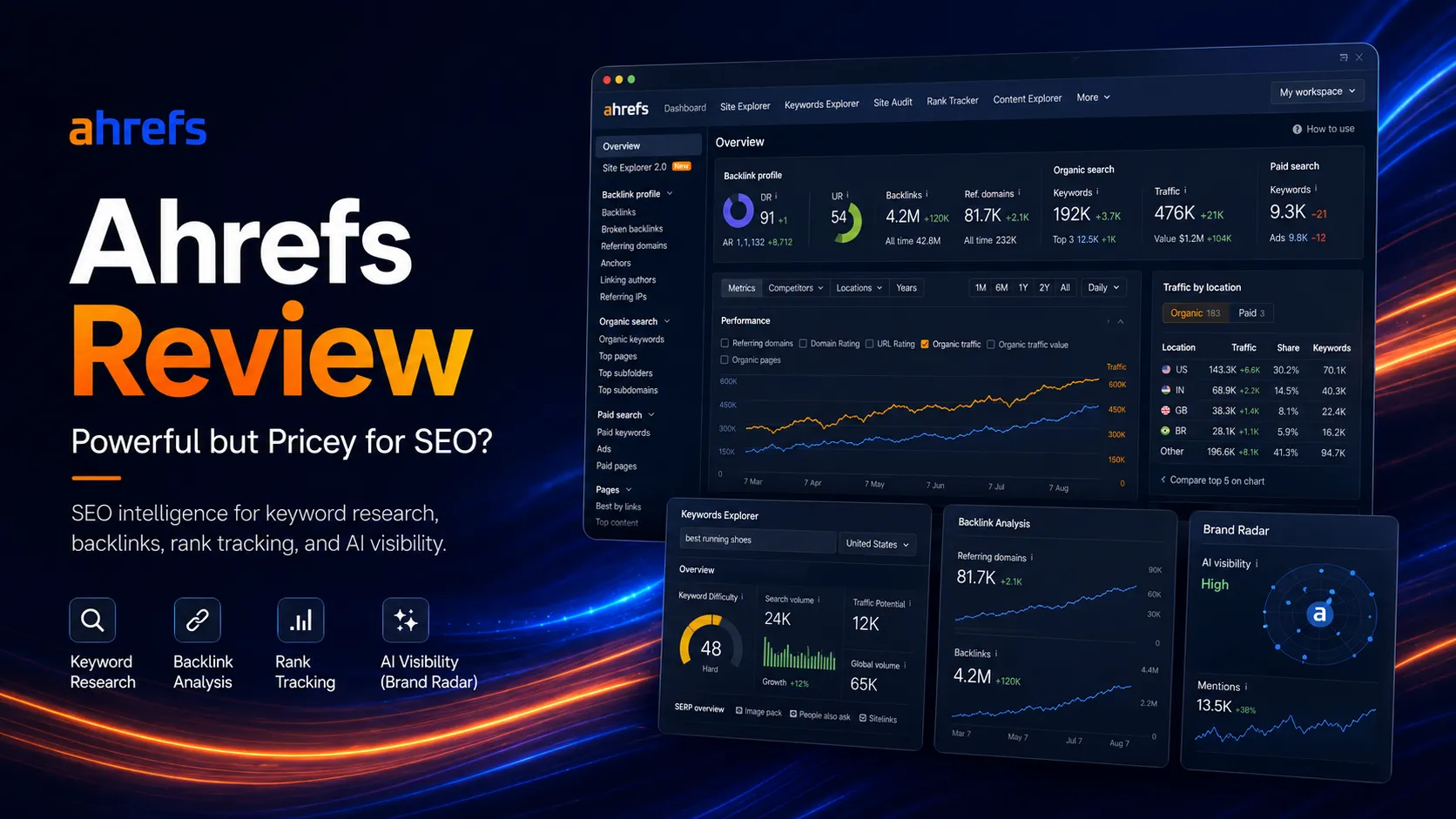
Ahrefs is a top-tier SEO intelligence platform for serious SEO work, but its price and add-on structure make it a poor fit for casual users.
Use it if…
- ✓ SEO is already a recurring growth channel for your business, client work, or content portfolio.
- ✓ You need keyword research, competitor analysis, backlink intelligence, rank tracking, and site audit data in one platform.
- ✓ You want to add AI search visibility monitoring to a traditional SEO workflow.
- ✓ You can justify the monthly cost by using Ahrefs for decisions, not just curiosity checks.
Skip it if…
- – You only need occasional keyword lookups and can start with free SEO tools.
- – Your primary need is AI writing, content generation, email marketing, or social scheduling.
- – You do not have time to act on the data with content updates, technical fixes, or link work.
- – You need the lowest possible SEO tool bill and can accept lighter data from cheaper alternatives.
Review scorecard
Scored by workflow fit, ease of use, value, and stack compatibility. Weights reflect importance for typical buyers.
| Criteria | Score | ||
|---|---|---|---|
| SEO data depth | 9.2 | ||
| AI search visibility fit | 8.7 | ||
| Workflow completeness | 8.4 | ||
| Pricing clarity | 7.3 | ||
| Team and agency value | 8.5 | ||
| Ease of adoption | 7.8 | ||
| Weighted overall | 8.4 / 10 | ||
On this page
Quick verdict
Ahrefs is one of those tools that can feel overpriced or indispensable depending on the buyer. For a casual blogger who checks a keyword once a week, it is probably too much. For an SEO consultant, agency, or content team making recurring decisions from keyword data, backlink analysis, rank tracking, site audits, and AI visibility signals, it can sit close to the center of the stack.
My practical verdict: Ahrefs is worth considering when SEO work already pays for itself. It is not a beginner shortcut, not a content writer, and not a complete marketing operating system. It is a research and intelligence platform. That distinction matters because the value does not come from opening the dashboard. The value comes from using the data to choose better topics, improve pages, find link opportunities, monitor rankings, and catch visibility gaps before they turn into revenue problems.
This review is based on public product information, official Ahrefs pricing and product pages, the existing TopAIStacks Ahrefs YAML profile, and editorial stack-fit analysis. No private benchmark or paid account stress test was conducted. Verify current plan details before buying.
Who should use Ahrefs
Ahrefs is strongest for people who already know what they want SEO data to answer.
If you are asking, “Which topics should we publish next?”, “Which competitor pages are winning traffic?”, “Where are our backlinks weaker than theirs?”, “Which keywords moved this week?”, or “Are AI answers mentioning our brand?”, Ahrefs gives you a serious research layer.
The best-fit buyers are SEO consultants, in-house content teams, agencies, affiliate site operators, SaaS growth teams, and AEO or GEO specialists who need to monitor visibility across both classic search and AI answers. In those workflows, Ahrefs can shape real decisions every week.
Ahrefs is not ideal if you are still at the stage of “I just want a few keywords.” It can show you more data than you know how to use. That sounds like a nice problem, but it becomes expensive if you do not have a publishing, technical SEO, or link building process behind it.
What Ahrefs actually does
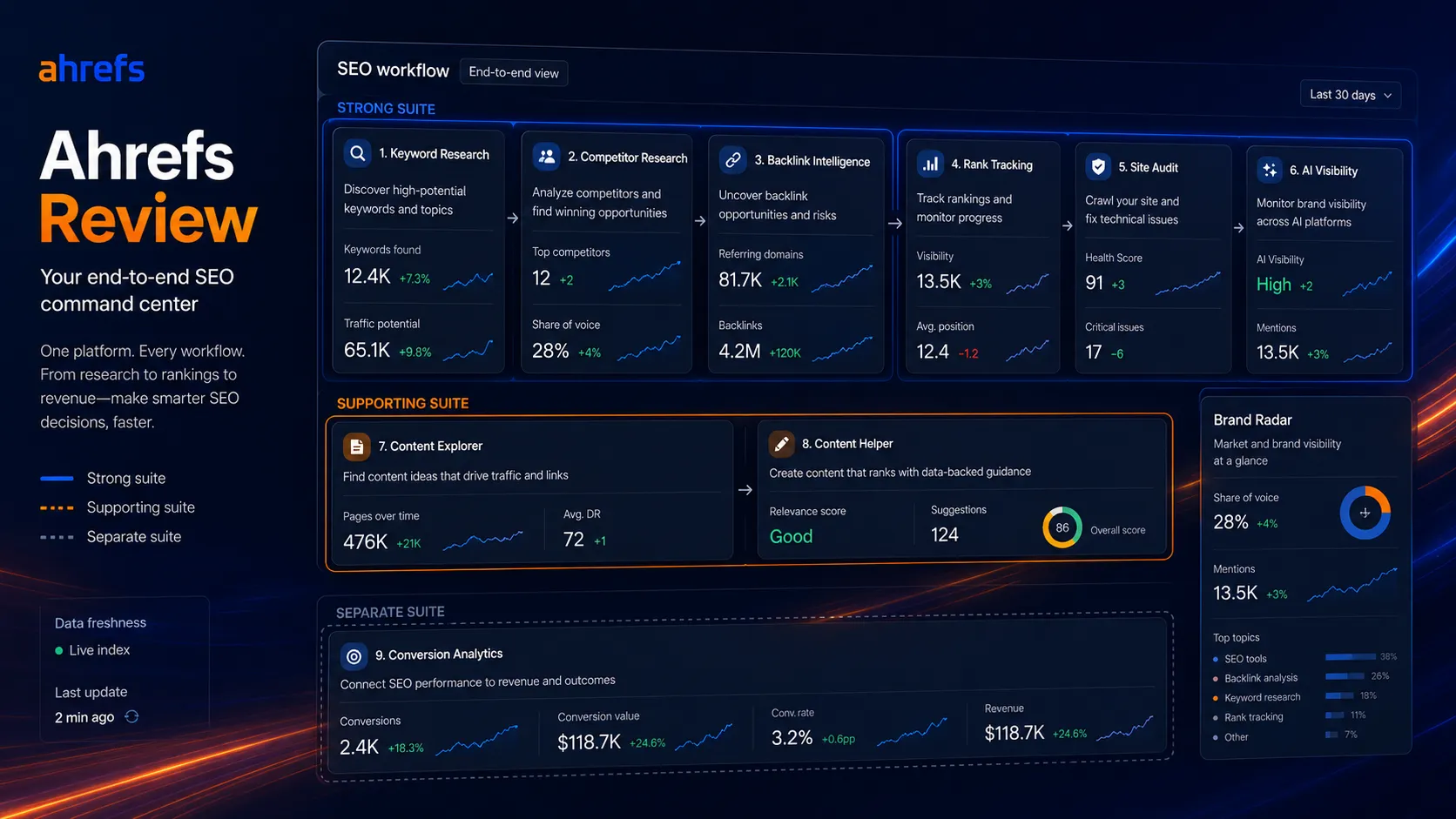
Ahrefs is best understood as an SEO and search intelligence platform. Its core jobs include keyword research, competitor research, backlink analysis, rank tracking, technical site audits, content discovery, and reporting. It also now leans harder into AI visibility through Brand Radar, custom prompts, and AI visibility checking.
The official Ahrefs positioning has shifted beyond classic SEO language. It now describes the product around discoverability in search, AI answers, traffic, visibility, and revenue. That is a useful signal. Ahrefs is trying to serve both the old search world and the newer AEO or GEO world where brands care about being mentioned and cited inside AI-generated answers.
That does not mean Ahrefs suddenly replaces every AI search tool. It means the product is expanding from “rank in Google” toward “understand how demand, mentions, links, citations, competitors, and AI answers shape visibility.” For serious content and SEO teams, that is exactly the right direction.
Where Ahrefs is strongest
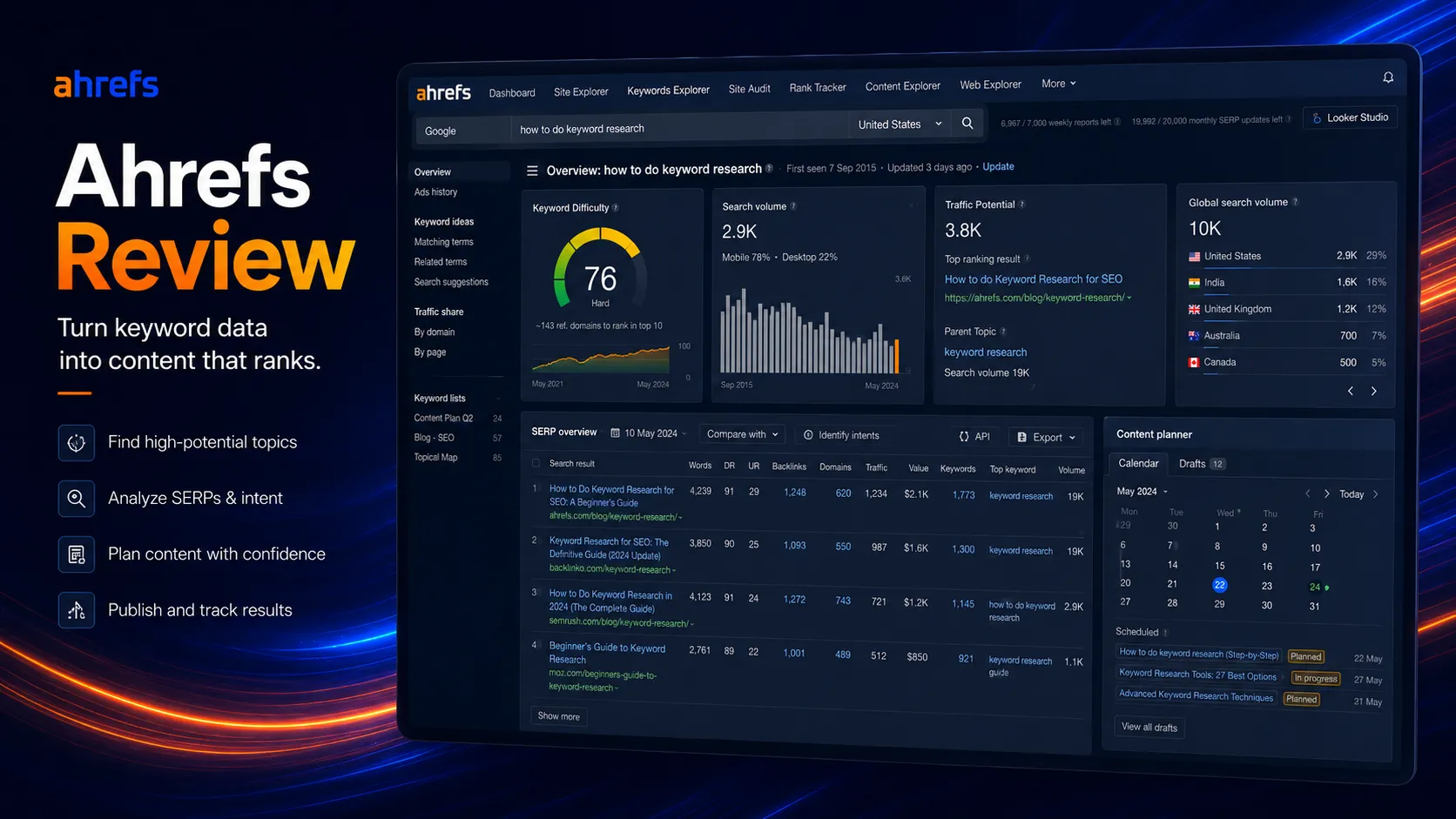
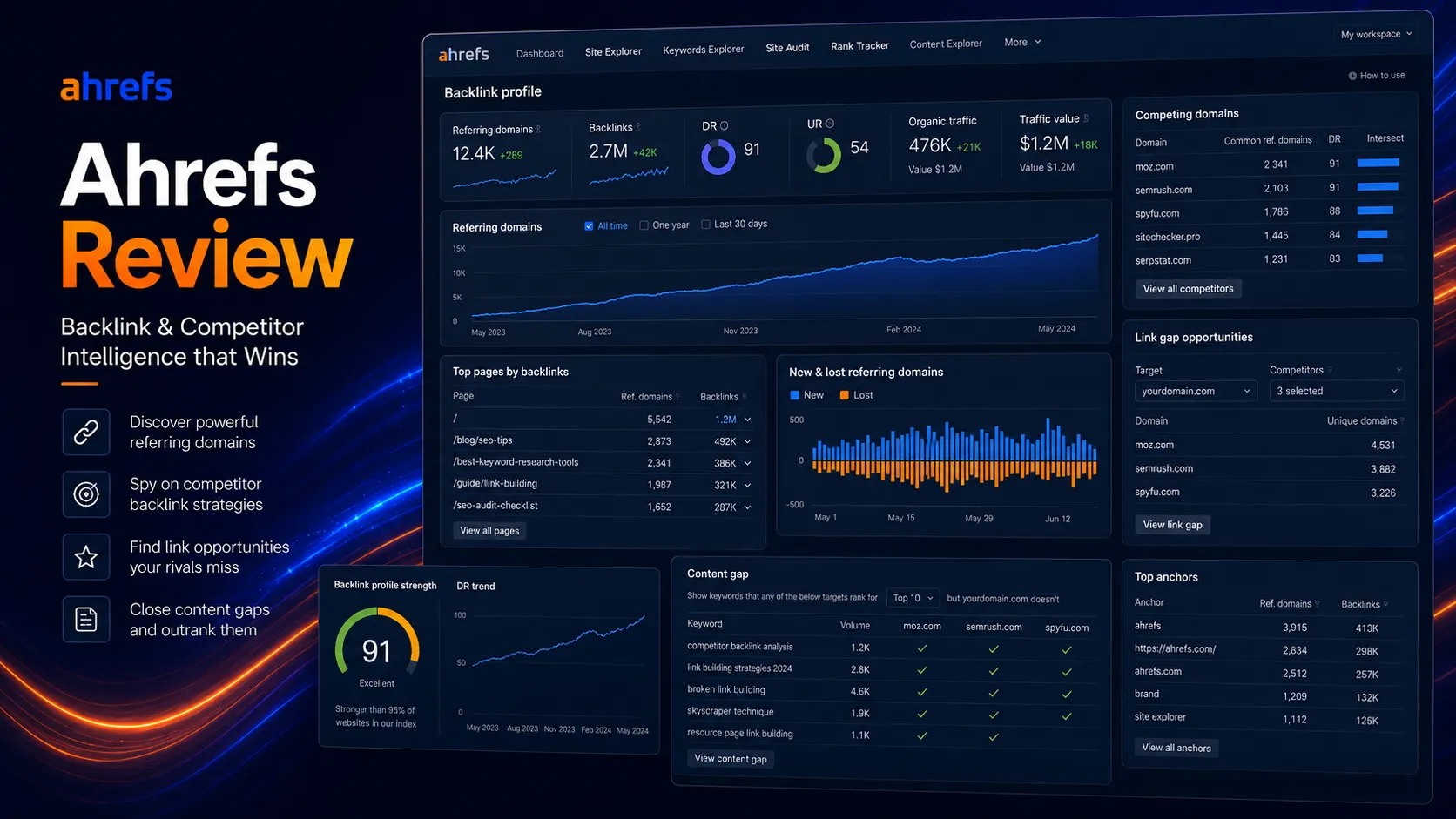
The first major strength is keyword research. Ahrefs can help teams move from vague ideas to specific topics with search volume, difficulty, traffic potential, related terms, SERP analysis, and intent signals. The practical value is not the number itself. The value is choosing a topic where your site can realistically compete and where the traffic is worth the effort.
The second major strength is competitor and backlink intelligence. This is where Ahrefs has historically been very hard to ignore. If a competitor is earning traffic from a page type, topic cluster, or link source you have not studied, Ahrefs gives you a way to reverse-engineer the opportunity. That is useful for content planning, link building, digital PR, affiliate SEO, and SaaS growth.
The third strength is ongoing monitoring. Rank tracking, site auditing, and competitor visibility checks make Ahrefs more useful over time. A one-time keyword export is not the best use case. The better use case is watching how a portfolio changes, which pages are decaying, what competitors are gaining, and which technical issues are blocking growth.
Ahrefs and AI visibility
The most interesting newer angle is Brand Radar. Ahrefs now talks about tracking brand visibility across AI answers, YouTube, Reddit, search demand, and web visibility. The official Brand Radar page describes a large search-backed prompt database and coverage across AI Overviews, AI Mode, ChatGPT, Copilot, Gemini, Perplexity, and Grok.
This matters for TopAIStacks because many SEO tools still talk as though visibility only means blue links. That is no longer enough. Buyers increasingly want to know whether their brand is being mentioned, cited, or ignored inside AI answers.
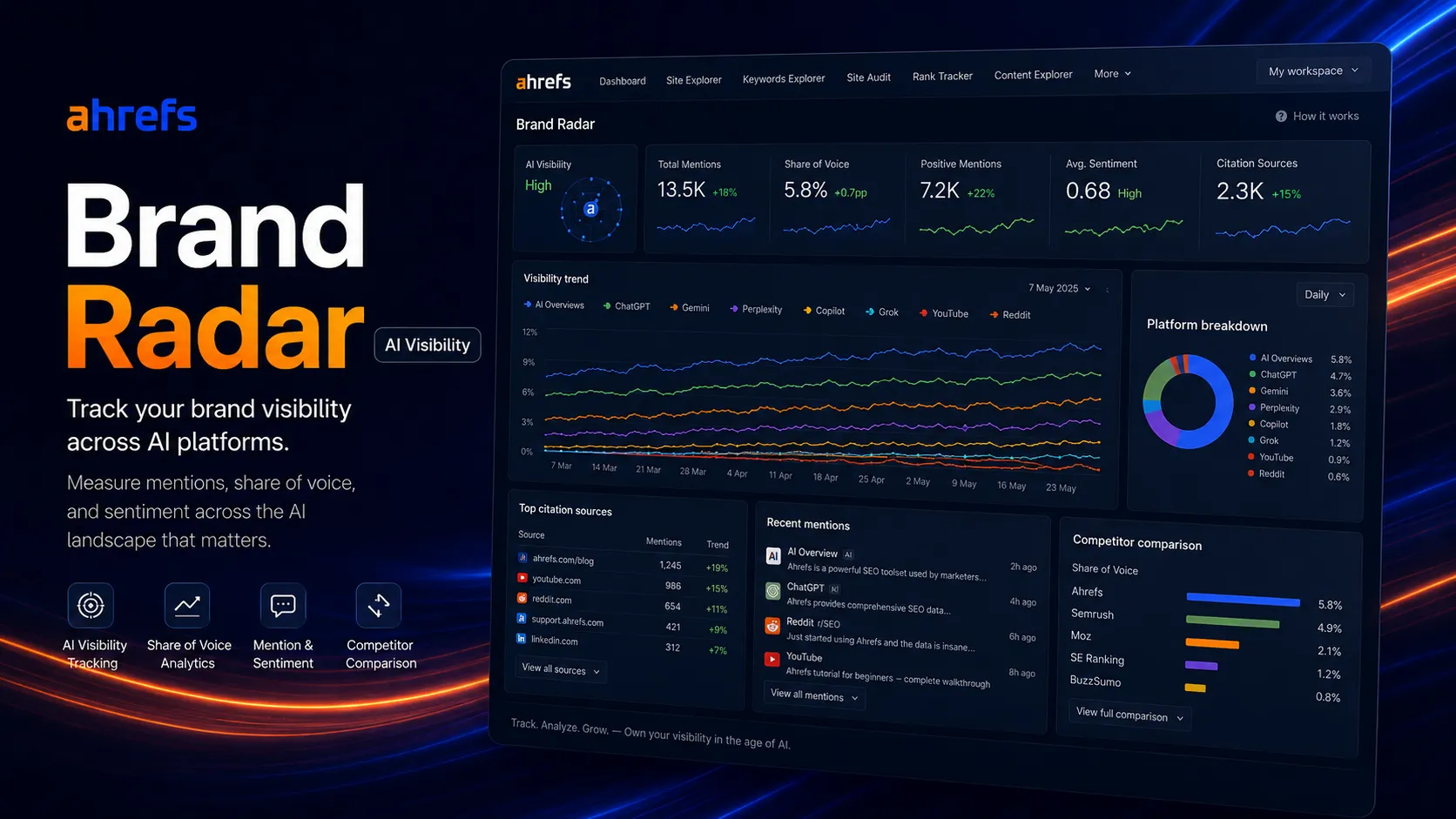
My caution: AI visibility tracking is still an emerging category. It is useful, but it should not be treated as perfect truth. AI answers vary, prompts shift, citations change, and different tools measure visibility differently. Ahrefs gives serious teams a powerful research layer, but you still need interpretation.
Pricing and plan fit
Ahrefs pricing needs careful reading. The public pricing page currently lists Lite at $129 per month, Standard at $249 per month, Advanced at $449 per month, and Enterprise from $1,499 per month with annual commitment. It also lists Starter at $29 per month and Ahrefs Free for limited access.
For serious SEO work, I would not judge Ahrefs only by the cheapest entry point. Starter can be useful for light keyword and competitor research, but the main suite starts at Lite. Standard often becomes the more realistic plan for freelancers and consultants because it unlocks broader workflow room such as more projects, more tracked keywords, more crawl credits, and more data depth.
The buying decision should not be “Can I afford $29, $129, or $249?” The better question is: “Which limits will I hit?”
Check these before paying:
- Number of projects.
- Historical data depth.
- Tracked keywords.
- Tracked prompts.
- Crawl credits.
- Export rows.
- Users and extra user pricing.
- API and MCP needs.
- Report Builder requirements.
- Brand Radar AI access.
- Custom prompt packages.
- Monthly versus annual billing.
- Refund and cancellation terms.
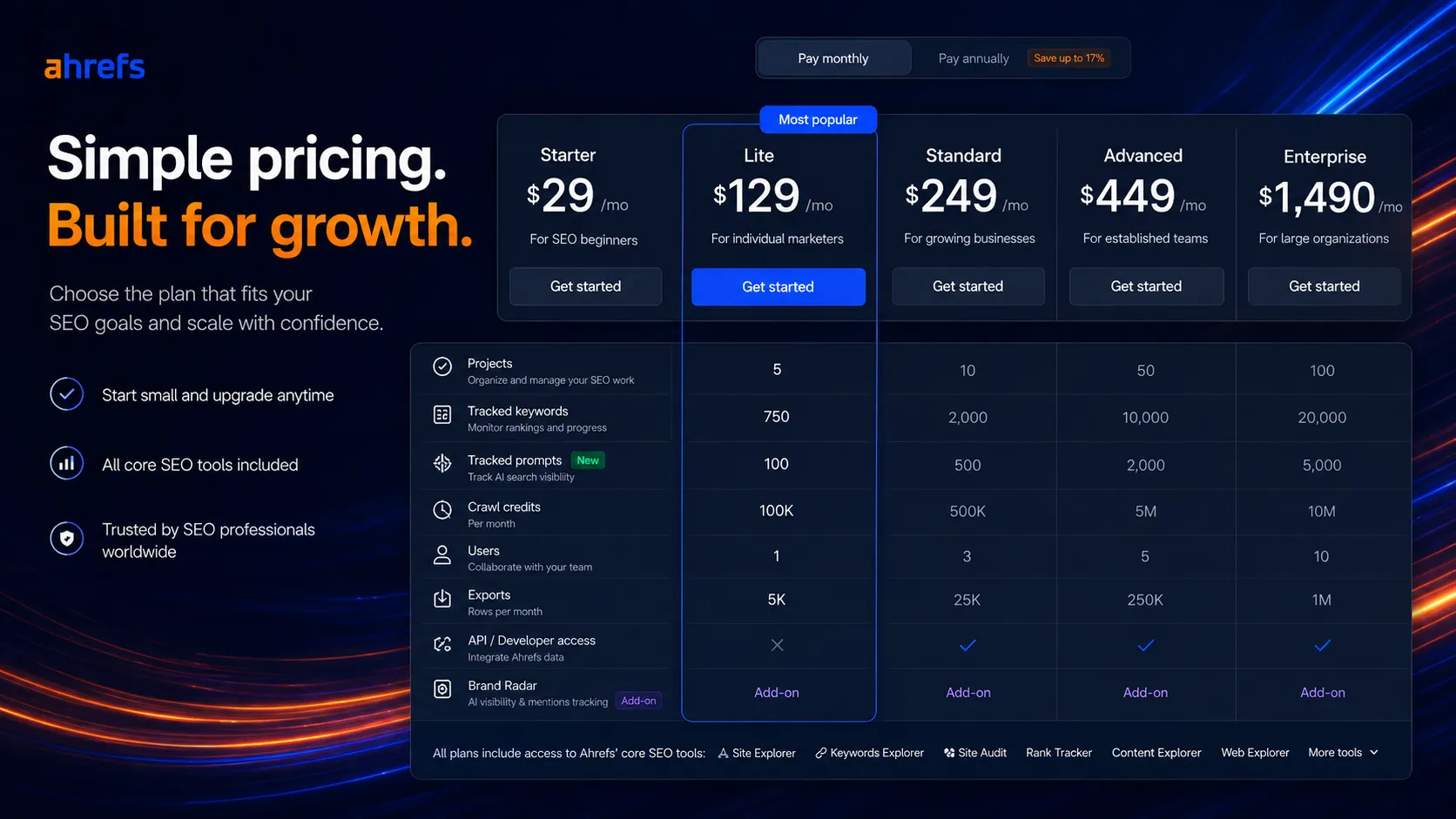
One important caution: Ahrefs states that it does not run discounts, and its refund policy is limited. The pricing page says it does not issue refunds in general, although monthly subscription refunds may be requested if the service has not been used and Ahrefs may decline if it sees material activity. That makes pre-purchase plan selection more important.
Real workflow fit
Ahrefs should sit before and around the content workflow. It tells you what to target, what competitors are doing, where links exist, what changed in search visibility, and where your site may have technical issues. Then other tools take over.
A typical SEO stack might look like this:
- Ahrefs for keyword, backlink, competitor, rank, site audit, and AI visibility research.
- Google Search Console for verified first-party search data.
- Google Analytics or another analytics tool for user behavior and conversion data.
- Screaming Frog for deeper technical crawling.
- Surfer SEO or Frase for content optimization and briefs.
- ChatGPT or Claude for ideation, outlines, synthesis, and draft assistance.
- WordPress, Webflow, Astro, or another CMS for publishing.
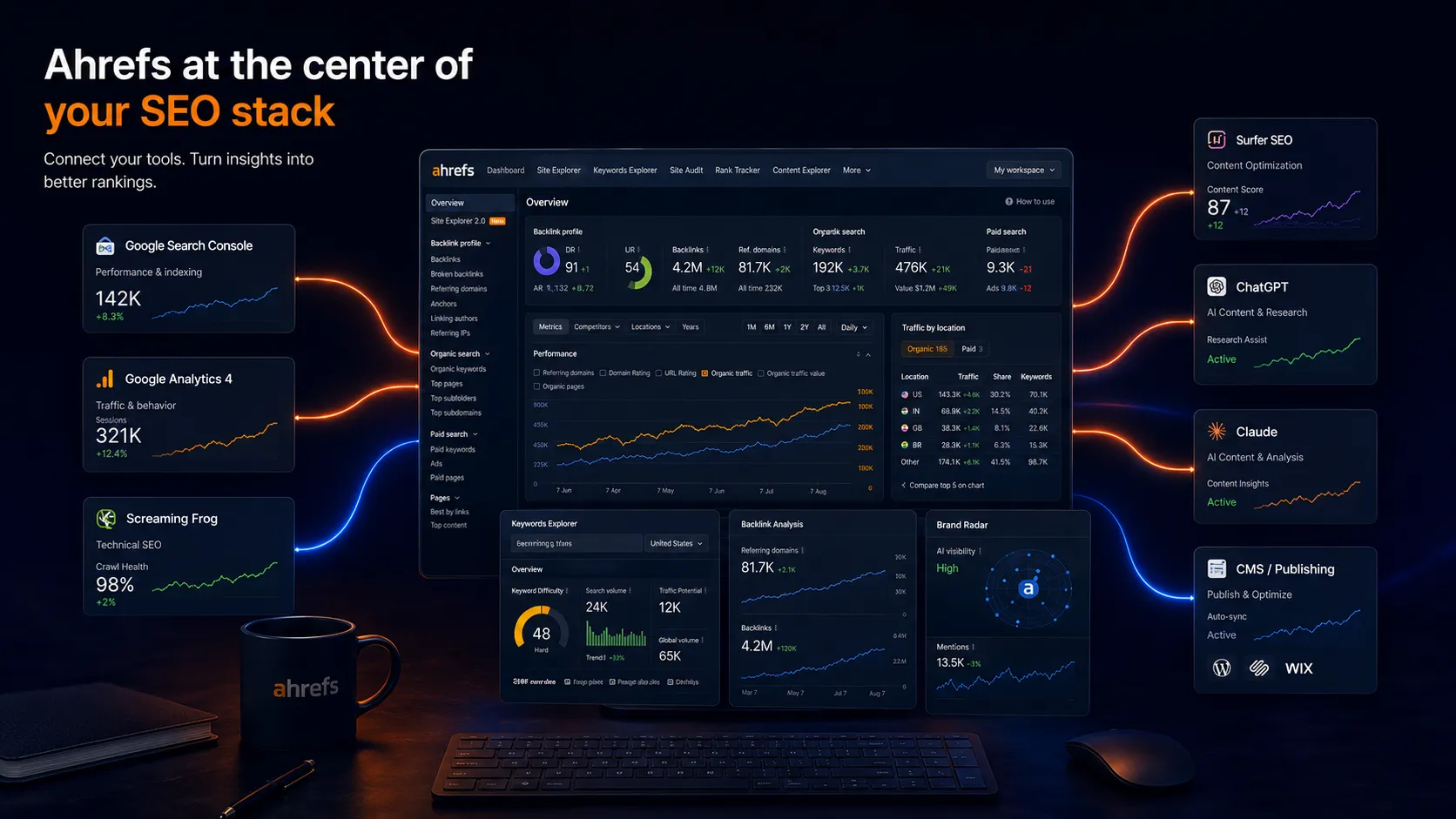
This is where many buyers overestimate Ahrefs. They see the data and assume the tool will create the strategy. It will not. It can reveal the battlefield, but someone still has to choose priorities, publish better pages, improve internal links, fix technical problems, earn links, and measure revenue.
Strengths
The biggest strength is that Ahrefs gives serious SEO teams a lot of decision data in one place. Instead of jumping between a keyword tool, backlink checker, rank tracker, site audit tool, and competitor research workflow, you can work from a shared research base.
Another strength is backlink and competitor analysis. Even if another platform is broader, Ahrefs remains one of the first tools many SEO professionals think of when they want to inspect competing pages, referring domains, link gaps, and top traffic opportunities.
The newer AI visibility direction is also a real strength. Whether you call it AEO, GEO, AI search optimization, or brand visibility in LLMs, the category is moving fast. Ahrefs has enough data infrastructure to make this direction credible, especially for teams that already use the product for classic search.
Finally, Ahrefs has strong educational gravity. Its blog, academy, YouTube channel, and free tools make it easier to learn SEO concepts around the product. That does not lower the subscription price, but it does help teams extract more value if they are disciplined.
Weak spots
The first weak spot is cost. Ahrefs is not priced like a lightweight writing tool or a beginner keyword generator. If your site is early, your revenue is uncertain, or your workflow is inconsistent, the paid plans can feel heavy fast.
The second weak spot is complexity around limits. Projects, tracked keywords, crawl credits, tracked prompts, custom prompt checks, export rows, API units, extra users, and add-ons all affect real cost. The pricing page is public, but the buyer still needs to map the plan against actual usage.
The third weak spot is that Ahrefs does not solve execution. It can tell you which competitor page wins, which keyword looks promising, which backlinks matter, and which pages have issues. It does not write the final article, negotiate links for you, rebuild your information architecture, or make your offer convert.
The fourth weak spot is AI visibility interpretation. Brand Radar and AI visibility tools are useful, but buyers should avoid treating every AI mention metric like a simple rank tracker. AI answers are more fluid than classic search results, so use these signals as directional intelligence rather than absolute truth.
Alternatives worth considering
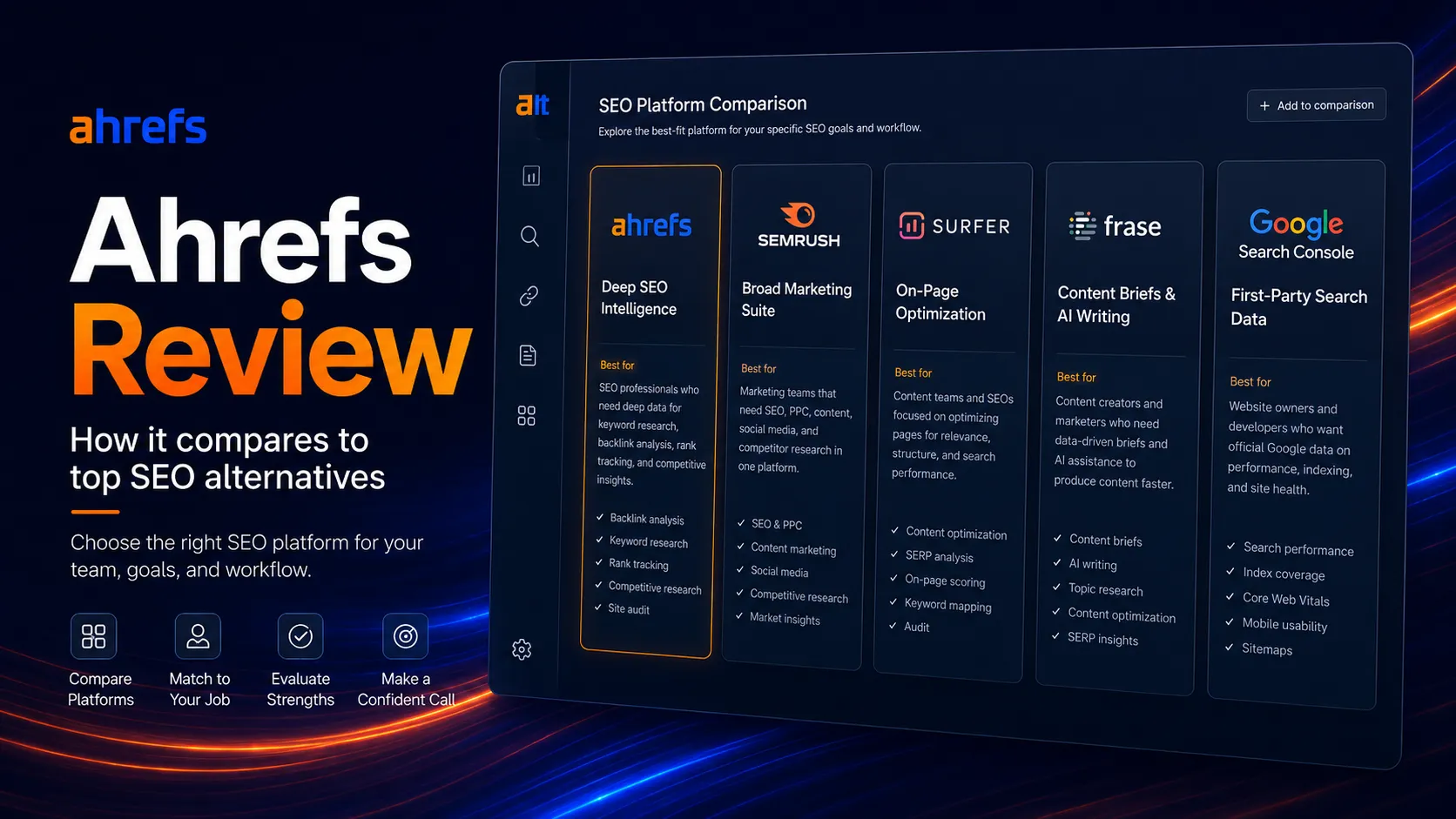
Semrush is the closest broad alternative. If you want a wider marketing suite that includes SEO plus PPC, social, local, content, and broader campaign workflows, Semrush may be easier to justify. Ahrefs is often cleaner for deep SEO research and backlink analysis, but Semrush is broader.
Surfer SEO is not a full Ahrefs replacement. It is better for on-page content optimization, content scoring, and brief-level decisions. If your main pain is “How do I optimize this article?” rather than “Which opportunity should we pursue?”, Surfer may fit better.
Frase is another lighter alternative for SERP research, content briefs, and question-driven content planning. It will not give you Ahrefs-level backlink or competitive intelligence, but it may be enough for content teams on a tighter budget.
Google Search Console is not a commercial alternative, but it is mandatory. It gives verified first-party search data for your own site. Ahrefs is stronger for competitor and market intelligence. Serious teams should not treat this as either-or.
Final verdict
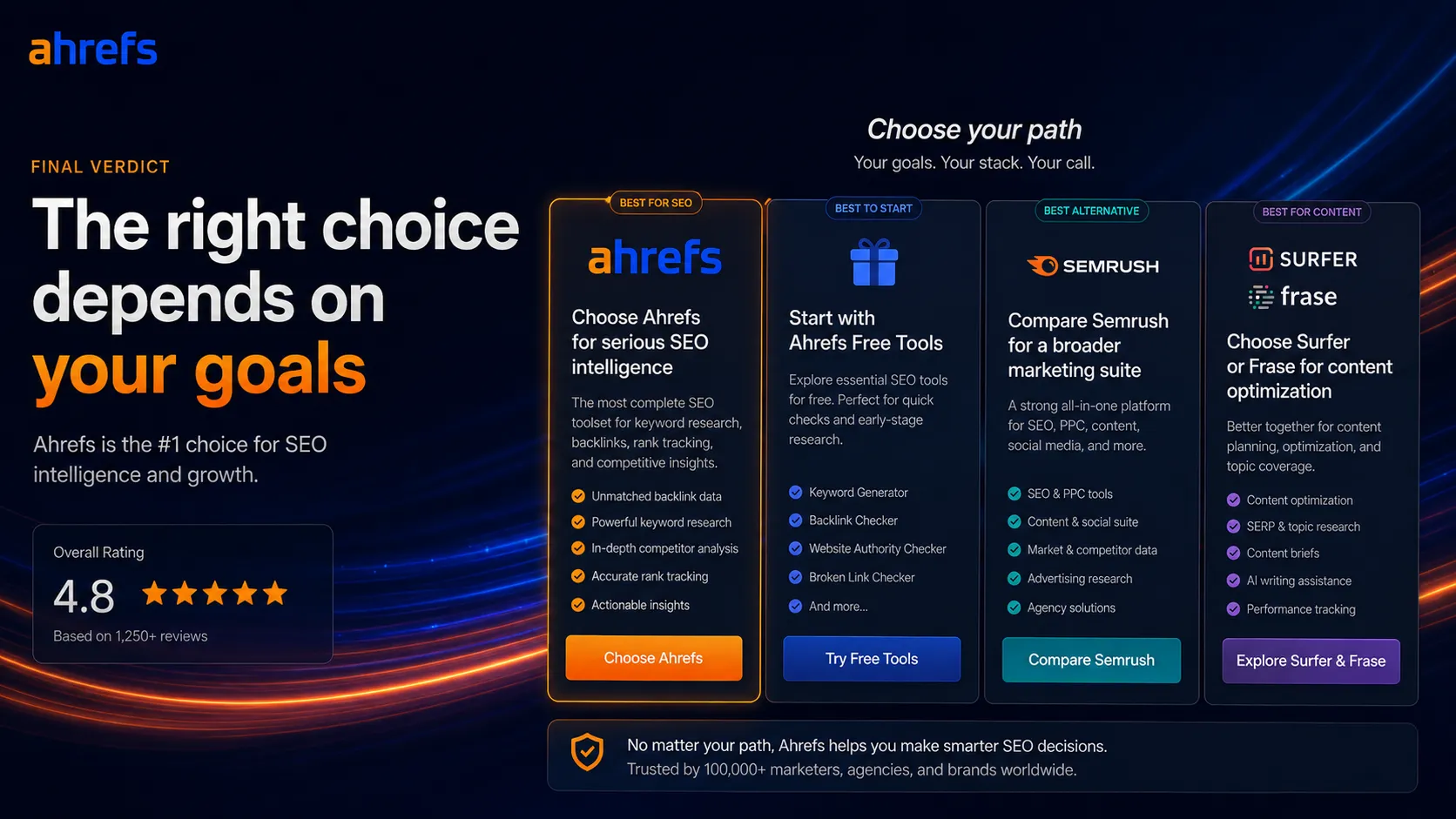
Ahrefs earns an 8.5 out of 10 because it is genuinely strong where serious SEO teams need strength: keyword research, backlink intelligence, competitor analysis, rank tracking, site auditing, and now AI visibility monitoring. It is not cheap, and it is not the right starting point for every site. But for teams that use SEO data to make recurring decisions, Ahrefs can be one of the most important tools in the stack.
I would choose Ahrefs if SEO already matters to your revenue, if you have multiple pages or clients to manage, if backlink and competitor data shape your decisions, or if you want a serious bridge between traditional SEO and AI visibility monitoring.
I would skip or delay Ahrefs if you are still validating your niche, publishing only occasionally, relying on free tools, or looking for an AI writer. In that case, start with Google Search Console, Ahrefs free tools, a lighter content tool, and a clear publishing process before taking on the subscription.
Frequently asked questions
Is Ahrefs worth it in 2026?
Does Ahrefs have a free plan?
What is the cheapest Ahrefs paid plan?
Is Ahrefs better than Semrush?
Does Ahrefs replace Google Search Console?
What is Ahrefs Brand Radar?
Who should skip Ahrefs?
Where Ahrefs fits in a stack
SEO research and search intelligence layer
Does not replace
- – Google Search Console for verified first-party search data
- – Google Analytics or another conversion analytics system
- – A CMS such as WordPress, Webflow, or Astro
- – Dedicated writing, editing, and content optimization workflows
- – Human SEO strategy and prioritization
Pairs well with
Head-to-head comparisons
Top alternatives to consider
If Ahrefs is not the right fit, these are the most common alternatives.

Semrush is the closest broad SEO and marketing suite alternative. Compare it first if you want SEO research plus PPC, social, local, content, and broader marketing workflow features in one platform.
Surfer SEO is a better fit when the main job is optimizing individual articles and content briefs, not deep backlink research or full competitive SEO intelligence.
Frase is a lighter option for SEO briefs, SERP research, and content planning when a full Ahrefs subscription would be too expensive.
Review methodology
This review is based on current public Ahrefs product pages, official pricing pages, Ahrefs Brand Radar information, the existing TopAIStacks Ahrefs YAML profile, public third-party coverage, and workflow-fit analysis.
No private benchmark, paid account stress test, or client deployment test was conducted for this review. Recommendations reflect public product information and editorial stack-fit judgment.
Not covered: Hands-on backlink index benchmark testing · Private account performance testing · Enterprise contract negotiation · Client campaign outcome measurement