 C
C Claude
Claude is an AI assistant built by Anthropic, best for professionals, developers, and enterprise teams who need reliable long-context reasoning, agentic coding, and document-heavy workflows without sycophantic behavior. Its free plan has daily usage limits, and the full agentic and coding capabilities require a Pro or Team subscription.
Quick answer
Claude is an AI assistant built by Anthropic, best for professionals, developers, and enterprise teams who need reliable long-context reasoning, agentic coding, and document-heavy workflows without sycophantic behavior. Its free plan has daily usage limits, and the full agentic and coding capabilities require a Pro or Team subscription.
Claude is not the right choice for teams that primarily need image generation, since Claude does not generate images natively. Buyers evaluating Claude for lightweight or occasional use should note that the Free plan carries daily usage limits that may interrupt workflows at critical moments. Teams that need predictable per-seat pricing at scale should verify current Team and Enterprise pricing directly with Anthropic, as the organizational plans have a minimum seat requirement and Enterprise is available by sales contract only. API costs are billed separately per token and are independent of subscription plans, which can create unexpected costs for teams that assume a subscription covers programmatic usage.
What is Claude?
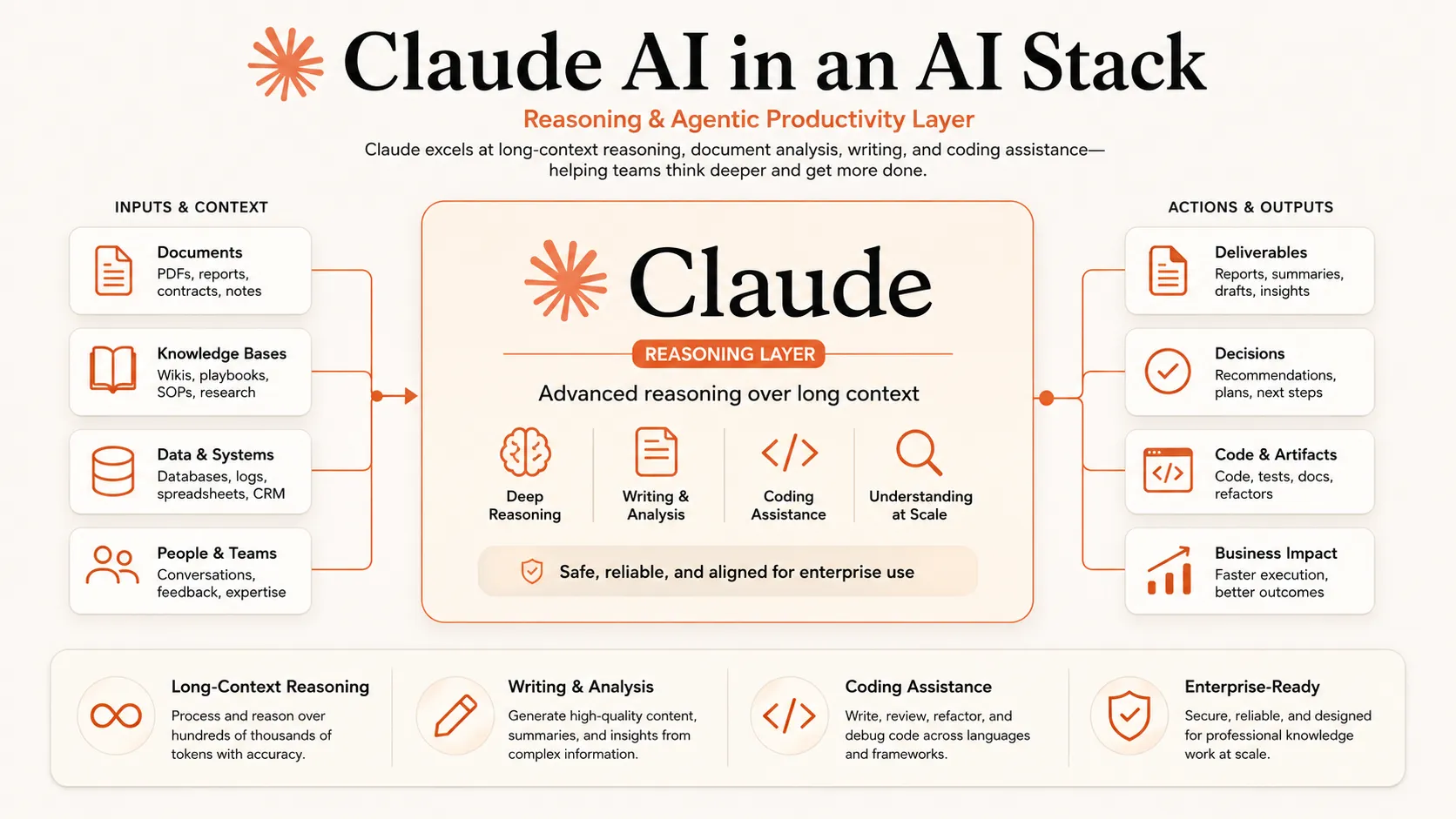
Claude is a family of large language models developed by Anthropic using Constitutional AI — a training method that instructs the model to evaluate and self-correct its responses against a written set of ethical principles, rather than purely optimizing for human approval ratings. This reduces the tendency toward sycophantic or agreeable-but-wrong answers that is common in models trained only on human preference feedback. The model family consists of three tiers: Haiku (fastest, cost-efficient), Sonnet (balanced speed and capability), and Opus (most capable, best for agentic and complex reasoning tasks). All three are accessible via the claude.ai web app, mobile apps, desktop client, and the Anthropic API, as well as through AWS Bedrock, Google Cloud Vertex AI, and Azure AI Foundry. The context window reaches 1 million tokens at standard pricing for Opus 4.6 and Sonnet 4.6, making Claude particularly practical for workflows that involve large codebases, lengthy documents, or multi-file analysis sessions. Claude Code, the agentic command-line tool included in Pro and Team plans, extends Claude's role beyond chat: it can plan multi-file changes, run tests, and execute code tasks autonomously from the terminal. The Model Context Protocol (MCP) — an open standard Anthropic introduced in late 2024 and donated to the Linux Foundation in December 2025 — allows Claude to connect to external tools and data sources such as GitHub, Jira, Slack, Google Drive, and custom internal systems without custom integration code.
Who Claude fits best
Claude fits best for developers building agentic workflows, knowledge workers processing long documents, and enterprise teams in regulated industries where consistent, non-sycophantic reasoning and data-handling assurances matter more than the broadest consumer ecosystem.
- ✓Developers and engineering teams using Claude Code for agentic coding, multi-file refactoring, and test-driven development in the terminal
- ✓Knowledge workers who regularly work with lengthy documents, contracts, research papers, or codebases that exceed standard AI context limits
- ✓Enterprise and regulated-industry teams (legal, healthcare, finance) that require contractual data protection, SSO, admin controls, and compliance tooling
- ✓Teams building AI-powered products who need a reliable API backbone with strong reasoning, MCP connectivity, and agentic orchestration capability
Not ideal for
- •Users who need native image generation as part of their core workflow, since Claude does not generate images
- •Casual users who want a simple chatbot for occasional queries and will find the Free plan usage limits frustrating without a clear upgrade path
- •Teams deeply embedded in the Microsoft ecosystem who may find GPT-4-based tools more natively integrated with Microsoft 365 and Azure AD
- •Small teams that need a multi-seat plan below the Team plan minimum of five members
Main use cases
Agentic coding and multi-file development with Claude Code
Engineering teams that need more than autocomplete use Claude Code to delegate multi-step tasks from the terminal: planning changes across files, writing and running tests, refactoring, and generating documentation. Claude Code is included in Pro, Max, Team, and Enterprise plans and operates as an autonomous coding agent rather than a passive suggestion engine. The primary limitation is that token costs can compound quickly in large agentic runs; teams managing cost at scale should track usage carefully.
Long-document analysis and knowledge extraction
Professionals working with lengthy contracts, research papers, financial reports, or regulatory documents benefit from Claude's 1 million token context window, available at standard pricing for Opus 4.6 and Sonnet 4.6. Rather than chunking documents manually or using separate retrieval pipelines, users can upload full documents and ask questions, extract structure, compare sections, or generate summaries in a single session. Buyers should confirm that 1M token context is enabled for their plan tier before relying on it in production.
Building AI-powered products with the Anthropic API and MCP
Development teams using Claude as the reasoning layer in their own products connect via the Anthropic API, available through native endpoints and via AWS Bedrock, Google Cloud Vertex AI, and Azure AI Foundry. The Model Context Protocol allows Claude to connect to external tools and internal systems without custom integration code. API access is always billed per token and is separate from subscription plans; teams should model expected token volume before committing to an API-based architecture.
Regulated-industry AI adoption with governance and compliance controls
Enterprise and regulated-industry teams use Claude Enterprise for contractual data protection, SSO, the Compliance API for auditing AI coding activity, and HIPAA-ready configuration. Constitutional AI's rule-based training approach produces more predictable behavior than models trained purely on human preference ratings, which can matter when deploying AI in compliance-sensitive environments. Teams should engage Anthropic sales to confirm specific compliance certifications and data residency options before rollout.
Where Claude fits in the AI stack
Claude operates as the primary reasoning, drafting, and coding layer in an AI stack. It handles tasks that require nuanced judgment, long-context retention, document-heavy analysis, or multi-step agentic execution. MCP connectivity lets Claude extend into surrounding tools — version control, project management, design systems, data stores — without Claude replacing those tools outright.
Stack role
Long-context reasoning and agentic AI layer
Best paired with
GitHub, Cursor, Notion
Strongest layer
Reasoning and decision support + Content drafting and editing + Coding and software development
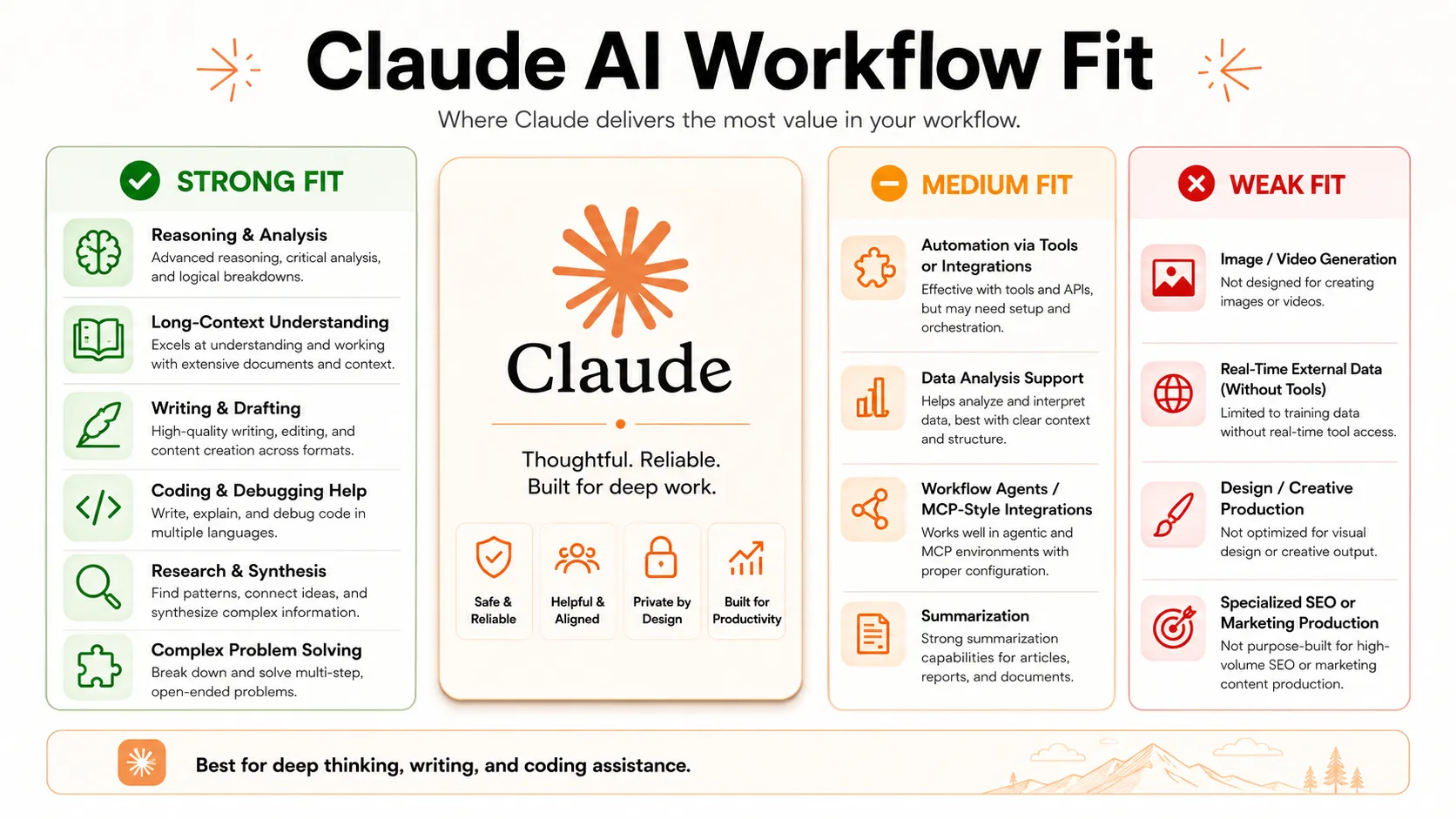
| Stack layer | Fit | What to know |
|---|---|---|
| Research and information gathering | medium | Claude handles document analysis and in-context research well, but lacks real-time web retrieval by default. Web search is available via tool use; dedicated research tools may still be needed for live data workflows. |
| Reasoning and decision support | strong | Constitutional AI training and extended reasoning models make Claude well-suited for judgment-heavy tasks where sycophancy resistance and consistent behavior matter. |
| Content drafting and editing | strong | Claude produces clear, structured prose and handles long-form drafting without degrading over long context sessions. |
| Coding and software development | strong | Claude Code's agentic capabilities go beyond autocomplete to multi-file planning, test execution, and terminal-native task delegation. |
| Visual and image output | weak | Claude does not generate images natively. Workflows requiring visual output need a separate image generation tool. |
| Automation and tool connectivity | medium | MCP integration enables strong connectivity to external systems for Pro and above plans. Complex cross-platform automation may still require a dedicated automation layer. |
Best stack combinations
Solo developers building AI-powered SaaS products
claude-ai + cursor + github
Use Claude as the reasoning and long-context layer for architecture decisions and documentation, Cursor for IDE-native coding assistance, and GitHub for version control. Claude Code covers agentic terminal tasks.
Enterprise knowledge teams in legal or financial services
claude-ai + perplexity
Claude handles long-document analysis, contract review, and structured knowledge extraction. Perplexity covers real-time research and current-event lookups that Claude's training cutoff cannot address.
Startup founders building their first AI product
claude-ai + replit
Claude Code handles terminal-based agentic coding for developers; Replit provides a browser-based coding and deployment environment for non-developers or early prototyping before a full engineering stack is established.
What Claude can replace
- · Manual document review and summarization workflows for long-form content
- · Basic AI-assisted coding suggestion tools for teams moving to full agentic task delegation
- · Repetitive knowledge work that involves extracting, comparing, or reformatting information across large documents
- · Standalone chatbot solutions for enterprise teams who need governance, SSO, and compliance tooling built in
What it still needs
- · GitHub or another version control system: Storing and managing code produced by Claude Code
- · A deployment platform such as Vercel, Netlify, or AWS: Shipping applications built with Claude Code
- · An image generation tool (Canva AI, Midjourney, or similar): Any workflow that requires visual output
- · Data infrastructure (databases, vector stores, RAG pipelines): Applications that require dynamic retrieval beyond a single context window
Add it to your stack if
- · Your workflow requires nuanced reasoning over long or complex documents that exceed normal AI context limits
- · You need agentic coding beyond autocomplete — multi-file planning, test execution, and terminal task delegation
- · You are building an API-backed AI product and need a reliable reasoning backbone with MCP connectivity
- · Your team is in a regulated industry and needs contractual data handling assurances and SSO
Skip it if
- · Your primary need is real-time web search rather than document-based reasoning
- · You need native image generation as a core workflow output
- · You only need occasional simple queries that a free consumer tool handles adequately
- · Your team has fewer than five members and needs a multi-seat plan below the Team plan minimum
Choose your next step
Pricing
→Check plan fit, free access, and what to verify before paying.
Alternatives
→Compare direct alternatives, adjacent tools, and when to stay with Claude.
Compare options
→Compare Claude with the most common general AI assistant alternative.
Stack fit
→See how Claude fits into a practical developer productivity workflow.
Deal
→Check available savings, trial, or deal paths.
Review
→See whether Claude is worth it for your workflow.
Pricing summary
This is a profile-level summary. Use the pricing page for deeper plan checks.
Starting path
Free plan available; Pro from $20/month; Team from $25/seat/month billed annually
Free plan
Yes
Free trial
No
Anthropic offers four subscription tiers for individuals and organizations via claude.ai, plus a separate per-token API for developers. These are two distinct billing systems: a subscription covers human-paced access to the claude.ai app and Claude Code in the terminal, while API usage is always billed by token regardless of subscription status. Buyers should confirm current plan limits, seat minimums, and annual billing options directly on the official pricing page before purchasing.
Best starting path: Individual developers and power users will find Pro at $20/month the most practical entry point for Claude Code and extended reasoning access. Teams of five or more should evaluate the Team plan for shared Projects, admin controls, and included Claude Code seats. Enterprise requires a direct sales conversation and a minimum of 20 seats.
Related stack page
Top alternatives
See all →Direct alternatives

ChatGPT is the closest direct alternative for general-purpose AI assistance, writing, and coding. It has a broader consumer ecosystem, stronger Microsoft product integration, and its own agentic coding tools, but its models are more prone to sycophancy at scale and its context window is smaller than Claude's 1M token offering.

Google Gemini is a direct alternative for teams embedded in the Google Workspace ecosystem. It offers native integration with Google Docs, Sheets, and Drive. Buyers should compare current context window size, agentic coding capability, and data handling terms before choosing between Gemini and Claude.
Adjacent tools in the same stack

Cursor is an AI-native code editor that often runs Claude models under the hood. It complements Claude Code for developers who prefer an IDE-native environment. Cursor does not replace Claude as a reasoning or document-analysis layer.

GitHub Copilot provides inline code suggestions inside VS Code and other editors. It occupies the autocomplete layer that Claude Code operates above. Many engineering teams use both together.

Perplexity is a real-time research and search engine that fills the live-data retrieval gap in Claude-based stacks. It does not replace Claude for reasoning, coding, or document-heavy workflows.
Related comparisons
FAQ
What is Claude best for?
Claude is best for reasoning over long or complex documents, agentic coding via Claude Code, building AI-powered products through the Anthropic API, and professional knowledge work in regulated industries where consistent, non-sycophantic behavior and data handling assurances matter. Its 1 million token context window makes it particularly strong for workflows involving large files, codebases, or lengthy reports.
Is Claude enough as a complete AI stack on its own?
For most individuals, Claude covers the core reasoning, writing, and coding layers well. However, a complete production stack typically also needs version control (GitHub), a deployment platform (Vercel or AWS), and for some workflows, real-time research tools (Perplexity) and image generation (Canva AI or similar). Claude does not generate images natively, which is a meaningful gap for visual workflows.
What tools should I pair with Claude?
Common pairings include GitHub for version control and code context, Cursor for IDE-native coding alongside Claude Code terminal tasks, Perplexity for real-time web research, and Google Workspace or Notion for document storage that Claude accesses via MCP or file upload.
What is the best Claude alternative?
ChatGPT is the closest direct alternative for general-purpose use, with a broader consumer ecosystem and stronger Microsoft product integration. Google Gemini is the most practical alternative for teams embedded in Google Workspace. Neither fully replicates Claude's 1M token context window or Constitutional AI training approach, so the best fit depends on the specific workflow and existing tool ecosystem.
Who should not use Claude?
Claude is not ideal for users who need native image generation, teams heavily embedded in Microsoft tools where GPT-4-based products integrate more natively, casual users who only need occasional queries and will hit Free plan limits, or small teams of fewer than five people who need a multi-seat plan but cannot meet the Team plan minimum.
Does Claude have a free plan, and what are the limits?
Claude offers a free plan with no credit card required, covering web, iOS, Android, and desktop access with text, image input, code generation, and web search. The Free plan has daily usage limits, but Anthropic does not publicly specify the exact cap. Users who hit limits regularly should verify whether the Pro plan at $20 per month fits their needs before committing.
How TopAIStacks evaluates Claude
This profile is based on official Anthropic product pages, official pricing page structure, and third-party analyses that aggregate official plan details. Pricing figures for Pro ($20/month) and Free plan availability are consistent across official and third-party sources. Team and Enterprise pricing figures are sourced from third-party reporting and may not reflect the current official rate; buyers are directed to confirm on the official pricing page. Stack role, workflow fit assessments, and alternative groupings are based on observed product positioning, competitor categories, and common buyer decision patterns. No hands-on testing was conducted. Pricing claims use cautious language where official verification was not directly possible.
Last checked: May 2026 · Source confidence: high