 P
P Perplexity AI
AI answer engine for fast research with source citations
Quick answer
Perplexity is best when you want an AI search experience with citations, fast topic discovery, and follow-up research. It is not a replacement for source judgment, and important claims should still be checked against the original documents.
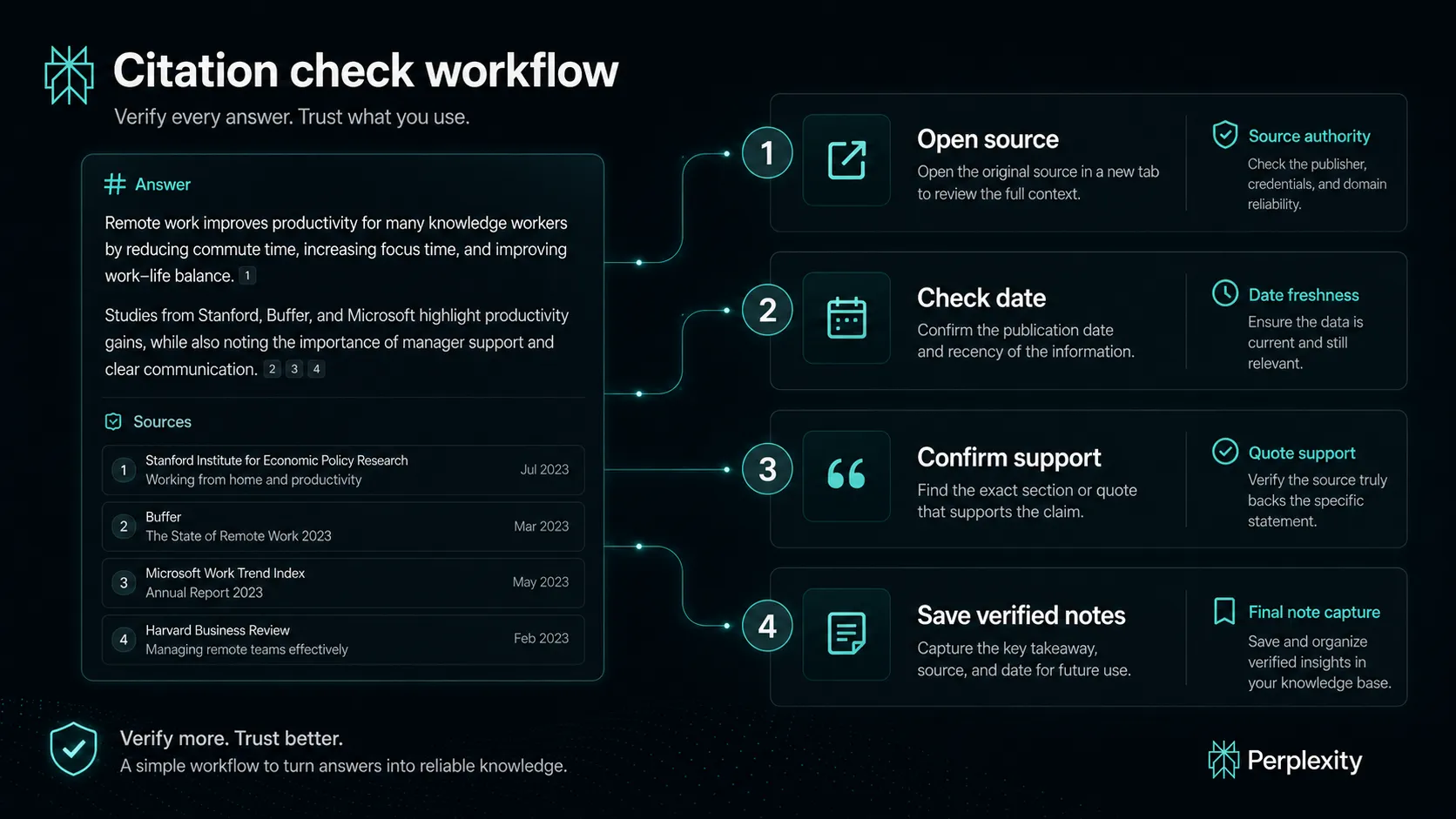
Perplexity can make research faster, but citations do not automatically make an answer correct. Users should open the source links, check whether the source actually supports the claim, and be especially careful with legal, medical, financial, scientific, or breaking-news topics.
What is Perplexity AI?
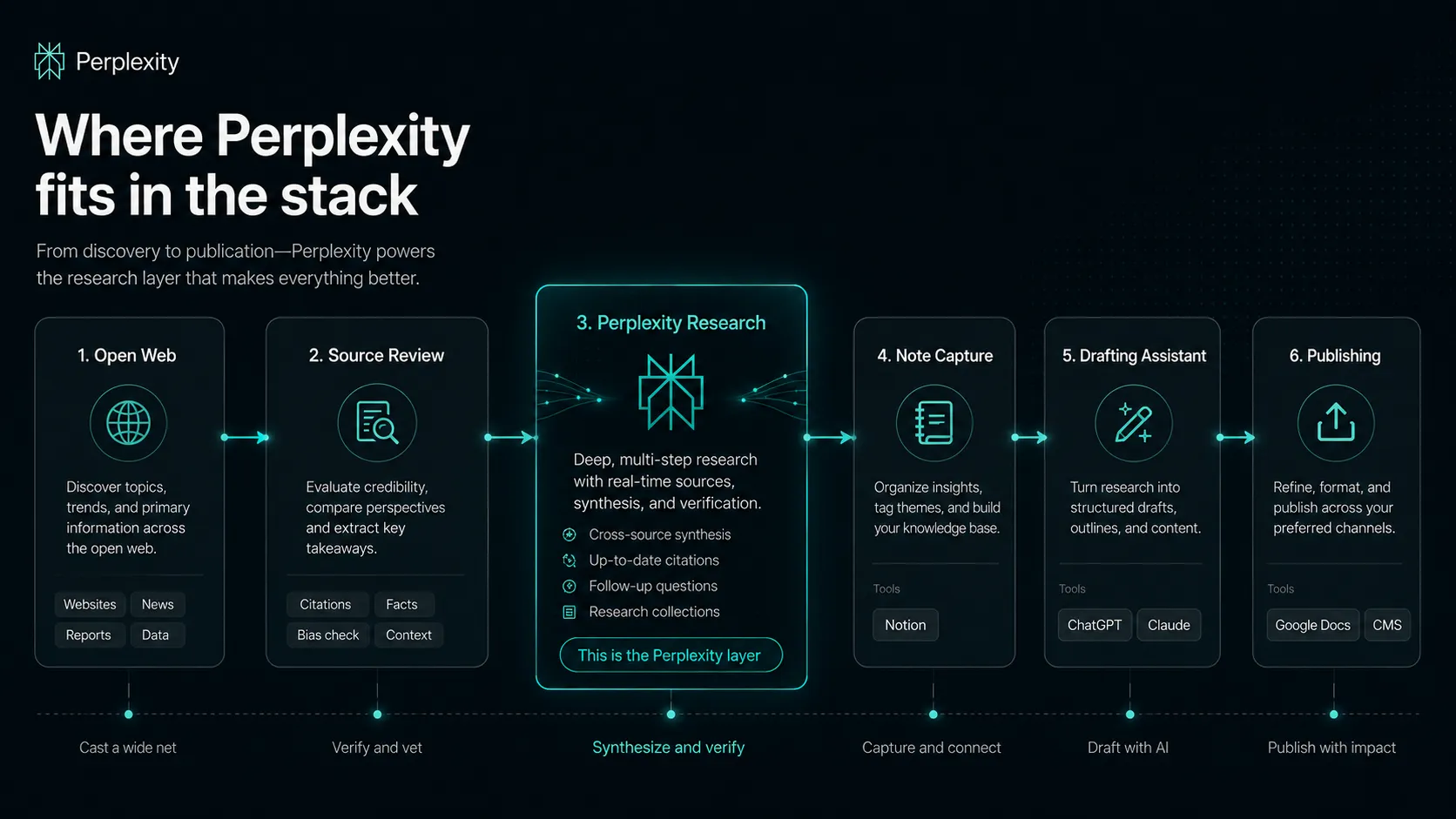
Perplexity is an AI answer engine that searches the web, summarizes findings, and shows sources alongside answers. Instead of starting from a blank chat prompt, users can ask research questions, compare sources, upload files, and continue the thread with follow-up questions. It fits the research layer of a stack, especially when freshness and source visibility matter more than brand voice or long-form generation.
Who Perplexity AI fits best
Choose Perplexity when your main problem is finding and checking current information, not producing final polished copy.
- ✓Researchers who want source-backed summaries before reading full articles or papers.
- ✓SEO and content teams collecting source material, definitions, statistics, and topic angles.
- ✓Professionals who need quick comparison research across current web sources.
- ✓Students who want a starting point for learning, source discovery, and question refinement.
Not ideal for
- •Teams that need strict editorial control, brand voice libraries, or campaign copy workflows.
- •Users who will publish AI-generated claims without opening the cited sources.
- •Buyers who need deterministic enterprise research records without checking Enterprise terms.
- •People who mainly want creative writing, image generation, or codebase-aware development help.
Main use cases
Fast current-topic research
Perplexity is useful for getting an initial map of a topic, seeing source links, and deciding which sources deserve deeper reading.
Source discovery for content teams
Writers and editors can use Perplexity to collect background sources, definitions, public claims, and comparison angles before drafting in a separate writing tool.
Fact-checking and claim verification
Perplexity can surface supporting or conflicting sources quickly, but the reviewer still needs to open the original pages and decide whether the evidence is strong enough.
Research follow-up conversations
The threaded interface helps users refine a question, narrow the scope, compare answers, and turn broad searches into more specific research paths.
Where Perplexity AI fits in the AI stack
Perplexity sits in the research layer of an AI stack. It helps users search, summarize, compare, and cite current information before writing, planning, or making decisions. It can replace some manual web searching and source gathering, but it does not replace primary-source review, expert judgment, note organization, or final editorial responsibility.
Stack role
AI research and answer engine layer
Best paired with
ChatGPT, Claude, NotebookLM
Strongest layer
Current web research + Source discovery and verification
| Stack layer | Fit | What to know |
|---|---|---|
| Current web research | strong | Perplexity is strongest when users need fast answers with source links and follow-up questions. |
| Source discovery and verification | strong | It helps surface sources quickly, but the user must still inspect the originals before relying on claims. |
| Long-form writing | medium | It can help with research notes, but dedicated writing tools are usually better for voice, structure, and final copy. |
| Sensitive expert advice | weak | Legal, medical, financial, and compliance questions still need primary sources and qualified human review. |
Best stack combinations
Content researchers
perplexity + notion + google-docs + chatgpt
Use Perplexity for source discovery, Notion for notes, Google Docs for drafting, and ChatGPT for structure.
SEO and editorial teams
perplexity + surfer-seo + google-search-console + wordpress
Use Perplexity for background research, then validate intent and optimization with SEO tools before publishing.
Students and professionals
perplexity + notebooklm + google-docs + claude-ai
Use Perplexity to discover sources, NotebookLM to work with selected materials, and Claude for long-document synthesis.
What Perplexity AI can replace
- · Some manual web search and source discovery
- · Some quick answer synthesis
- · Some first-pass comparison research
- · Some background topic mapping
What it still needs
- · primary-sources: Original documents, official pages, and direct evidence for important claims
- · human-review: Judgment on whether sources are reliable and actually support the answer
- · notes-system: A place to save, organize, and reuse verified research
- · editorial-check: Final fact-checking before publishing, advising, or making decisions
Add it to your stack if
- · You need current web information with visible source links.
- · You often compare multiple sources before making a decision.
- · Traditional search feels too slow for early research and topic mapping.
- · Your workflow includes human verification before publishing or acting on answers.
Skip it if
- · You need final polished writing more than research discovery.
- · You will not open and verify source links.
- · Your work involves highly sensitive advice that requires expert review.
- · You need a tool that guarantees every citation fully supports the answer.
Choose your next step
Pricing
→Check Perplexity plan options, free access, Pro pricing, usage limits, and buyer cautions before upgrading.
Alternatives
→Compare Perplexity with ChatGPT, Claude, Gemini, NotebookLM, and other AI research tools.
Compare options
→Use this comparison if you are choosing between a general AI assistant and an answer engine built around cited research.
Stack fit
→See how Perplexity fits with source gathering, citation review, note-taking, and final editorial judgment.
Review
→Read the full editorial review before using Perplexity as your main AI research tool.
Pricing summary
This is a profile-level summary. Use the pricing page for deeper plan checks.
Starting path
Free plan, Pro reported at $20/mo
Free plan
Yes
Free trial
No
Perplexity has a free entry path for standard search and a Pro subscription that is widely reported at $20 per month or $200 per year. A higher Max tier has been reported at $200 per month for users who need heavier access and early feature availability. Because plan names, model access, search limits, and browser-agent access can change quickly, buyers should verify the live Pro page before subscribing.
Best starting path: Start free if you only need occasional research. Consider Pro when you rely on Perplexity daily for deeper searches, file work, model choice, or higher usage. Treat Max as a specialist tier for heavy users after verifying current limits.
Related stack page
SEO Content Stack
→Role: Research and source discovery layer
Perplexity fits an SEO content workflow when writers need fast source discovery, topic framing, and fact-checking before building a brief or draft.
AI Research Stack
→Role: Cited answer engine
Perplexity is a natural front door for AI research because it combines search, answers, citations, follow-up questions, and quick comparison paths.
Top alternatives
See all →Direct alternatives

Better as a general-purpose assistant and drafting tool, while Perplexity is more search-first.

Better for long-context document reasoning, while Perplexity is better for current web source discovery.

Stronger for users already inside Google's ecosystem, while Perplexity is more focused on citation-led AI search.
Adjacent tools in the same stack

Related comparisons
FAQ
Is Perplexity free?
Yes. Perplexity has a free entry path for standard AI search. Paid Pro access is for heavier users who need more advanced features, higher limits, or broader model access. Always verify the live pricing page before subscribing.
How much does Perplexity Pro cost?
Public reporting lists Perplexity Pro at $20 per month or $200 per year. Prices and plan limits can change, so buyers should confirm the current details on Perplexity's official Pro page before checkout.
Is Perplexity better than ChatGPT?
It depends on the job. Perplexity is better when the main need is current web research with source links. ChatGPT is usually better for broad reasoning, drafting, rewriting, and workflow help after the research is verified.
Can I trust Perplexity citations?
Treat citations as a starting point, not a guarantee. Open the cited pages, confirm that the source actually supports the answer, and use primary sources for important claims.
Who should use Perplexity?
Perplexity fits researchers, students, content teams, analysts, and professionals who need fast topic exploration with visible sources. It is less ideal for users who only need polished writing or who will not verify sources.
How TopAIStacks evaluates Perplexity AI
This profile combines the TopAIStacks task input with current public research. Pricing uses public reporting where the official Pro page could not expose full structured pricing text through the available parser, and the copy tells buyers to verify the live Perplexity checkout page before subscribing. The top-level public rating uses the Apple App Store listing because it has a much larger visible rating count than Product Hunt. Editorial scoring is separate from public rating and reflects stack fit for research workflows.
Last checked: May 2026 · Source confidence: medium