Originality.ai Review
Originality.ai review for publishers, agencies, pricing, AI detection limits, plagiarism checks, and safer buyer fit.
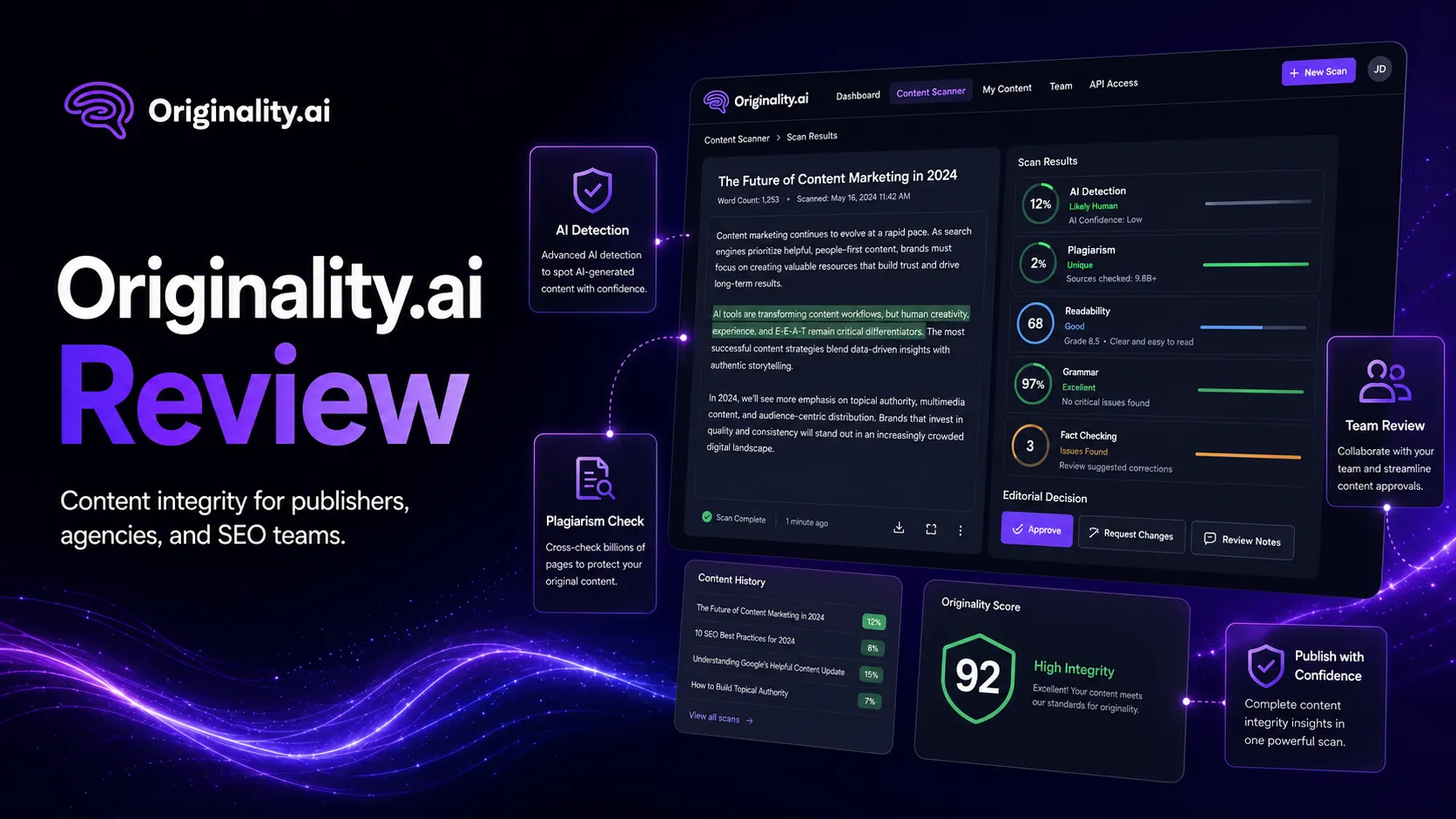
Strong publisher-focused content integrity tool, with detection limits that require human review.
Use it if…
- ✓ You review a steady flow of submitted articles, briefs, or SEO drafts.
- ✓ You want AI detection and plagiarism checking inside one content QA process.
- ✓ You are willing to use scan results as signals for review instead of automatic decisions.
Skip it if…
- – You only need a free occasional checker.
- – You need an academic misconduct workflow with institution-specific policy support.
- – You want a tool that can guarantee whether text was or was not generated by AI.
Review scorecard
Scored by workflow fit, ease of use, value, and stack compatibility. Weights reflect importance for typical buyers.
| Criteria | Score | ||
|---|---|---|---|
| Workflow fit | 8.6 | ||
| Detection and QA coverage | 8.4 | ||
| Ease of use | 8.0 | ||
| Pricing clarity | 7.6 | ||
| Stack value | 8.0 | ||
| Weighted overall | 8.2 / 10 | ||
On this page
Quick verdict
Originality.ai is a practical tool for the messy middle of publishing: the moment after a draft arrives, but before an editor spends real time polishing it. If you run an SEO site, a niche publishing workflow, or an agency that receives work from multiple writers, that checkpoint matters.
The buyer mistake is treating the product like a judge. It is better used like a traffic light. A clean result can speed up review. A risky result should trigger a closer look. It should not become the whole conversation with a writer.
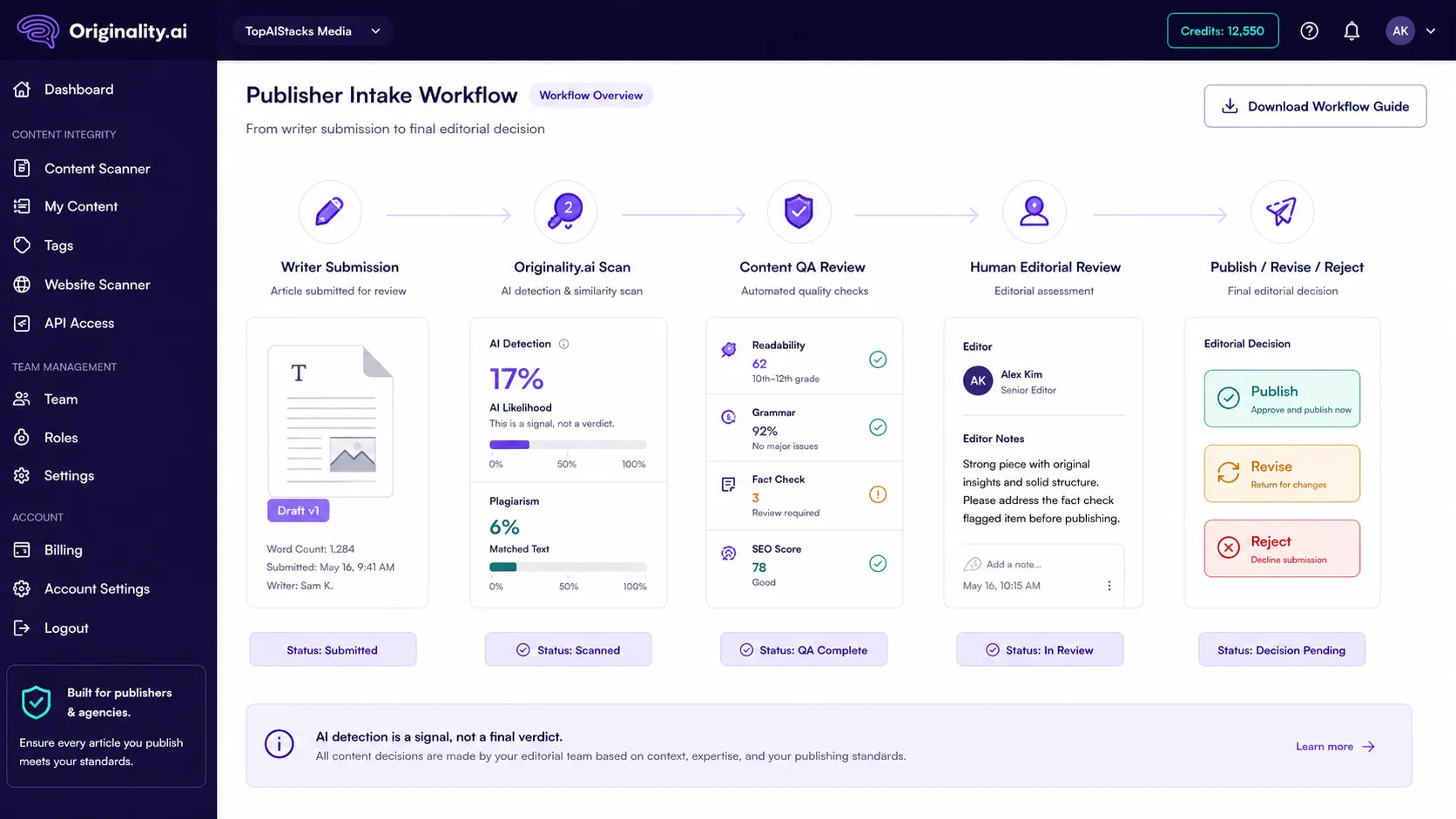
For a serious publisher, that is the real value. Originality.ai is not just a detector button. It is a quality-control layer around AI detection, plagiarism checks, readability, grammar, fact checking aids, bulk scanning, reports, extension access, WordPress flow, and API options.
Who should use Originality.ai
You should look at Originality.ai if you pay writers, accept guest posts, publish affiliate content, manage a content agency, or review many SEO drafts before they go live. The tool fits teams that already know one painful truth: content QA becomes expensive when every problem reaches the editor too late.
A small affiliate site owner might use it before adding a draft to WordPress. An agency might use it before assigning edits. A publisher might use it to create a repeatable intake rule for writers. In each case, the scan is not the full review. It is the first layer that tells you where to slow down.
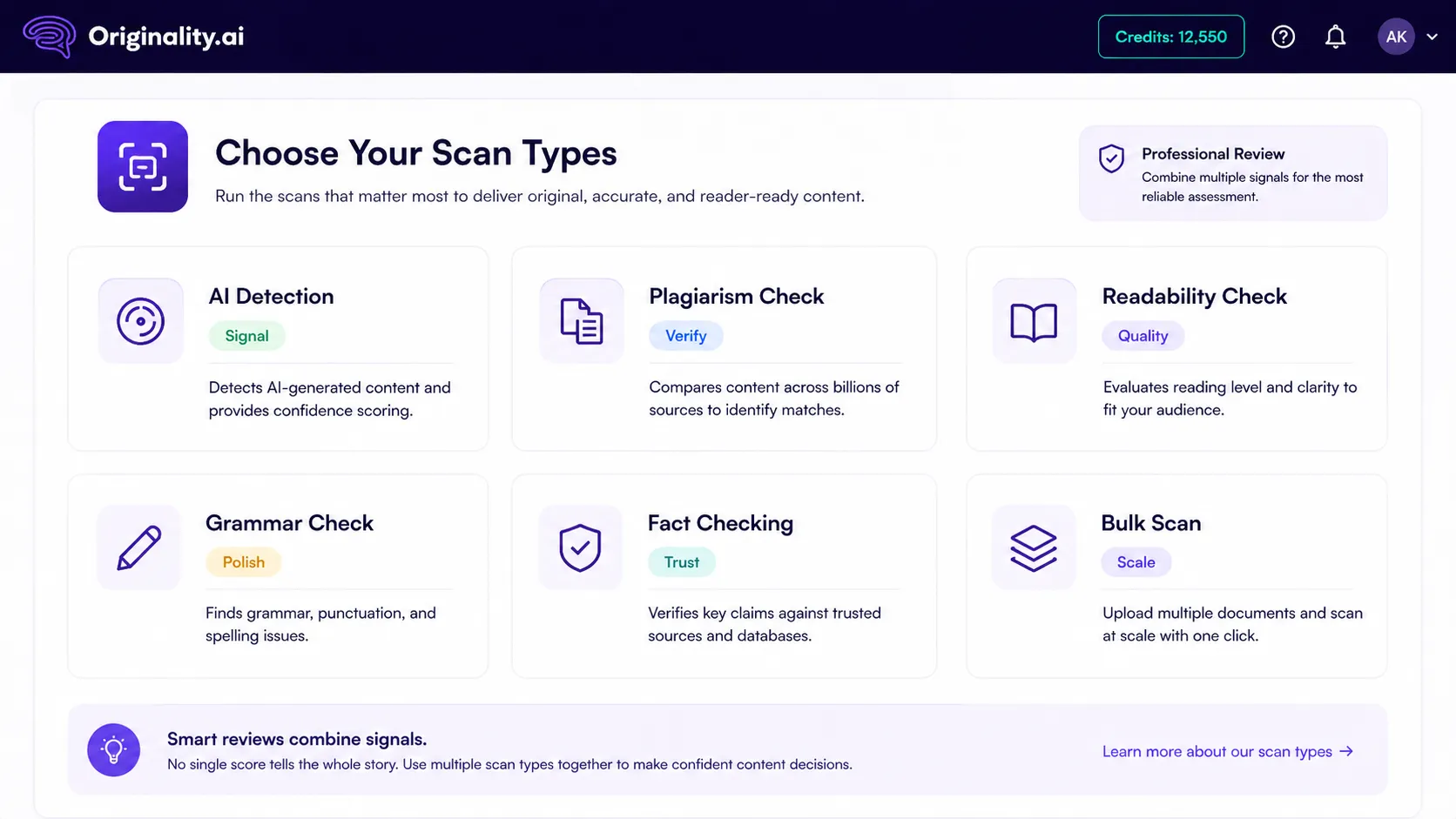
It is also a better fit for teams that care about plagiarism and content quality, not just AI detection. If your actual workflow is “Can I trust this article enough to continue editing it?”, then the combined scan types are more useful than a single AI percentage.
Who should skip Originality.ai
Skip it if you only need a free occasional AI checker. Originality.ai is built around credits and paid workflows, so casual use can feel heavier than necessary.
Skip it if your main use case is academic discipline. That does not mean educators cannot use it. It means high-consequence academic decisions need policy, evidence, drafts, history, and process. A detector score alone is too thin for that job.
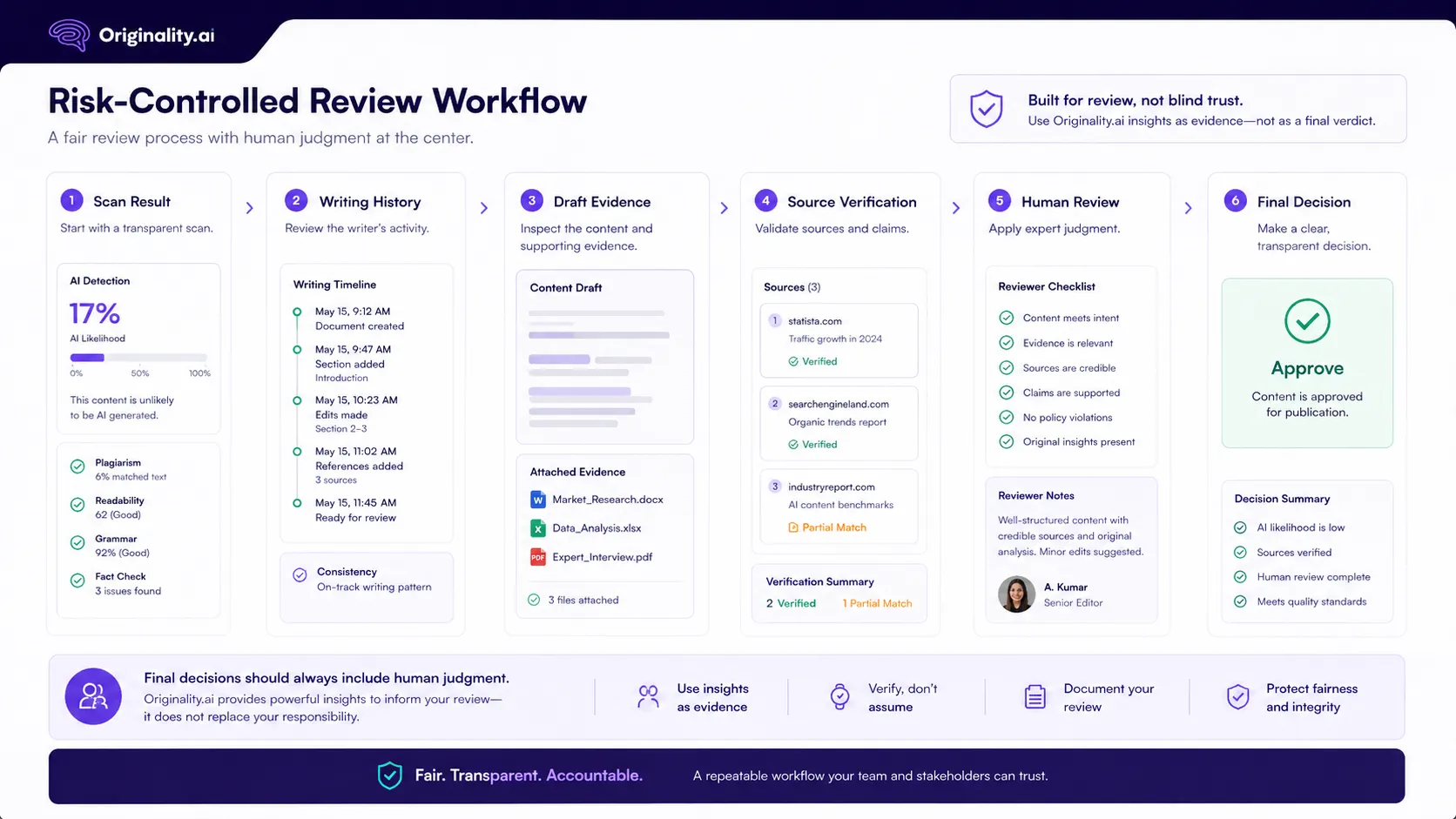
You should also skip it if your plan is to reject writers automatically. That creates the wrong workflow. Detection tools can be useful, but edited drafts, translated content, formulaic human writing, and hybrid workflows can all complicate interpretation. A good editor uses the result as a question, not a verdict.
Real workflow fit
The strongest workflow is simple. A draft comes in. The editor runs AI detection and plagiarism checks. If the draft is clean enough, it moves forward. If it raises concerns, the editor checks sources, asks for process evidence, compares writing history, or sends it back with specific notes.
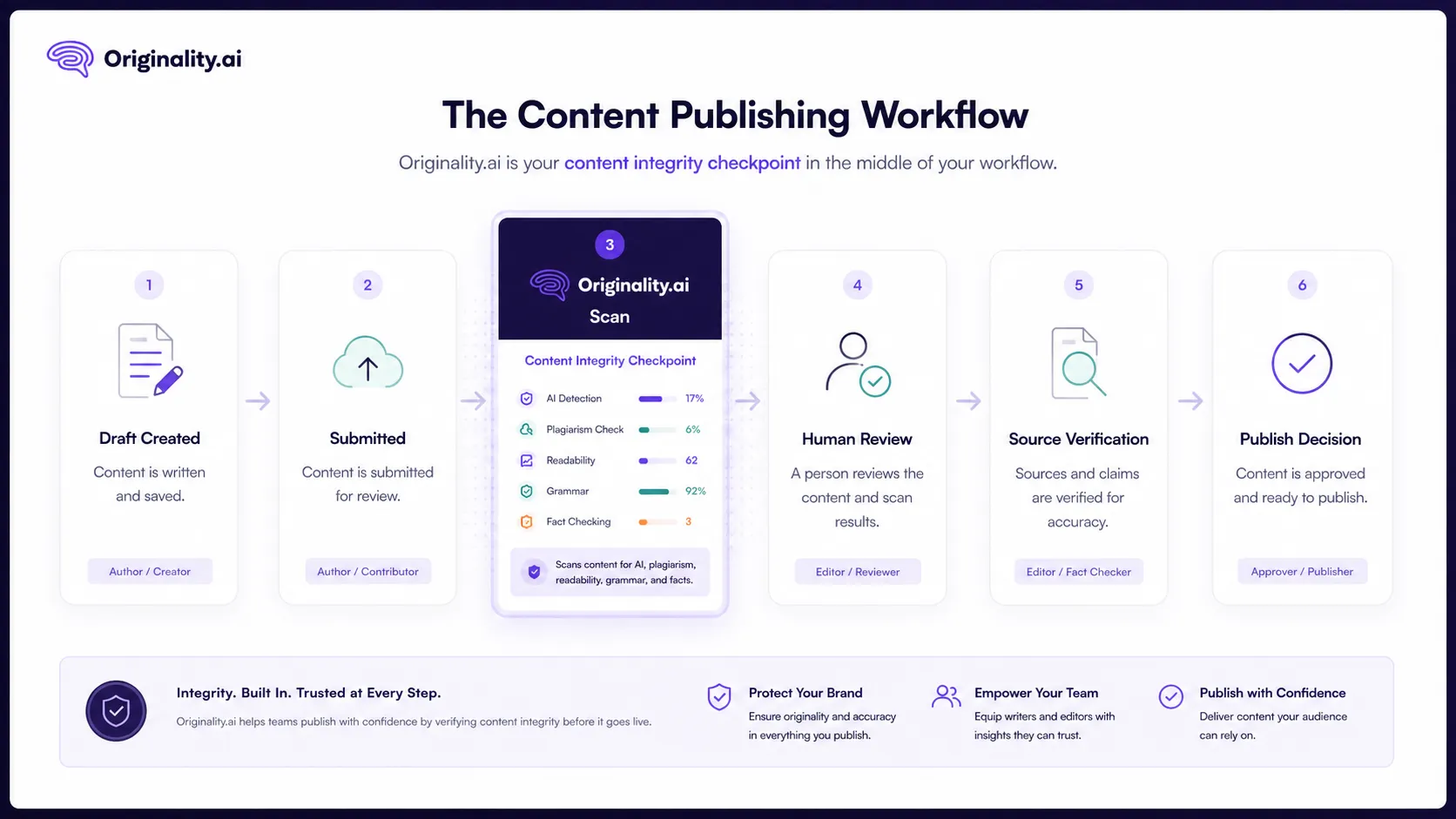
That makes Originality.ai most useful before heavy editing, not after final polish. Once an editor has rewritten several paragraphs, changed structure, added sources, and cleaned tone, the scan result may be less connected to the original writer behavior. Put the scan near intake, then use human review for the rest.
For SEO teams, this fits especially well because weak content is rarely just an AI problem. It can also be thin, copied, unreadable, inaccurate, or poorly matched to the search intent. Originality.ai gives you several checks in one place, which is more realistic than pretending AI detection alone solves content quality.
Where Originality.ai fits in an AI stack
In a content stack, Originality.ai should sit after drafting and before publishing. It pairs naturally with writing tools, source research, editing tools, SEO optimization, and WordPress. It does not replace those tools. It gives the editor a cleaner checkpoint before the real judgment work begins.
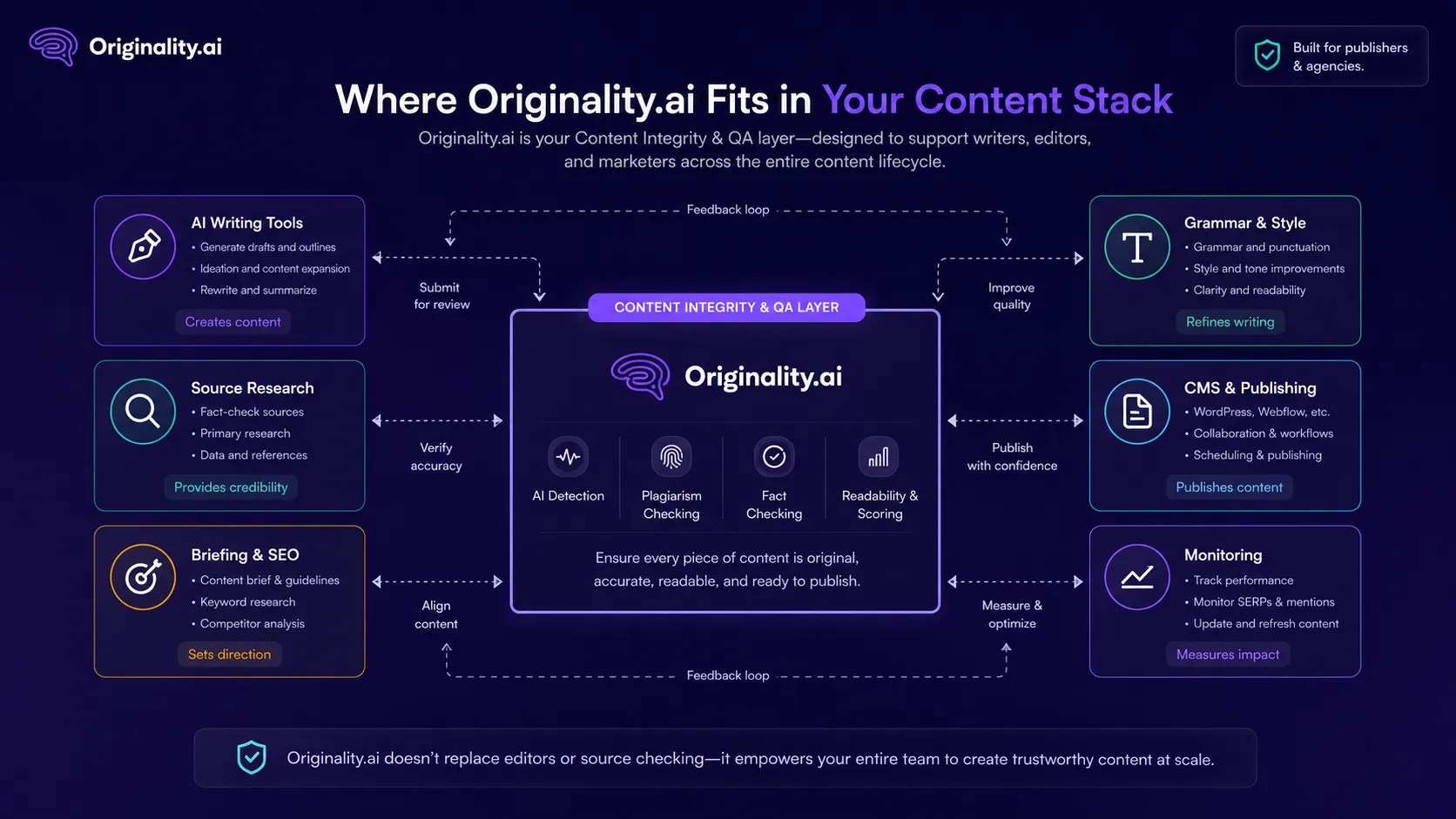
A practical stack might look like this: ChatGPT or Claude for working drafts, Perplexity or Google for source discovery, Grammarly for final polish, Surfer SEO or Frase for content optimization, Originality.ai for content integrity checks, then WordPress for publishing.
That stack only works if the team has rules. Decide when to scan, which scan types to use, what score range triggers extra review, what evidence writers can provide, and who makes the final call. Without that process, even a good detector becomes another dashboard nobody trusts.
What Originality.ai does well
Originality.ai does well when the buyer needs content QA at publishing speed. It gives editors a structured way to check AI risk, plagiarism, readability, grammar, and factual risk before content moves deeper into production.
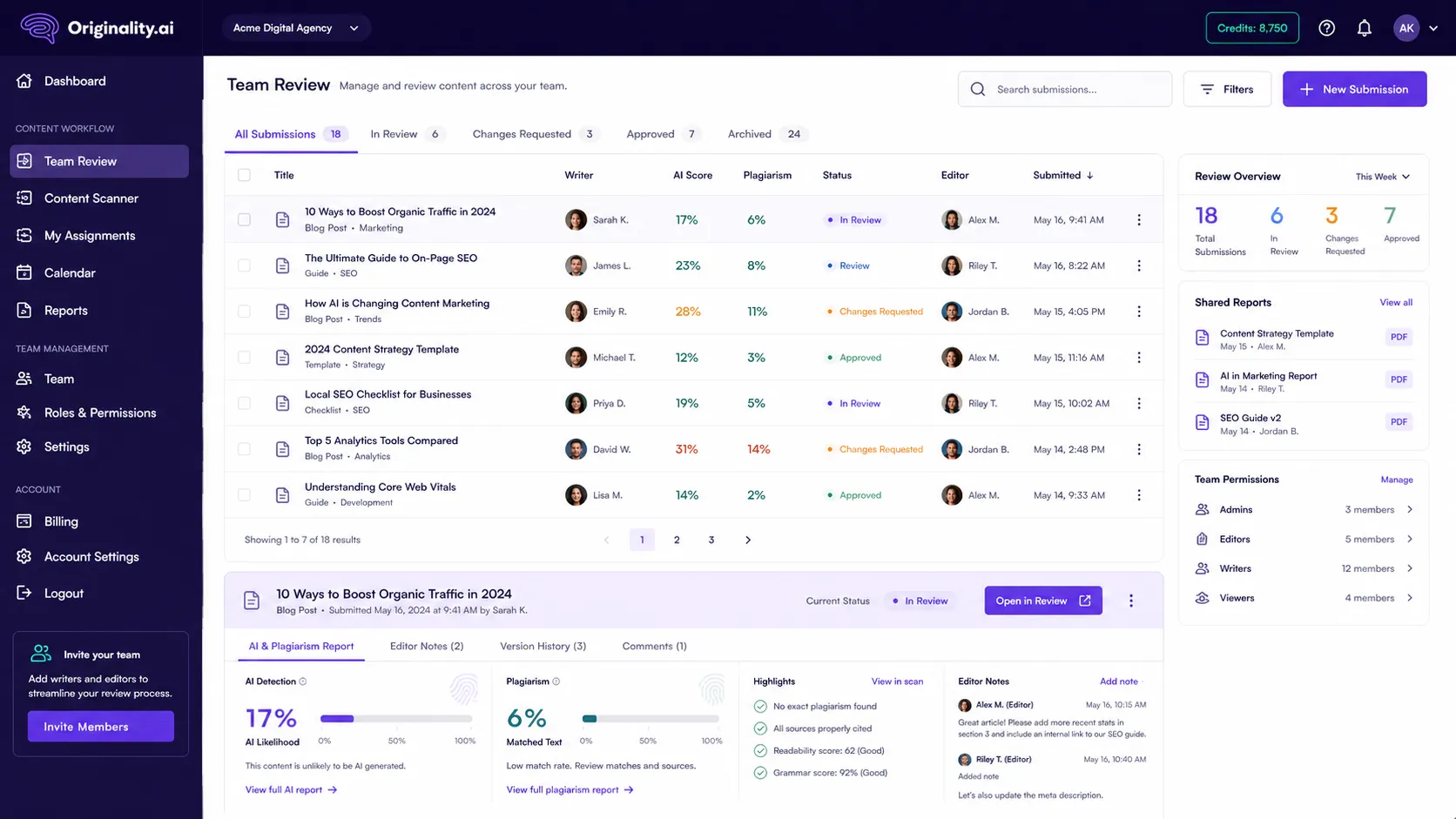
The team features and reporting angle also matter. If you are reviewing many writers, you need shareable records and consistent steps. A scan that only sits inside one editor’s private tab is not enough. A workflow with history, reports, and team review is easier to defend and improve.
The Chrome extension and WordPress plugin also make sense for the buyer this tool is aimed at. Publishers do not want to copy every article through five disconnected tools. They want checks closer to where writing and publishing already happen.
Where Originality.ai falls short
The main weakness is not unique to Originality.ai. AI detection is not absolute. The public conversation around detectors has enough mixed testing, paraphrasing research, and false-positive concern that buyers should stay careful.
That matters most when people are involved. Rejecting a contractor, accusing a student, or escalating a client issue based only on an AI score is not a safe process. Originality.ai is useful, but the workflow around it needs to be fair.
Another limitation is pricing psychology. Credit-based tools look affordable at first, then become harder to judge when teams scan long documents, multiple scan types, or large batches. You need to estimate monthly word volume before buying. Otherwise the plan choice becomes guesswork.
Pricing judgment
As of this review check, Originality.ai publicly lists three buying paths: Pay as you go at $30 for 3,000 one-time credits, Pro with monthly credits for individuals and small teams, and Enterprise for agencies and publishers with higher monthly credit volume. The pricing page also states that 1 credit equals 100 words for an AI check.
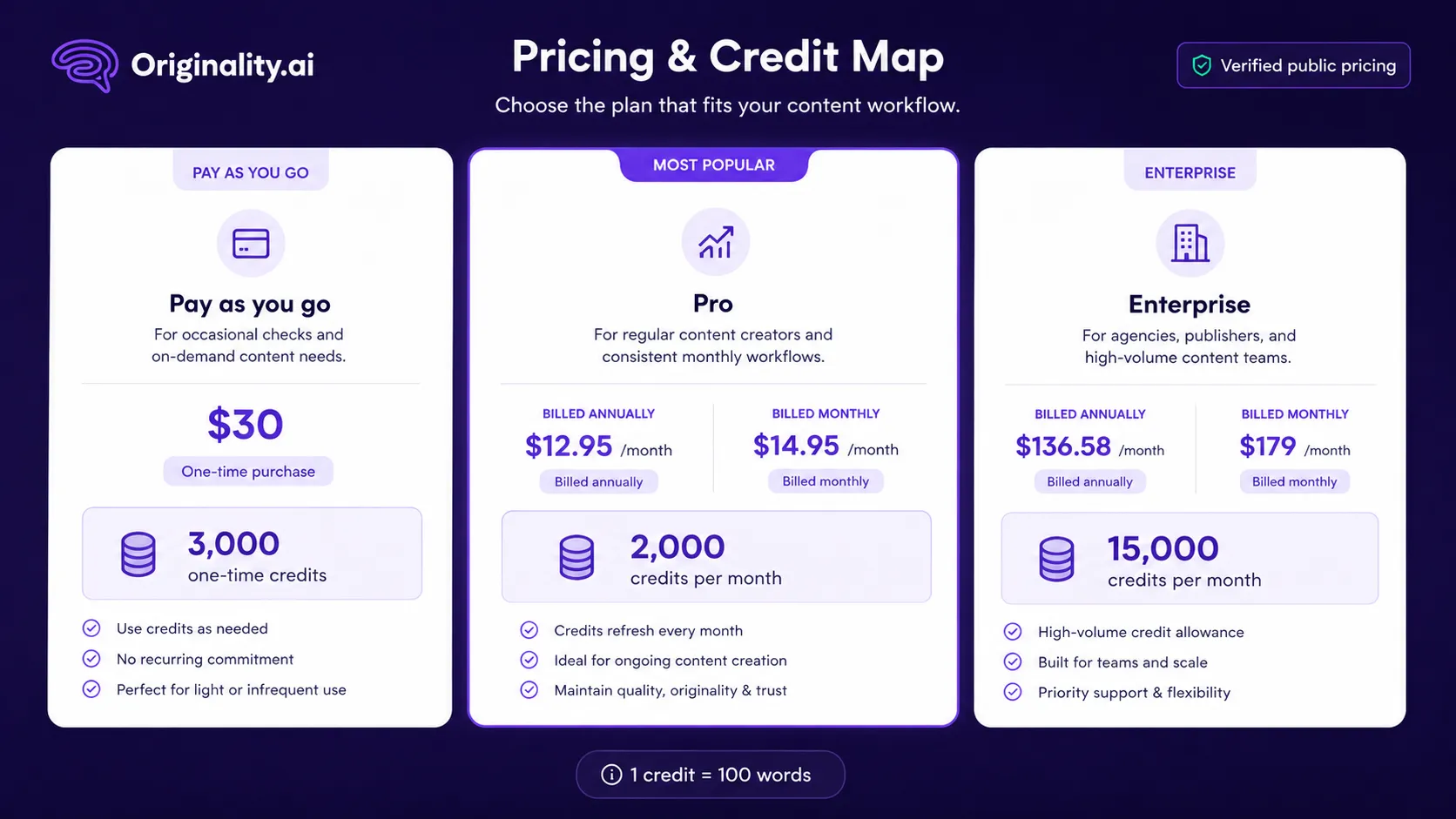
That makes the decision fairly clear. Use Pay as you go if you scan occasionally and want to avoid a subscription. Use Pro if you review content every month but do not need high-volume publisher features. Look at Enterprise only if you have enough content volume and team workflow needs to justify the higher monthly spend.
The hidden decision is not the sticker price. It is your scanning policy. If editors scan every draft repeatedly, credits disappear faster. If the team scans once at intake and only rescans when needed, costs are easier to control.
Best alternatives to compare
GPTZero is the first alternative to compare if your use case is more education-facing or you want a familiar AI detection brand. It may be a better place to start for teachers, students, or lighter AI-checking workflows.
Copyleaks is worth comparing when enterprise integration, API use, institution-scale policies, or broader originality infrastructure matters more than a publisher-first editorial workflow.
Winston AI is another relevant comparison for teams that want AI detection reports and a more education-style review experience. It may fit buyers who care more about report presentation than publisher intake operations.
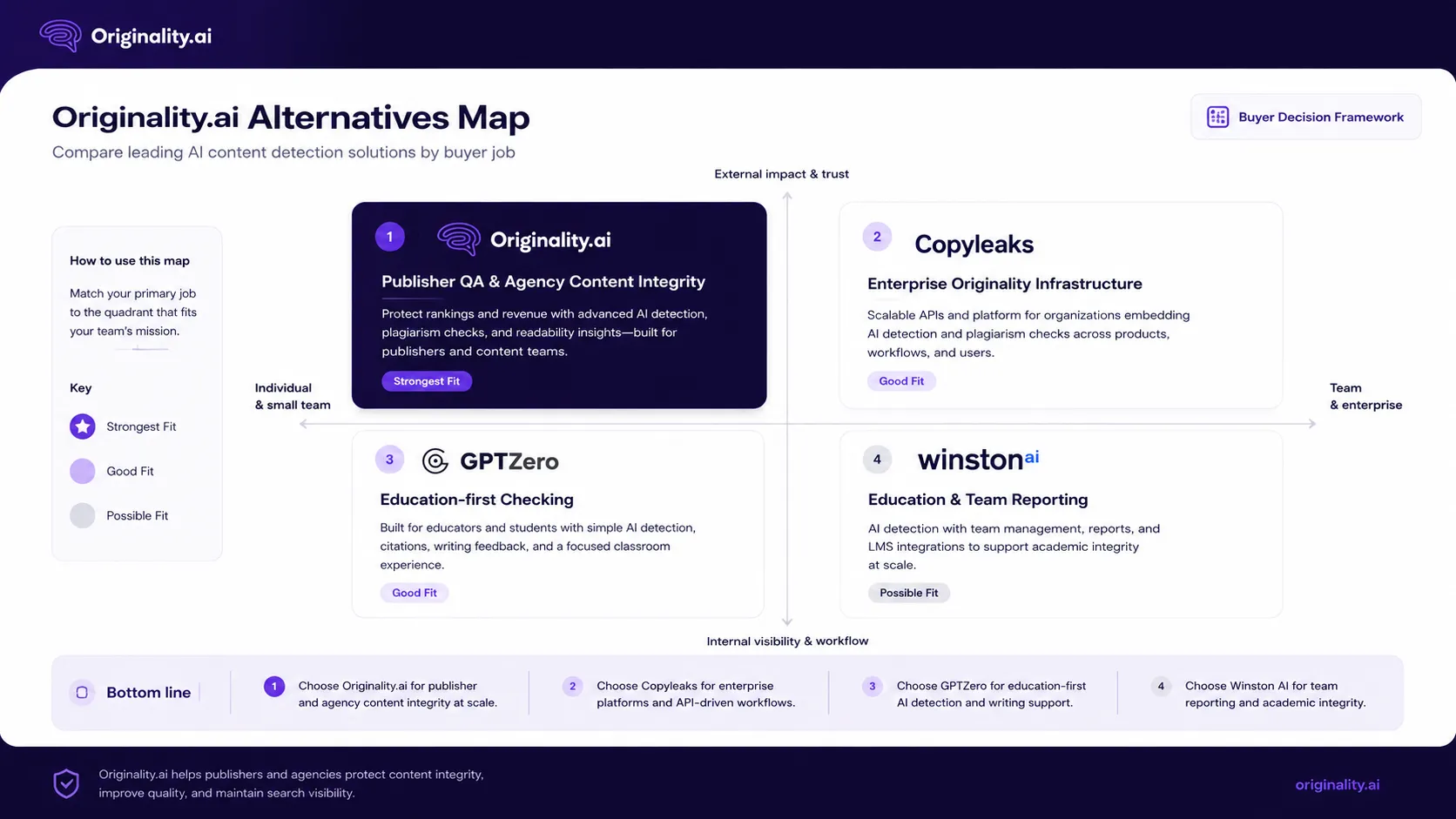
For publishers and SEO agencies, though, Originality.ai remains one of the more natural comparisons because the product language, scan types, and workflow features are aimed directly at content review before publishing.
Final decision
Originality.ai is worth shortlisting if your real problem is not “Can I check one paragraph for free?” but “Can my team review submitted content more consistently before we publish it?”
Use it as a first-pass integrity layer. Pair it with source review, writer process evidence, plagiarism checks, editorial judgment, and clear team rules. That is where it becomes useful.
Do not use it as a weapon. Do not turn one scan into a final accusation. If you build the workflow carefully, Originality.ai can save editorial time and reduce publishing risk. If you use it lazily, it can create a new kind of risk instead.
Frequently asked questions
Is Originality.ai worth it?
Does Originality.ai have a free plan?
Can Originality.ai prove that a writer used AI?
Who should compare Originality.ai with GPTZero?
Where Originality.ai fits in a stack
Content integrity and editorial QA layer
Does not replace
- – Human editorial judgment
- – Source verification
- – Writer policy
- – Legal or academic due process
Pairs well with
Head-to-head comparisons
Top alternatives to consider
If Originality.ai is not the right fit, these are the most common alternatives.
GPTZero is a better comparison for education-first users and buyers who want a widely recognized AI detector with a more academic-facing angle.
Copyleaks is worth comparing when enterprise integrations, API coverage, and institution-scale workflows matter more than publisher editorial QA.
Winston AI is a relevant alternative for educators and teams that want AI detection reports with a different interface and verification flow.
Review methodology
Editorial review based on current public product pages, pricing documentation, public third-party testing, and AI detection research. No hands-on testing was conducted unless explicitly stated.
This review is based on public product information and current research, not direct hands-on testing.
Not covered: Hands-on benchmark testing · Enterprise contract review · Private support terms