Writesonic Review
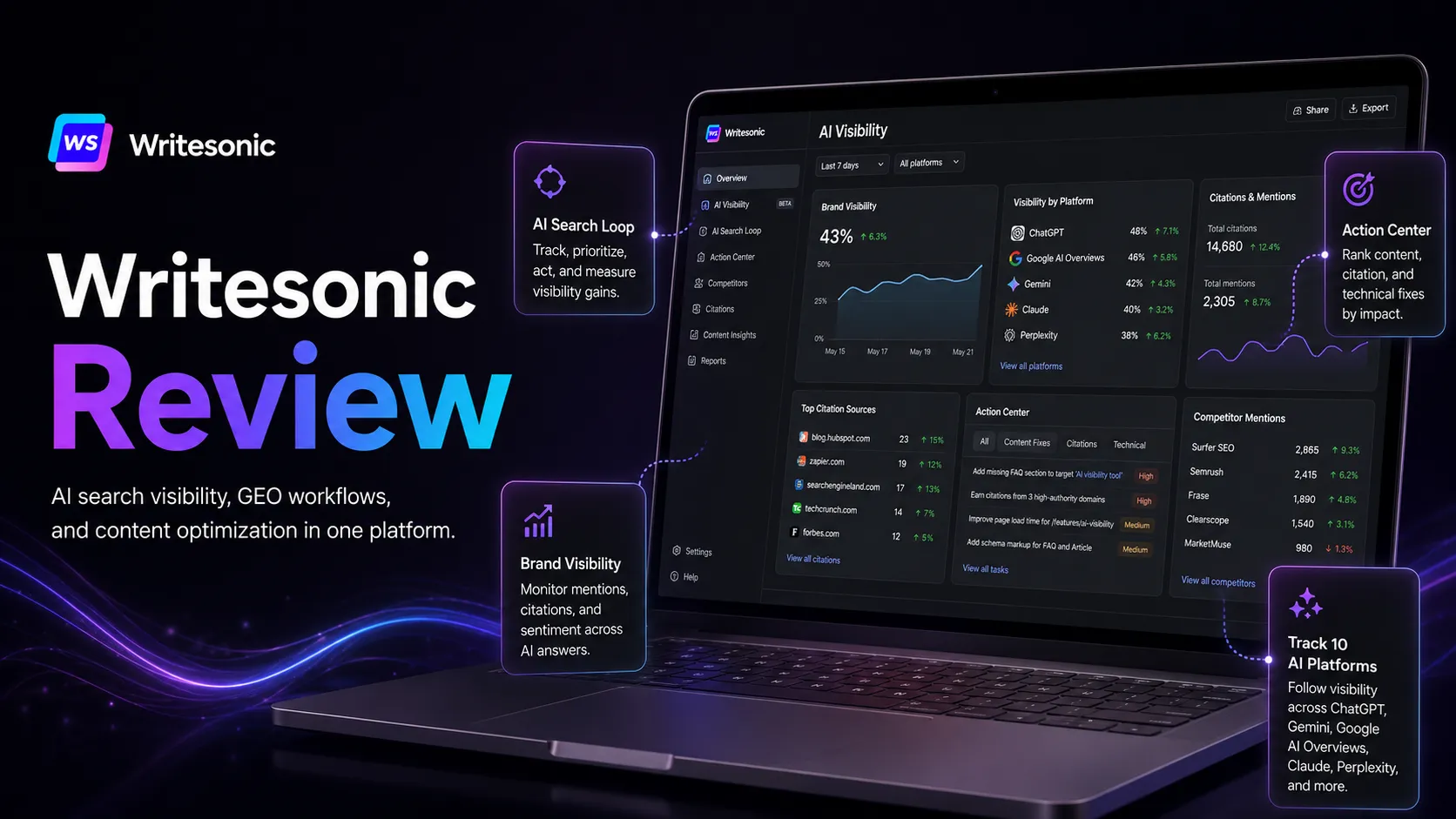
Writesonic now focuses on AI search visibility and GEO. See who should use it, pricing context, weak spots, and alternatives.
Strong fit for AI search visibility teams, but no longer the obvious pick for simple low-cost writing.
Use it if…
- ✓ You want to track how your brand appears in AI answers and turn the gaps into content, citation, and technical work.
- ✓ You manage SEO or content for a brand where AI search visibility is now part of the growth conversation.
- ✓ You want a workflow that connects measurement, prioritization, and content execution in one platform.
Skip it if…
- – You only need a low-cost AI writer for captions, emails, or basic blog drafts.
- – You do not have a content or SEO workflow that can act on the recommendations.
- – You need classic keyword research depth more than AI answer tracking.
Review scorecard
Scored by workflow fit, ease of use, value, and stack compatibility. Weights reflect importance for typical buyers.
| Criteria | Score | ||
|---|---|---|---|
| Workflow fit | 8.5 | ||
| Output quality | 8.0 | ||
| Ease of use | 7.5 | ||
| Pricing clarity | 7.0 | ||
| Stack value | 8.0 | ||
| Weighted overall | 7.8 / 10 | ||
On this page
Quick verdict
Writesonic is no longer just the simple AI writer many people remember. The current public positioning is much more specific: it is an AI search growth platform for teams that want to see where their brand appears in AI answers, decide which gaps matter, and turn those gaps into content, citation, and technical work.
That makes the review more interesting, but also less simple. If you want low-cost blog drafts, email copy, or social captions, Writesonic may feel heavier and more expensive than expected. If your team is now asking, “Are we visible in ChatGPT, Gemini, Google AI Overviews, and other answer engines?”, the product starts to make more sense.
The practical question is not whether Writesonic can write. It can. The better question is whether you need an AI search visibility workflow badly enough to pay for a platform built around tracking, prioritization, action, and measurement.
Who should use Writesonic
Writesonic fits marketing teams that already have an SEO or content operation and now need to add AI search visibility to the same workflow. The buyer is usually not a solo writer looking for a blank document and a “write article” button. The buyer is more likely a brand, agency, or growth team trying to understand why competitors show up in AI answers while their own pages, mentions, or product names do not.
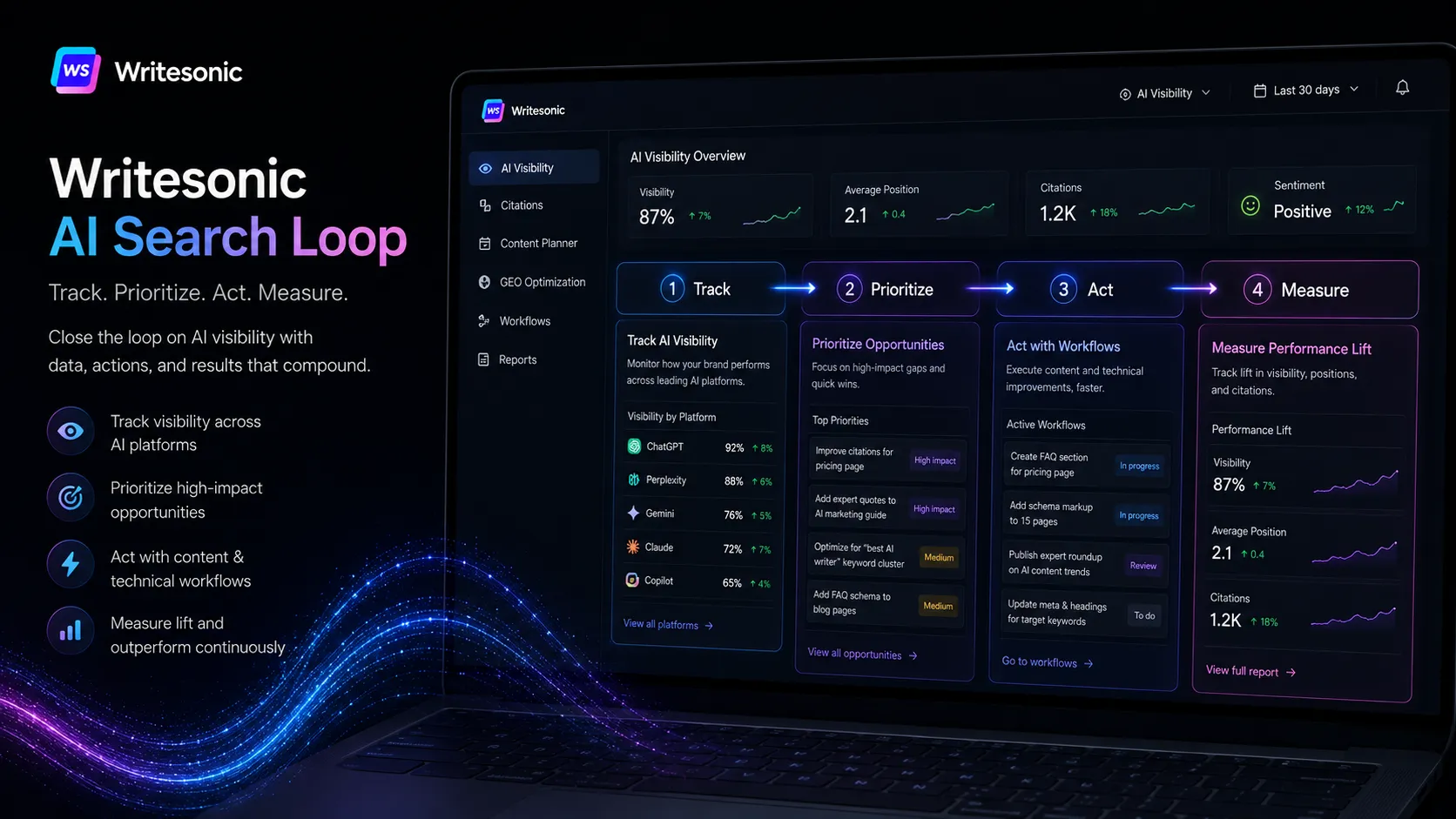
It also makes sense for agencies that need a more concrete GEO conversation with clients. Instead of saying “AI search matters” in a vague way, Writesonic gives the team a structure: track prompts, inspect answers, review citation sources, rank fixes, and produce content or technical updates.
This matters most when the team can act. A dashboard alone does not fix visibility. Writesonic’s current promise is that it helps move from insight to work. That is useful if someone owns content updates, schema fixes, FAQ improvements, outreach, and reporting.
Who should skip Writesonic
Skip Writesonic if your real need is still basic copy generation. If you mostly want a tool for social posts, product descriptions, ad variants, or simple first drafts, this may be more platform than you need. Copy.ai, Jasper, Rytr, ChatGPT, or Claude may be easier to justify depending on your workflow.
Small bloggers should also be cautious. AI search visibility sounds attractive, but the value depends on having enough brand demand, content volume, and publishing discipline. If your site has a small footprint and no repeat SEO process, the first move is usually better content planning, cleaner internal links, and stronger topical coverage before paying for AI visibility software.
I would also skip it if your team is not prepared to check recommendations manually. GEO work can drift into weak outreach, thin content refreshes, or over-optimized answer blocks if nobody applies editorial judgment.
Real workflow fit
Writesonic now fits best after your team has three things in place: a product or brand people search for, an existing SEO/content workflow, and a willingness to treat AI answers as another discovery surface. Without those pieces, the platform can feel like a smart map for a journey your team is not ready to take.
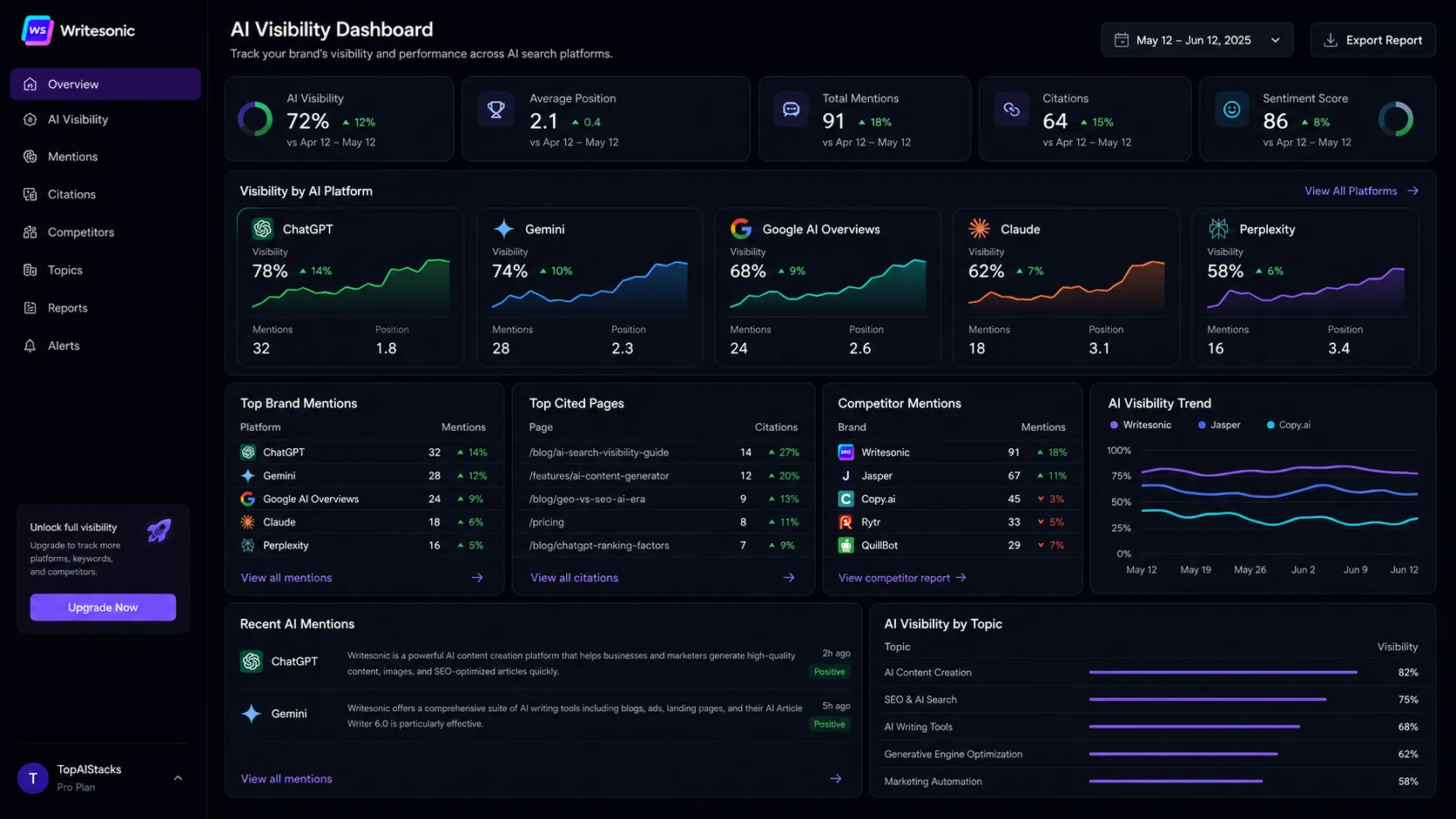
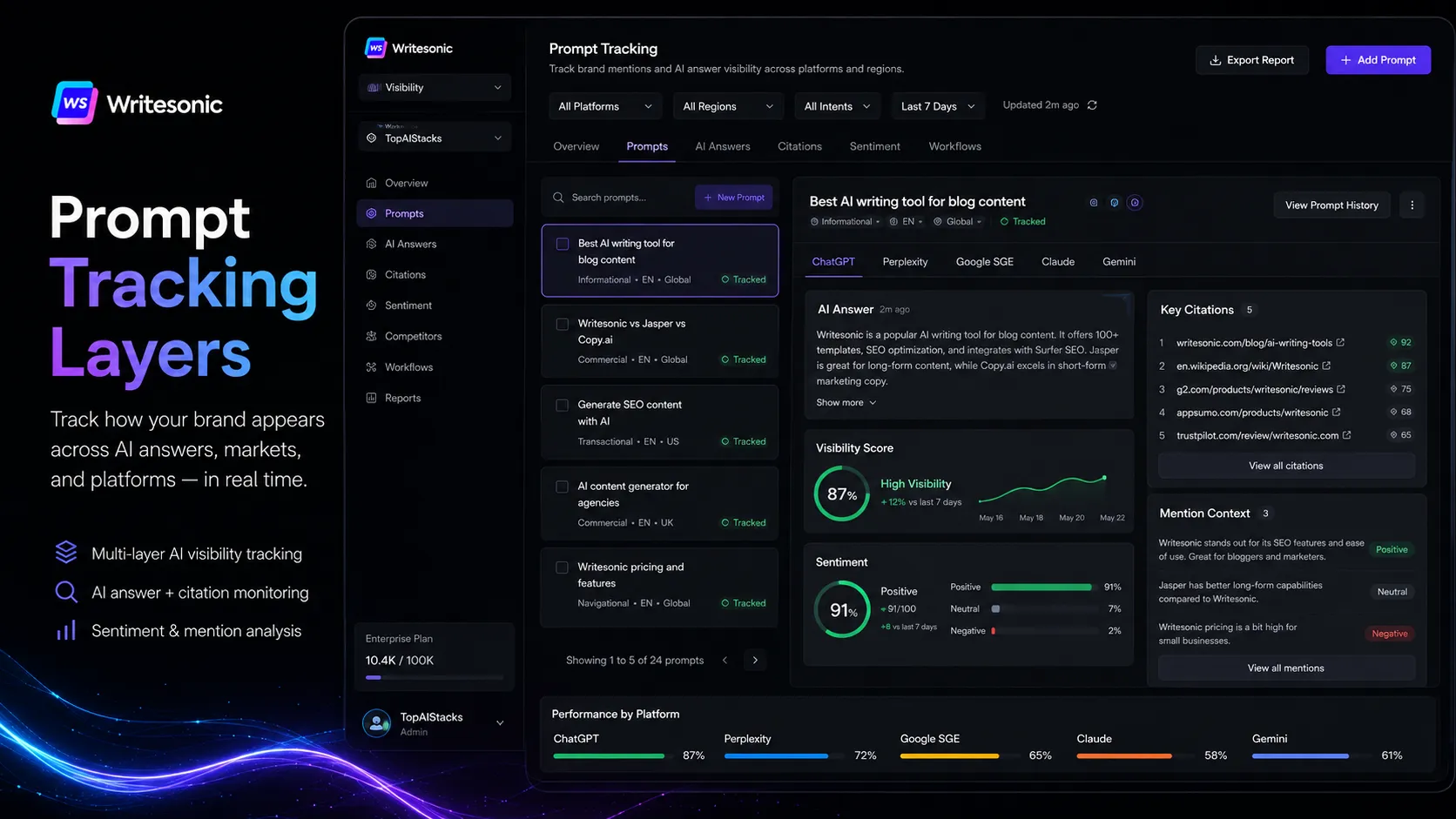
The workflow starts with visibility tracking. You look at prompts, AI answers, competitor mentions, citation patterns, sentiment, and platform coverage. Then the harder part begins. Which missing answer should you fix? Which page deserves a refresh? Which third-party source matters? Which technical issue blocks AI crawlers or weakens citation chances?
This is where Writesonic becomes more than a writing tool. It is trying to sit between search intelligence, content operations, and AI answer optimization.
Where Writesonic fits in an AI stack
In a practical AI stack, I would place Writesonic between SEO intelligence and content execution. Semrush or Ahrefs may still handle broad keyword, competitor, backlink, and site research. Surfer SEO or Frase may still help with content structure and on-page optimization. ChatGPT or Claude may still help with ideation, rewriting, and editorial support.
Writesonic’s cleaner role is narrower: AI search visibility plus action workflow. It helps answer a different question: when AI answer engines talk about your category, do they mention you, cite you, ignore you, or frame you poorly?
That role is becoming more important, but it is not a replacement for the rest of the stack. You still need source material, brand judgment, editorial review, analytics, CMS publishing, and technical SEO checks.
What Writesonic does well
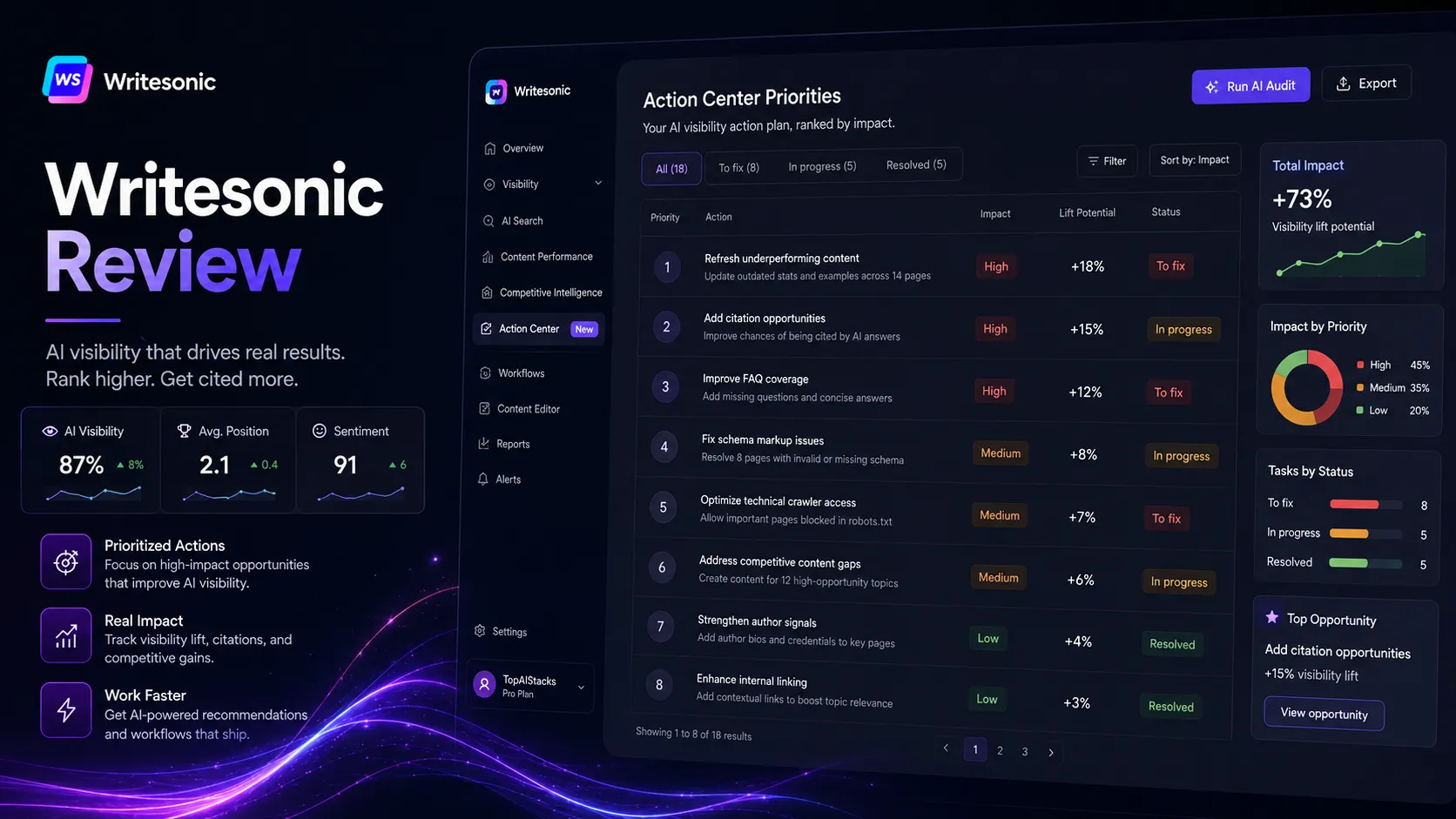
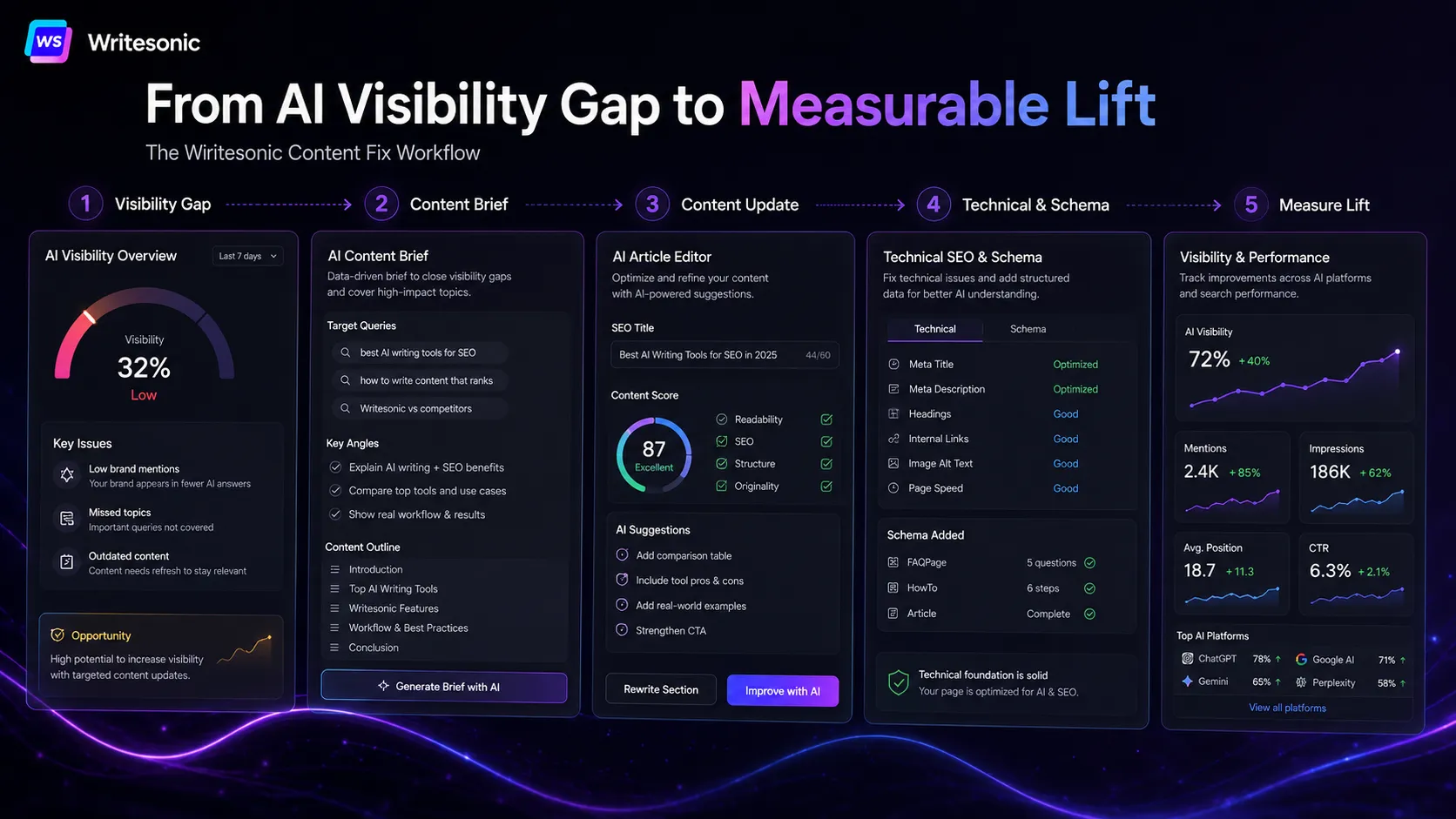
The strongest part of Writesonic’s current direction is that it does not stop at “you are invisible.” The official product messaging is built around a loop: track, prioritize, act, measure, then repeat. That is the right mental model for AI search because visibility is not fixed by one article or one prompt.
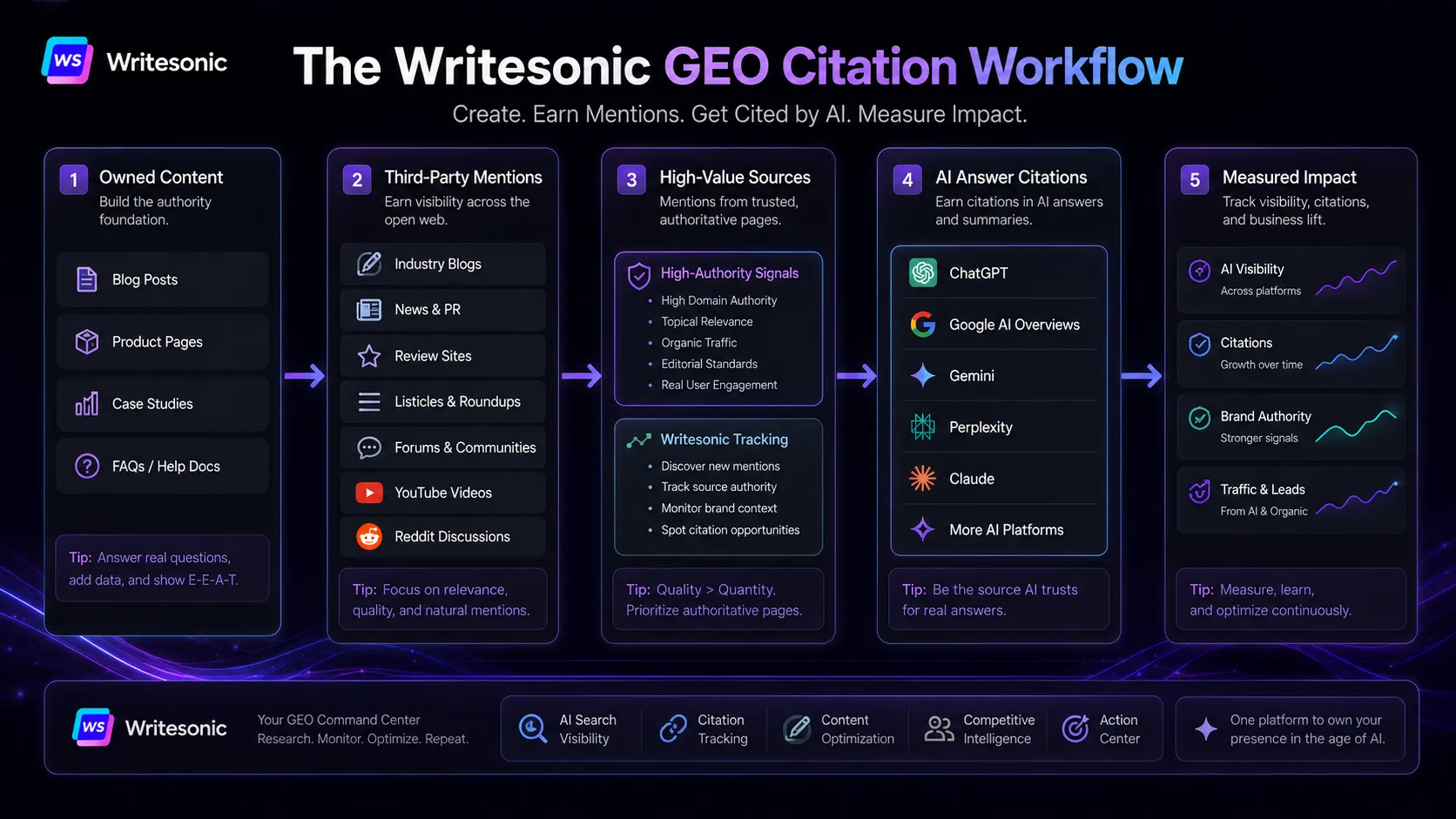
The product also makes a useful distinction between owned and external signals. AI answers often pull from pages you do not control. That means the work may include better on-site content, but also earning mentions, improving comparison coverage, answering recurring questions, and fixing technical blockers that affect how AI systems access or interpret your site.
For teams that already think in campaigns, this is helpful. You can turn a vague AI visibility concern into a weekly action list. That is more valuable than another generic content generator.
The other strength is buyer education. Writesonic makes it easier to explain why AI search is not the same thing as classic rankings. A brand can rank on Google and still be absent from ChatGPT answers. It can be cited in one AI platform and ignored in another. It can appear often but with poor sentiment or weak context. Those differences matter when leadership starts asking where pipeline is coming from.
Where Writesonic falls short
The first tradeoff is pricing fit. Writesonic may be harder to justify for users who arrived expecting an affordable AI writer. The public plans now look much more like a growth platform for brands and agencies than a casual writing subscription.
The second tradeoff is complexity. AI search visibility is still a moving target. Prompt sets, answer engines, citation behavior, crawler access, and source preferences can change. A platform can help you track patterns, but it cannot guarantee stable visibility across every AI interface.
The third risk is execution quality. Content fixes and citation work need care. If a team treats GEO as a shortcut to pump out thin pages or chase low-quality mentions, the stack gets noisier rather than stronger. Writesonic can point to opportunities, but the quality bar still belongs to the human team.
Pricing judgment
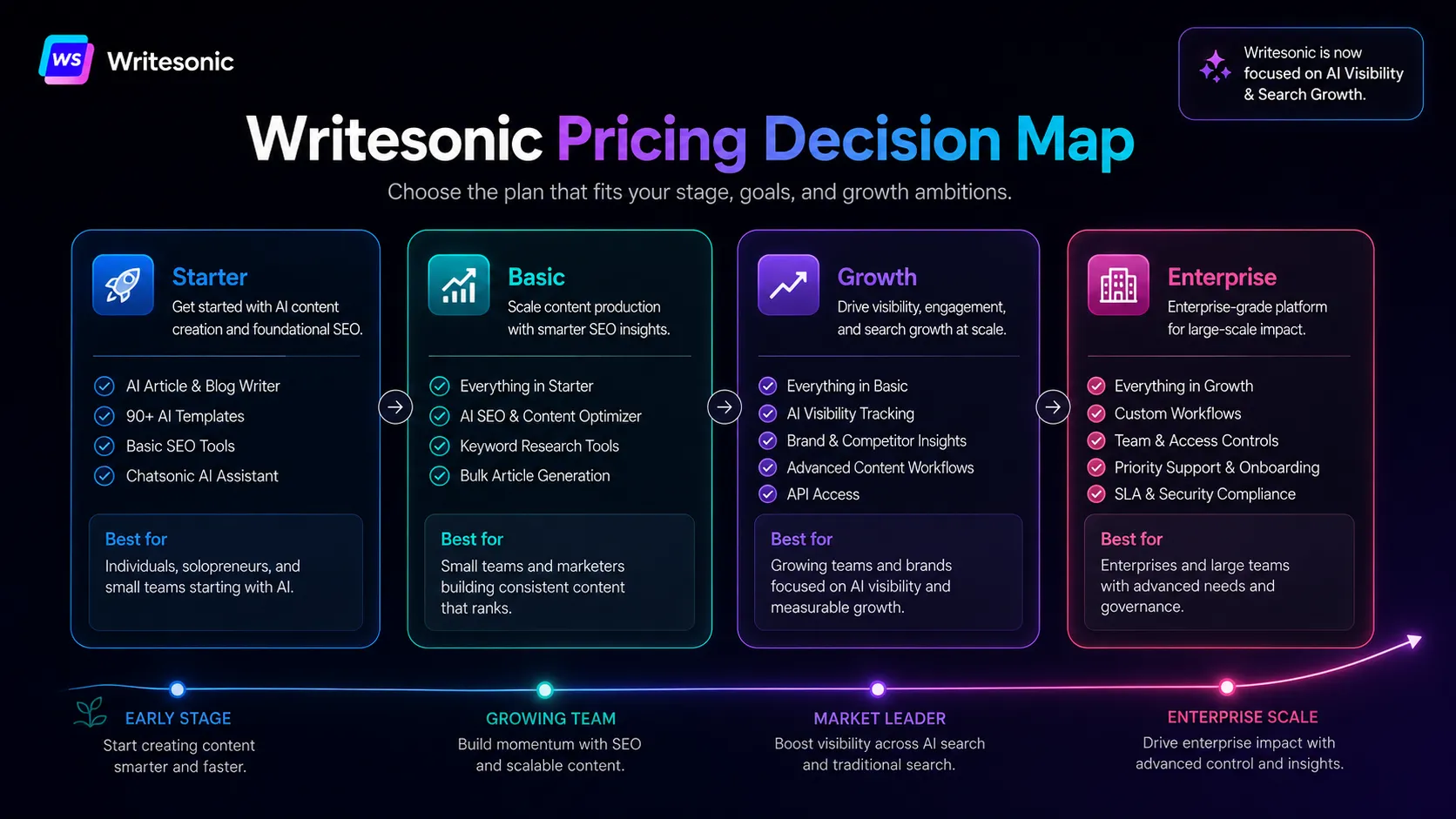
At the time of this review, the official pricing page showed annual billed plans for brands starting with Starter at $79 per month, Basic at $199 per month, Growth at $399 per month, and Enterprise as custom pricing. The page also promoted starting free with no credit card and trial CTAs.
The more important point is what you are paying for. Starter focuses on tracking ChatGPT and includes a smaller set of prompts, answers, articles, audits, and limited agentic workflow access. Basic expands platform tracking to ChatGPT, Gemini, and Google AI Overviews. Growth adds more volume and includes sentiment analysis with a trial level of Action Center work. Enterprise is where the broadest platform coverage and deeper strategy features appear.
So I would not judge Writesonic like a $19 writing tool. I would judge it like an AI visibility operations platform. If AI search visibility affects pipeline, agency retainers, or brand discovery, the price can make sense. If you only need draft content, it probably does not.
Best alternatives to compare
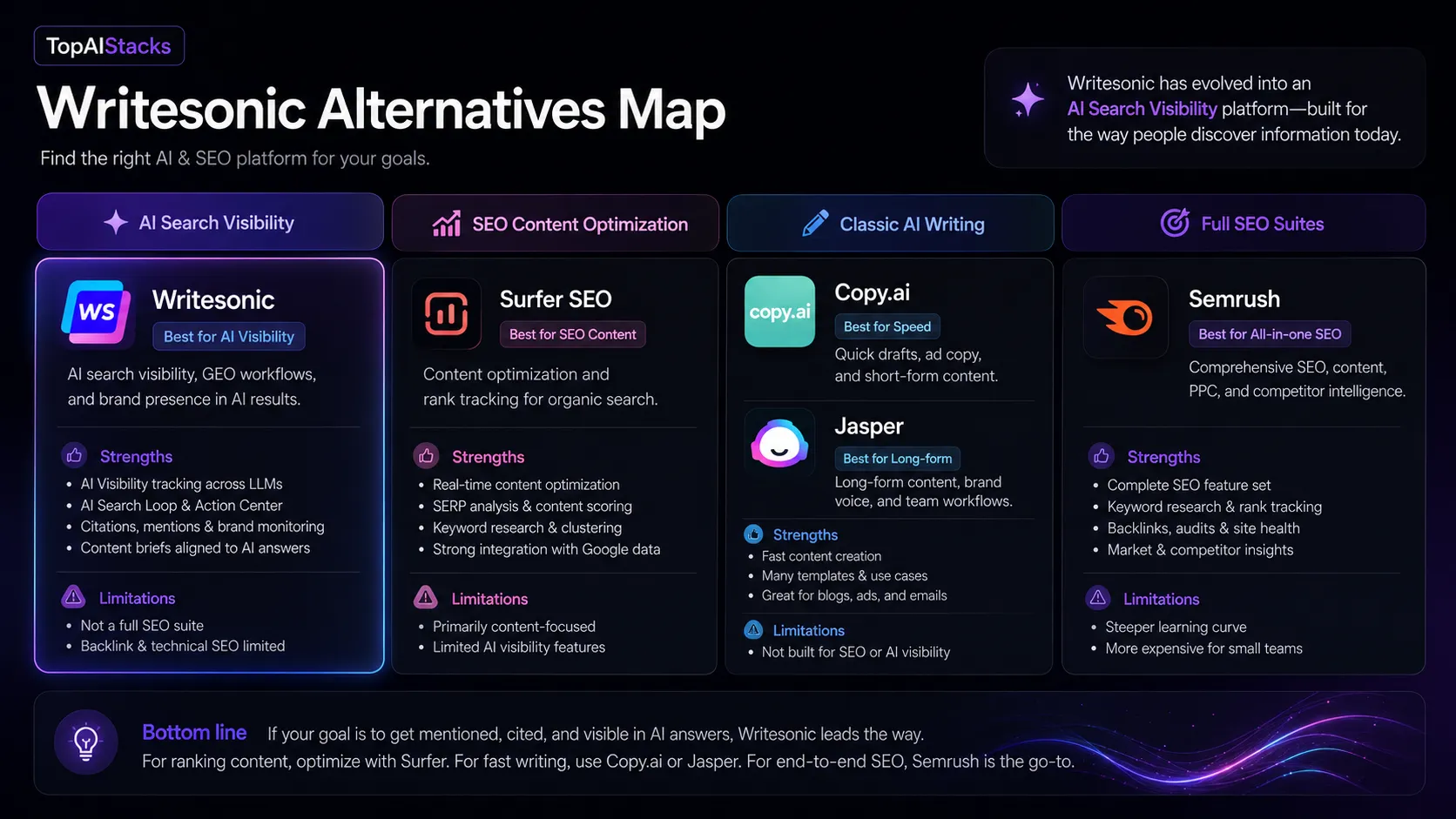
Compare Writesonic with Surfer SEO if your main job is content optimization. Surfer is usually the cleaner choice when you want an editor, content score, topic coverage, and SEO writing workflow around specific pages.
Compare it with Semrush if you want a broader SEO and competitive intelligence stack. Semrush is stronger for traditional search research, competitive analysis, site audit breadth, and larger SEO operations. Writesonic is more specialized around AI answer visibility and GEO action workflows.
Compare it with Frase if your team wants briefs, SERP questions, and content structure without stepping fully into AI visibility operations. Frase is simpler for many content teams.
Compare it with Copy.ai or Jasper only if your real job is still marketing copy production. That comparison used to make more sense for Writesonic. In its current form, it is a less accurate match.
Final decision
Add it to your stack if you are serious about tracking and improving brand visibility inside AI answers, and you have a team ready to act on content, citation, and technical recommendations.
Compare it first if your budget could also go toward Semrush, Surfer SEO, Frase, or a broader SEO workflow. The right choice depends on whether your pain is classic SEO, content optimization, or AI answer visibility.
Skip it for now if you only need basic AI writing. Writesonic can still help with content, but its current best fit is not the old “cheap AI writer” job. Its better role is helping a brand understand where AI search ignores it, then giving the team a workflow to fix the most important gaps.
Frequently asked questions
Is Writesonic still an AI writing tool?
Who should use Writesonic?
Does Writesonic have a free plan?
How much does Writesonic cost?
Is Writesonic better than Surfer SEO?
Should small bloggers use Writesonic?
Where Writesonic fits in a stack
AI search visibility and content execution layer
Does not replace
- – Human SEO strategy
- – Editorial judgment
- – Technical SEO review
- – Brand positioning
- – Manual relationship building for high-quality citations
Pairs well with
Top alternatives to consider
If Writesonic is not the right fit, these are the most common alternatives.

Semrush is better if the buyer wants a broader SEO and competitive intelligence suite with AI visibility as part of a larger search stack.
Surfer SEO is a stronger comparison for content teams that mostly care about content optimization, topic coverage, and SEO writing workflows.
Frase is a simpler comparison for teams focused on briefs, SERP questions, and content structure rather than full AI visibility operations.
Review methodology
Editorial review based on current official product pages, official pricing pages, public product positioning, and market context. No hands-on testing was conducted unless explicitly stated.
This review is based on public product information and current research, not direct hands-on testing.
Not covered: Hands-on benchmark testing · Enterprise contract negotiation · Private customer performance data · Unverified coupon or discount claims