
beehiiv Review
A practical beehiiv review for creators comparing newsletter growth, monetization, AI features, pricing fit, and alternatives.
Strong for creator-led newsletter growth and monetization, but not the best fit for deep marketing automation or budget-only email sending.
Use it if…
- ✓ You want one place to publish a newsletter, host a simple publication website, track growth, and build monetization paths.
- ✓ You care about recommendation growth, ad network access, paid subscriptions, digital products, or creator-style audience building.
- ✓ You are moving from a simpler newsletter tool and want more control over publication branding and revenue options.
- ✓ You want AI writing support inside the newsletter workflow rather than a totally separate generic writing app.
Skip it if…
- – You mainly need e-commerce email automation, transactional email, or deep CRM campaign logic.
- – You are still testing a small hobby list and the paid-plan jump would feel premature.
- – You want a general AI assistant more than a newsletter operating platform.
- – You need a full marketing suite for multi-channel lifecycle campaigns rather than a newsletter-first publishing system.
Review scorecard
Scored by workflow fit, ease of use, value, and stack compatibility. Weights reflect importance for typical buyers.
| Criteria | Score | ||
|---|---|---|---|
| Newsletter workflow fit | 8.8 | ||
| Growth and monetization depth | 8.6 | ||
| Ease of use | 8.2 | ||
| Pricing fit | 7.4 | ||
| AI and stack fit | 7.8 | ||
| Automation depth | 6.9 | ||
| Weighted overall | 8.2 / 10 | ||
On this page
Quick verdict
beehiiv is strongest when your newsletter is becoming a business asset, not just another channel for updates.
That sounds obvious, but it matters. A lot of email tools can send a newsletter. beehiiv is trying to solve a bigger problem: how a creator, publisher, or small media team captures an audience, publishes consistently, grows that audience, and turns it into revenue without stitching together five separate tools.
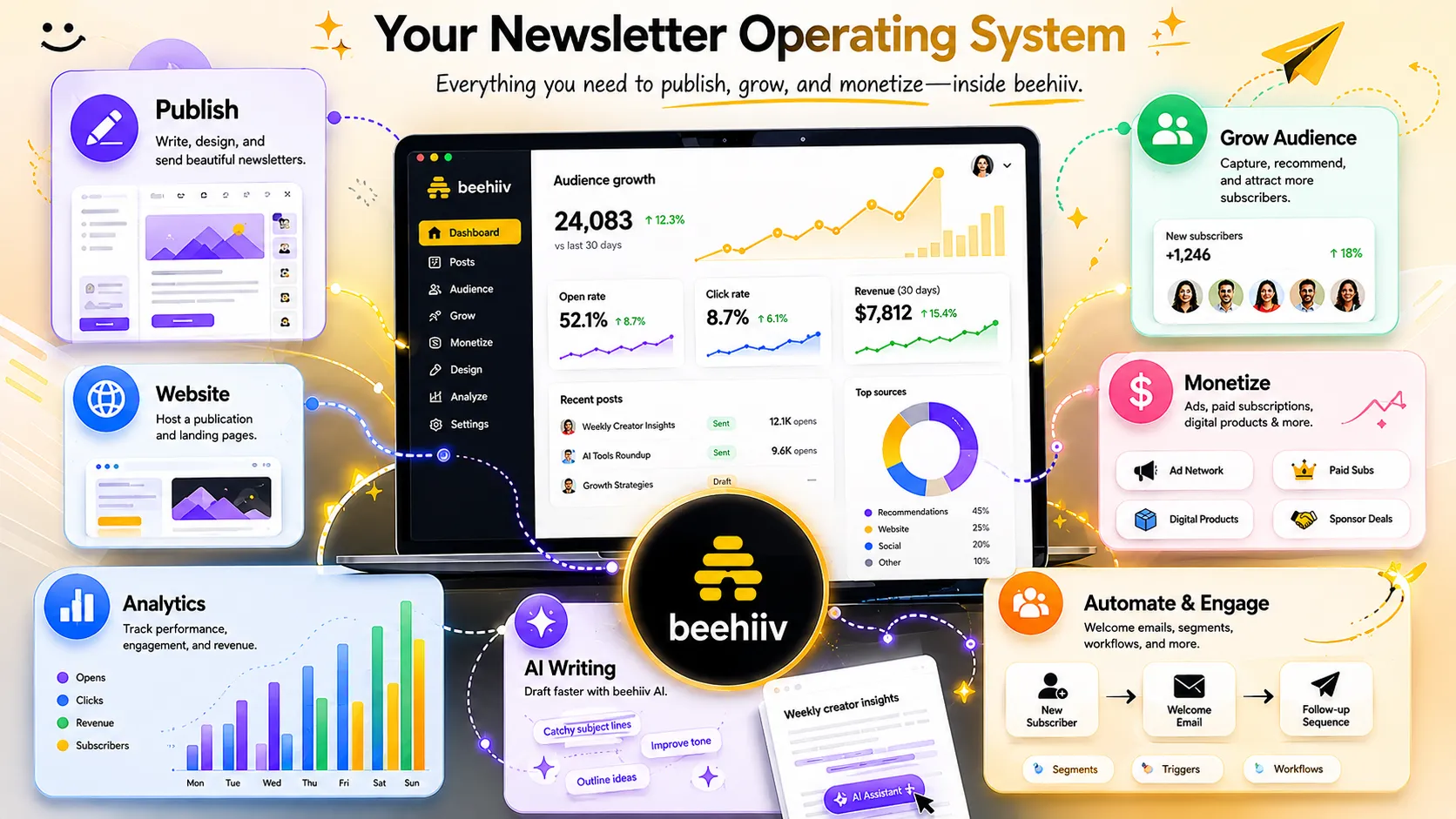
For the right buyer, that makes beehiiv feel focused and modern. You get newsletter publishing, a simple website layer, analytics, recommendations, paid subscriptions, digital products, ads, and AI-assisted writing features in one place. For the wrong buyer, it can feel like paying for a media-business toolkit before you actually have a media business.
So the practical verdict is simple: use beehiiv if the newsletter itself is the product, growth channel, or monetization engine. Skip it if you only need a cheap sender, deep e-commerce automation, or a general CRM marketing suite.
What this means in practice
beehiiv is not really competing with every email tool on the same terms. It overlaps with Mailchimp, Kit, Substack, Ghost, and ConvertKit-style creator tools, but the center of gravity is different.
Mailchimp-style tools usually start from business email marketing. Substack starts from simple hosted publishing. Kit leans toward creator automation and funnels. beehiiv starts from the newsletter as a growth product.
That is why the platform makes more sense when you ask different questions:
- Can I publish a newsletter and host the archive in one place?
- Can I grow through recommendations or referrals?
- Can I monetize through paid subscriptions, ads, or digital products?
- Can I see what is working without building a custom analytics stack?
- Can I write, edit, and package issues faster with AI help inside the same workflow?
If those questions match your actual day-to-day work, beehiiv becomes interesting. If your real problem is abandoned-cart recovery, transactional email, lead scoring, or long CRM nurture flows, it is probably not the cleanest fit.
Who should use beehiiv
beehiiv is best for creators and publishers who are serious about audience ownership.
That includes solo newsletter operators, niche media builders, content-led founders, affiliate publishers, analysts, creator-educators, and small editorial teams. These buyers do not just want a list. They want a publication system.
The platform is especially attractive if you are trying to move away from platform dependence. Social traffic is unreliable. Search traffic can be volatile. Paid acquisition is expensive. A newsletter gives you a direct audience relationship, and beehiiv adds tools around that relationship: landing pages, archives, analytics, referrals, recommendations, and monetization paths.
The strongest use case is a creator who has a clear topic, a repeatable publishing cadence, and a plan to monetize later. You do not need to be big on day one, but you should at least be building toward something more intentional than “send an update whenever I remember.”
Who should skip beehiiv
beehiiv is not the best first choice for every email workflow.
E-commerce teams should be careful. If your revenue depends on product triggers, abandoned carts, post-purchase flows, SMS, discount logic, inventory-based segments, or deep Shopify lifecycle automation, tools built for commerce may fit better.
Traditional B2B marketing teams should also check their needs carefully. beehiiv can support audience growth and publishing, but it is not meant to replace a full CRM, sales pipeline, lead scoring model, or enterprise marketing automation platform.
Budget-first users should also do the math. The free Launch plan is a real entry point, but the paid tiers are easier to justify when growth or revenue features matter. If your list is still experimental and monetization is far away, staying on a simpler setup may be more practical for now.
Real workflow fit
A realistic beehiiv workflow looks like this: plan the issue, draft the newsletter, polish the voice, publish to email and web, review analytics, and feed the next issue with what you learned.
beehiiv helps most in the middle of that cycle. It gives you the publishing surface and the growth infrastructure. The AI features can reduce blank-page friction, help with drafting and editing, and support newsletter-specific writing tasks. But they do not replace the hard parts: choosing a good angle, having something worth saying, building trust with readers, and developing a repeatable editorial rhythm.
That is the part buyers sometimes underestimate. A newsletter platform can make distribution easier. It cannot manufacture taste, credibility, or audience insight by itself.
The best beehiiv users will likely pair it with tools like Notion for planning, ChatGPT or Claude for ideation and research support, Grammarly for polish, Canva for lightweight visuals, and analytics tools for broader business context.
Pricing and plan fit
As of the latest checked public pricing page, beehiiv lists Launch at $0 per month, Scale from around $43 per month when billed annually, and Max from around $96 per month when billed annually at the lowest visible subscriber tier. The page also presents Enterprise as the custom path for larger organizations.
That pricing should be read with one important caveat: beehiiv pricing is tied to plan type, feature access, billing choice, and subscriber scale. You should always check the live pricing page before checkout, especially if your list is growing quickly.
The free Launch plan is useful for starting. It is the right place to test your topic, publishing cadence, and audience response.
Scale is where beehiiv starts to make the most sense for serious creator businesses because more growth and monetization features become relevant. If you are earning from paid subscriptions, sponsorships, ads, or digital products, the monthly cost becomes easier to evaluate against upside.
Max is more of a commitment. It may fit publishers who need more advanced features, support, or operating room, but casual creators should not jump there just because it sounds premium.
The buyer-safe move is to upgrade only when you can name the specific feature or revenue path that justifies the next tier.
What beehiiv does well
beehiiv is good at reducing stack fragmentation for newsletter-first creators.
Instead of separately managing a landing page builder, blog archive, email sender, referral system, sponsorship workflow, and analytics layer, you can keep much of that inside one platform. That does not make it perfect, but it does make the operating model simpler.
The monetization story is also stronger than a generic email sender. Paid subscriptions, digital products, recommendations, and ad-related features make sense for publishers who want multiple revenue paths. For many creators, that is more relevant than having the most complex automation builder.
The AI direction is also worth watching. beehiiv has positioned AI around newsletter operators rather than generic content generation. That is the right framing. A newsletter creator does not just need text. They need help turning audience data, topic ideas, tone, structure, and publishing cadence into better issues.
Where beehiiv feels weaker
The main weakness is that beehiiv can look expensive before the newsletter is mature.
A creator with a small list and no revenue may look at the paid tiers and feel the jump. That is fair. The platform becomes more valuable when recommendations, paid subscriptions, ads, advanced analytics, or team workflow matter. Before that, simpler tools may be enough.
The second weakness is automation depth. beehiiv has automation features, but buyers should not confuse it with a full customer lifecycle platform. If your email strategy depends on detailed behavioral segments, e-commerce events, customer scoring, and multi-channel campaigns, you need to compare it carefully against tools built for that world.
The third weakness is that newsletter growth is not automatic. Referral tools, recommendations, and ad networks can help, but they do not replace positioning, consistency, and reader trust. A weak newsletter on a better platform is still a weak newsletter.
Alternatives worth considering
Substack is the cleanest alternative for writers who want the simplest possible path to publish and charge readers. It is easier conceptually, but less attractive if you want more control over brand, growth mechanics, and monetization options.
Kit, formerly ConvertKit, is worth considering if your creator business depends more on automations, lead magnets, product funnels, and creator commerce than on a newsletter-as-media model.
Mailchimp still makes sense for small businesses that need broader marketing email workflows rather than a creator newsletter stack. It may be the more familiar choice for business campaigns, but it is not as focused on newsletter growth and creator monetization.
Ghost is another option if you want a publication-style website and membership model with more control over the publishing layer. The tradeoff is that it can feel more site-centric and may require a different operating setup.
The clean way to choose is not “which tool is best?” It is “what kind of audience business am I building?”
Final verdict
beehiiv is worth it if your newsletter is central to your business, audience, or content strategy.
It is not the cheapest email tool, and it is not the deepest marketing automation suite. But that is not really the point. beehiiv is trying to give creators and publishers a focused operating system for growing and monetizing a newsletter.
For early creators, the free plan is the safest place to start. For serious newsletter operators, Scale is where the platform becomes more meaningful. For larger publishers, Max or Enterprise may make sense only after the growth and monetization use case is already proven.
My practical recommendation: do not buy beehiiv just because you want to “start a newsletter.” Use it when you are ready to treat the newsletter like an asset that deserves its own growth, publishing, and revenue system.
Frequently asked questions
Is beehiiv worth it in 2026?
Does beehiiv have a free plan?
How much does beehiiv cost?
Who is beehiiv best for?
Is beehiiv better than Substack?
Can beehiiv replace Mailchimp?
Where beehiiv fits in a stack
Newsletter operating layer for audience capture, publishing, growth analytics, referrals, monetization, and creator-led distribution.
Does not replace
- – A full CRM or customer lifecycle marketing platform.
- – A dedicated e-commerce automation suite.
- – A full editorial planning system.
- – Human editorial strategy, fact-checking, voice development, and audience positioning.
Top alternatives to consider
If beehiiv is not the right fit, these are the most common alternatives.
Substack may be easier for writers who want the simplest publish-and-charge workflow and do not need as much brand control or native growth tooling.
ConvertKit, now commonly branded as Kit, may be better for creators who want broader creator-commerce email automation rather than a newsletter-first media platform.
Mailchimp may fit small businesses that need broader marketing email templates, campaign tools, and business-style email workflows rather than a creator newsletter stack.
Review methodology
Editorial review based on beehiiv's official homepage, pricing page, AI feature page, monetization pages, support resources, and current third-party coverage. No hands-on benchmark testing was conducted.
This review is based on public product information and current research, not direct hands-on testing.
Not covered: Hands-on deliverability testing · Enterprise contract terms · Private migration support terms · Long-term subscriber growth benchmarks