
ElevenLabs Review
A practical ElevenLabs review for creators and teams: voice quality, pricing fit, workflow limits, and alternatives.
ElevenLabs is one of the strongest AI voice layers for serious creator, localization, and developer audio workflows.
Use it if…
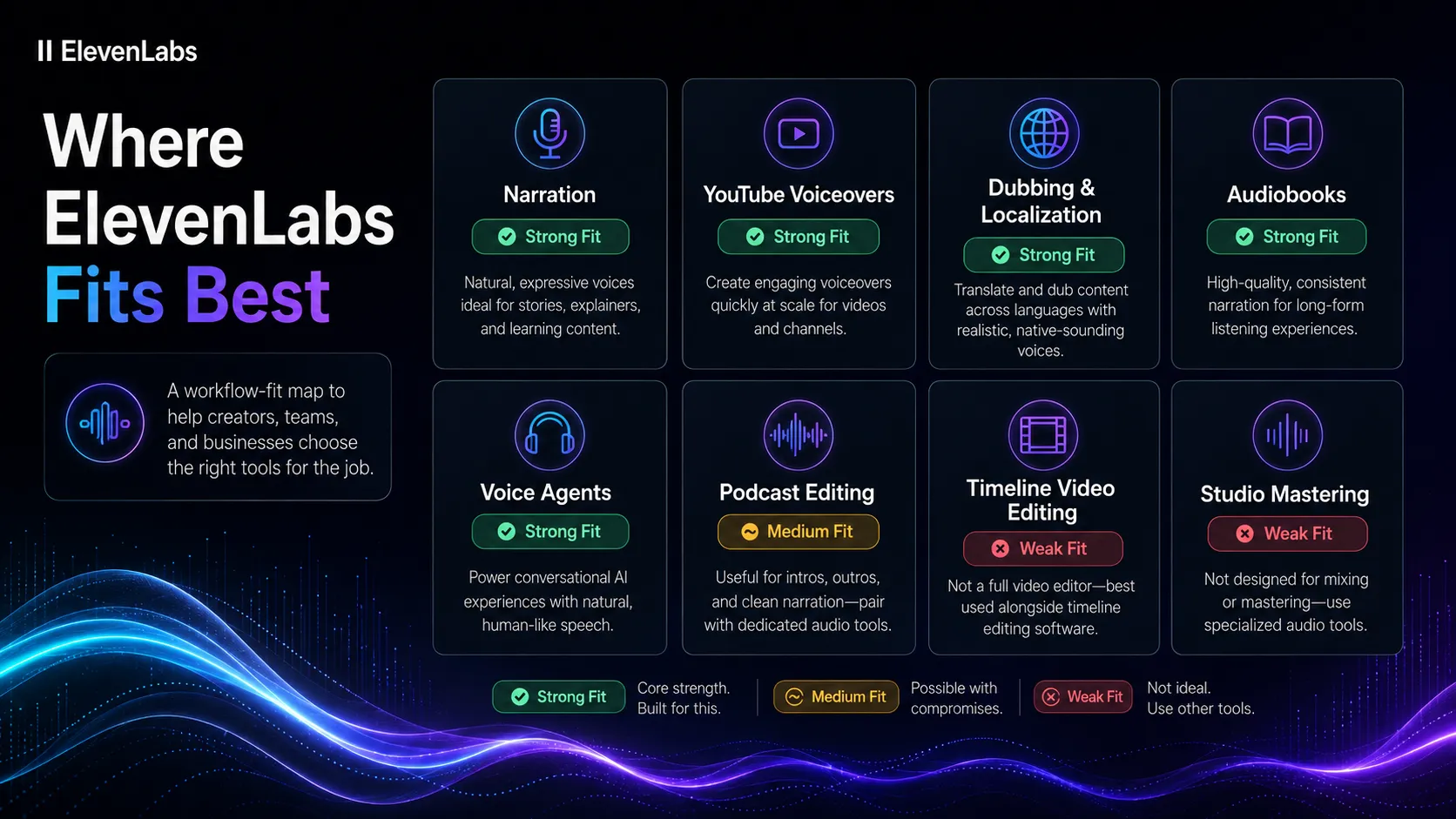
- ✓ Voiceover, dubbing, narration, or voice agents are recurring parts of your workflow.
- ✓ You need more realistic speech output than basic text-to-speech tools provide.
- ✓ You can review pronunciation, pacing, translations, consent, and usage rights before publishing.
- ✓ You want an API-ready audio layer for product, support, learning, or content workflows.
Skip it if…
- – You only need occasional draft audio and can stay on a free or simpler tool.
- – Your main problem is editing recorded video or podcasts, not generating voice.
- – You cannot manage cloned voice permission, disclosure, client approvals, or final audio review.
- – You need human performance direction and studio supervision as the core value.
Review scorecard
Scored by workflow fit, ease of use, value, and stack compatibility. Weights reflect importance for typical buyers.
| Criteria | Score | ||
|---|---|---|---|
| Voice quality and realism | 9.3 | ||
| Workflow coverage | 9.1 | ||
| Commercial readiness | 8.5 | ||
| Pricing clarity | 8.0 | ||
| Stack compatibility | 9.0 | ||
| Buyer risk control | 8.1 | ||
| Weighted overall | 8.8 / 10 | ||
On this page
Quick verdict
ElevenLabs is the AI voice tool I would add when voice is a real production layer, not a once-in-a-while experiment.
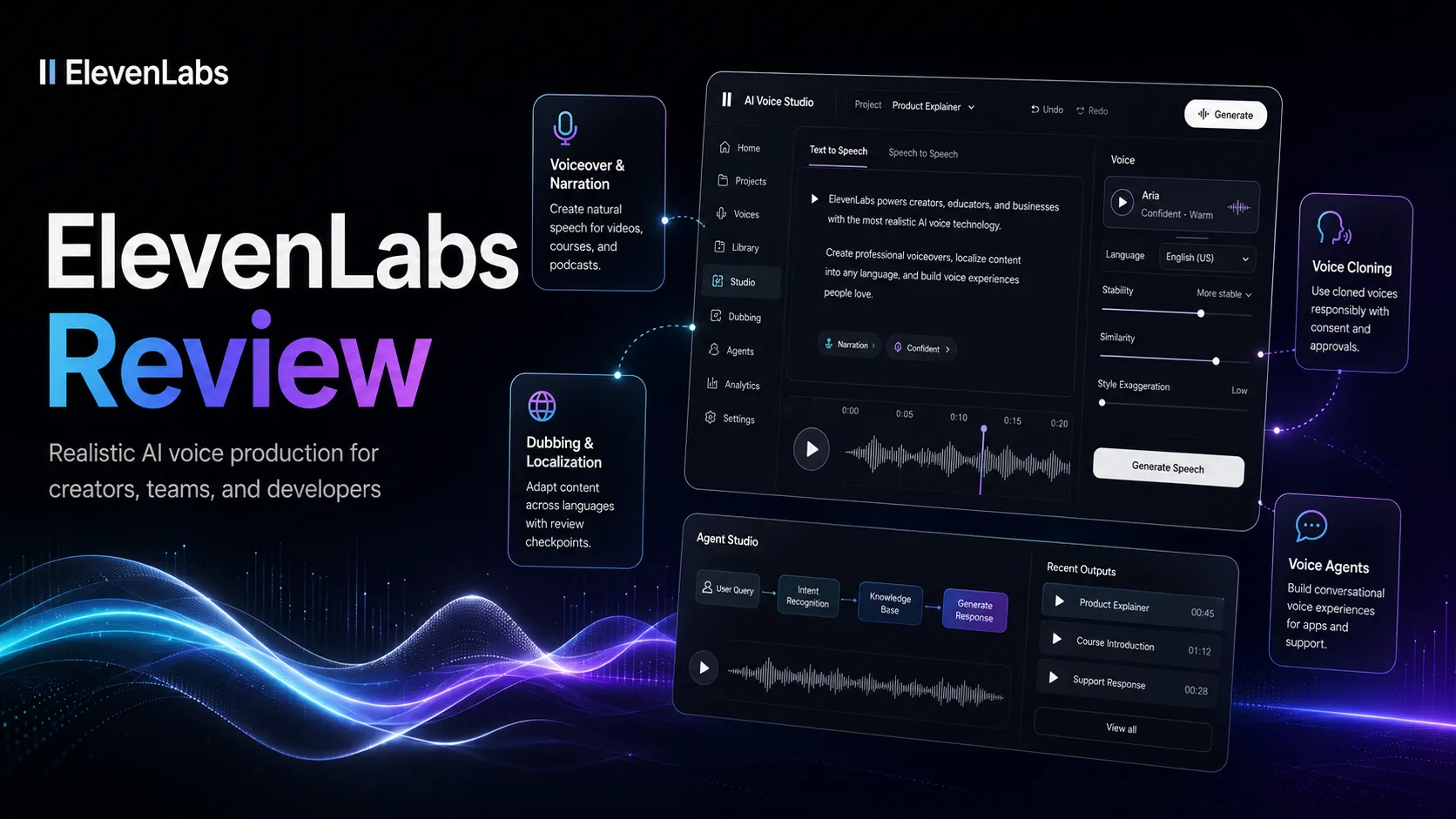
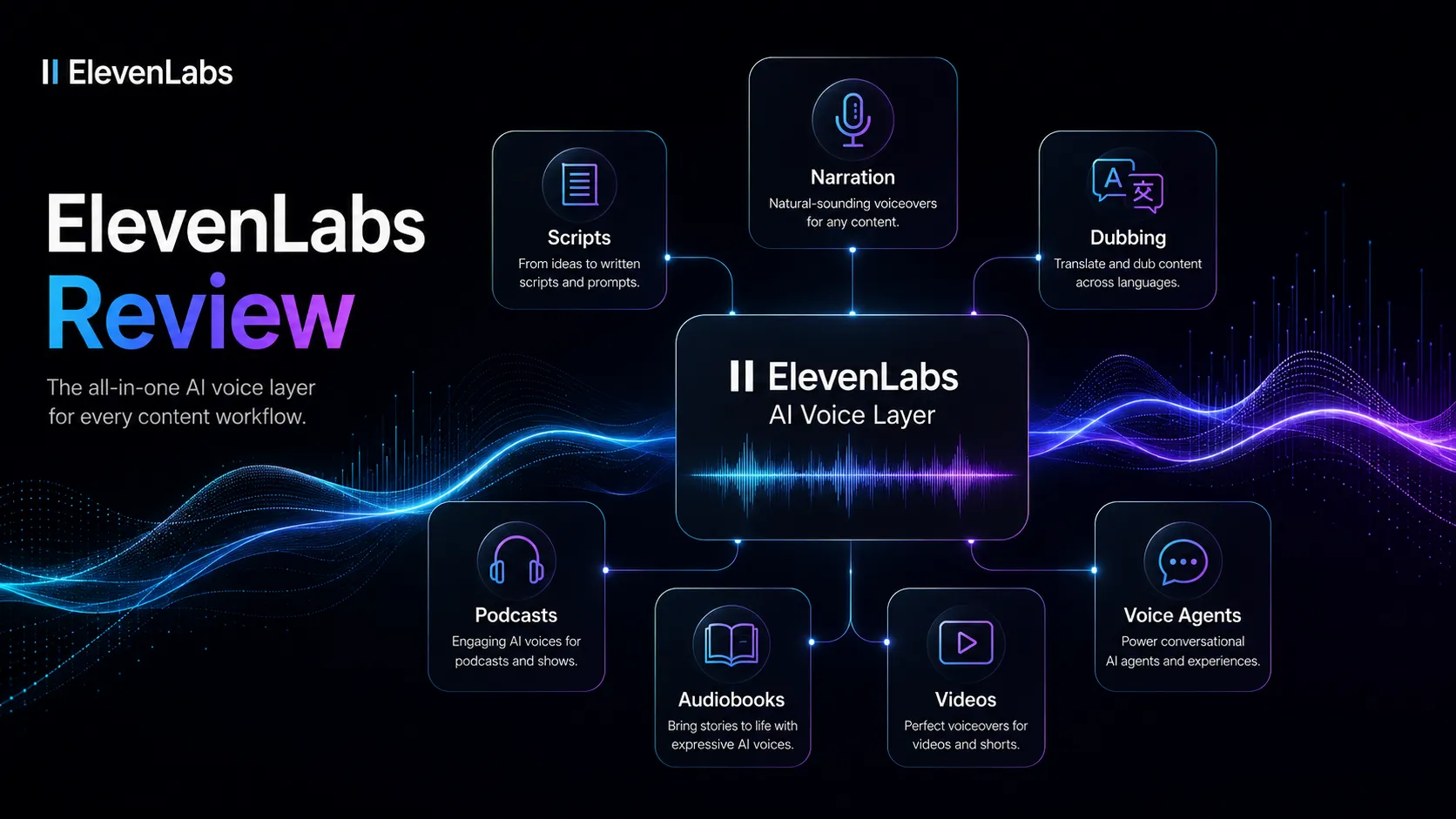
If you publish YouTube narration, course audio, podcast snippets, audiobook-style content, localized videos, or voice-agent experiences on a recurring schedule, ElevenLabs deserves a serious look. The voice quality is the obvious draw, but the broader value is the workflow coverage: text-to-speech, dubbing, voice cloning, speech-to-text, sound effects, music, Studio-style production, API access, and agents.
The caution is just as real. Better voice quality does not remove the need for consent, review, rights checks, pronunciation control, translation review, and credit planning. A polished AI voice can still be the wrong voice for a brand, a client, or a sensitive use case.
My score is 8.8 out of 10. Add ElevenLabs if voice output is repeated and valuable. Compare it first if you mainly need editing, occasional voice clips, or a simpler business voiceover tool. Skip it if you cannot manage cloned voice permission, commercial-use rights, or final human QA.
This review is based on official product pages, pricing, documentation, safety information, public market context, and editorial workflow analysis. No private paid account benchmark or cloned voice test was performed. Verify pricing, credits, licensing, and policies before buying.
Who should use ElevenLabs
You are a good fit for ElevenLabs if your workflow already turns written scripts into spoken output.
That might be a faceless YouTube channel. It might be a course library. It might be a newsletter that wants an audio version. It might be a SaaS app that needs a voice agent. It might be a video team that localizes demos into several languages.
The common pattern is simple: you do not just need an AI voice once. You need a repeatable voice layer.
ElevenLabs is strongest for:
- Creators producing regular narration or voiceovers
- Course creators and educators turning lessons into audio
- Publishers experimenting with audio articles or audiobook-style assets
- Marketers creating multilingual video variations
- Product teams adding voice features through API workflows
- Support or operations teams exploring voice agents
- Agencies that can manage client approvals and voice rights
The better your script process is, the more useful ElevenLabs becomes. A messy script still sounds messy when read by a better voice.
Who should skip ElevenLabs
Skip ElevenLabs if your real bottleneck is not voice generation.
If you mainly need to cut interviews, remove filler words, edit a podcast timeline, add captions, or repurpose clips, Descript may be a more direct first step. If you only need one short voiceover every few months, a paid ElevenLabs plan can be more tool than you need.
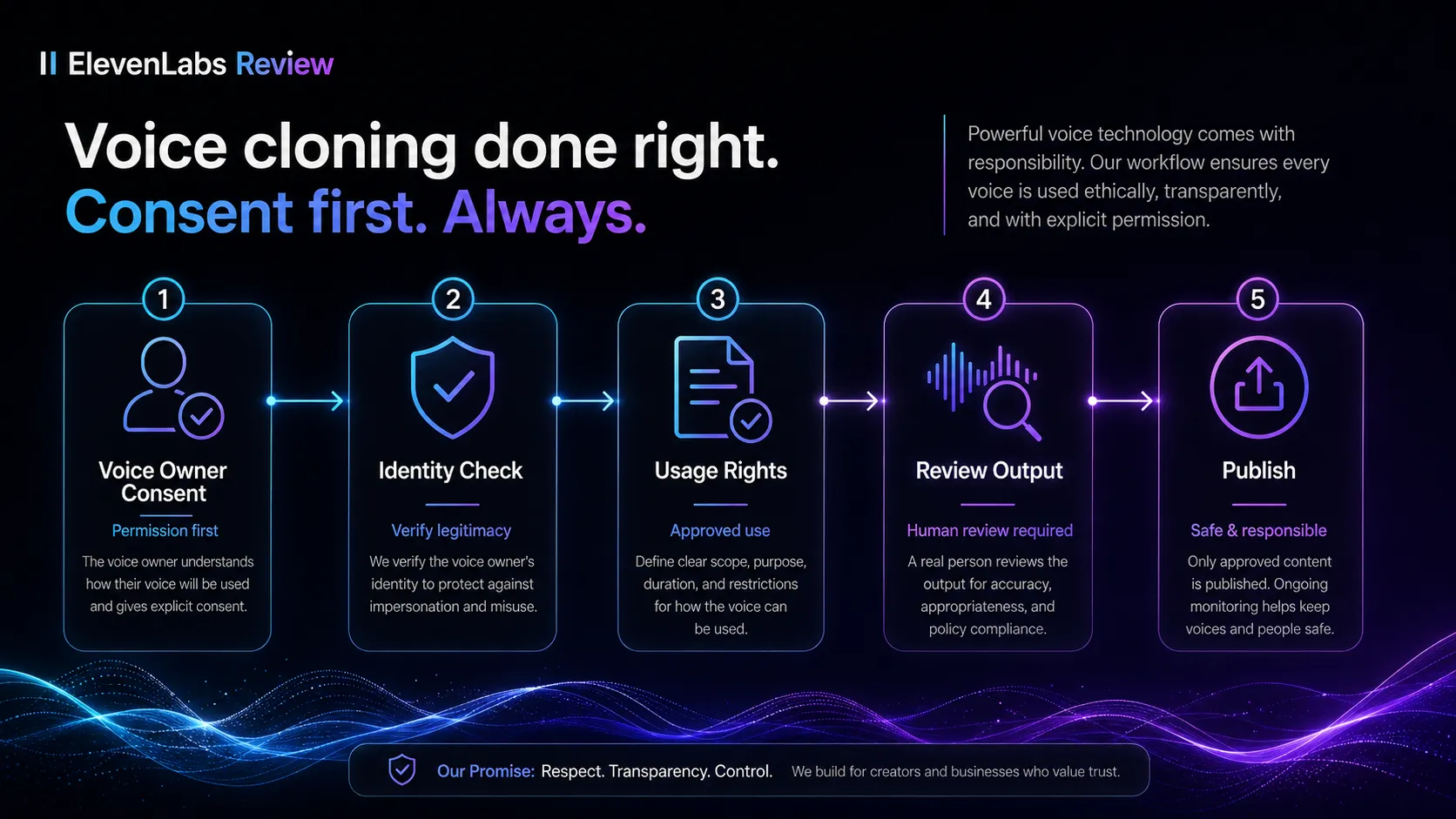
The bigger skip case is governance. Voice cloning is useful, but it is not casual. You need permission, usage boundaries, and approval. That matters for employees, clients, public figures, creators, internal training, and any commercial asset where a voice represents a person or brand.
Skip it for now if:
- You cannot verify consent for cloned voices
- You need editing more than voice generation
- You only need occasional draft audio
- Your client requires human-only voice work
- You cannot review pronunciation, pacing, and translations
- You do not want to monitor credits or regeneration costs
The friction moment is this: ElevenLabs can make audio generation feel easy before the surrounding workflow is actually safe.
ElevenLabs pros and cons
Pros
- Strong voice realism for narration, dubbing, and production audio.
- Broad platform coverage beyond basic text-to-speech.
- Useful free plan for testing voice quality and workflow fit.
- API and SDK support make it credible for developer stacks.
- Strong fit for multilingual content and voice-agent workflows.
Cons
- Credit-based pricing requires usage planning before serious production.
- Voice cloning needs consent, disclosure, and client approval rules.
- It does not replace a full podcast or video editor.
- Temporary promotions can make the true renewal cost easy to miss.
- Output still needs human listening review before publishing.
Real workflow fit
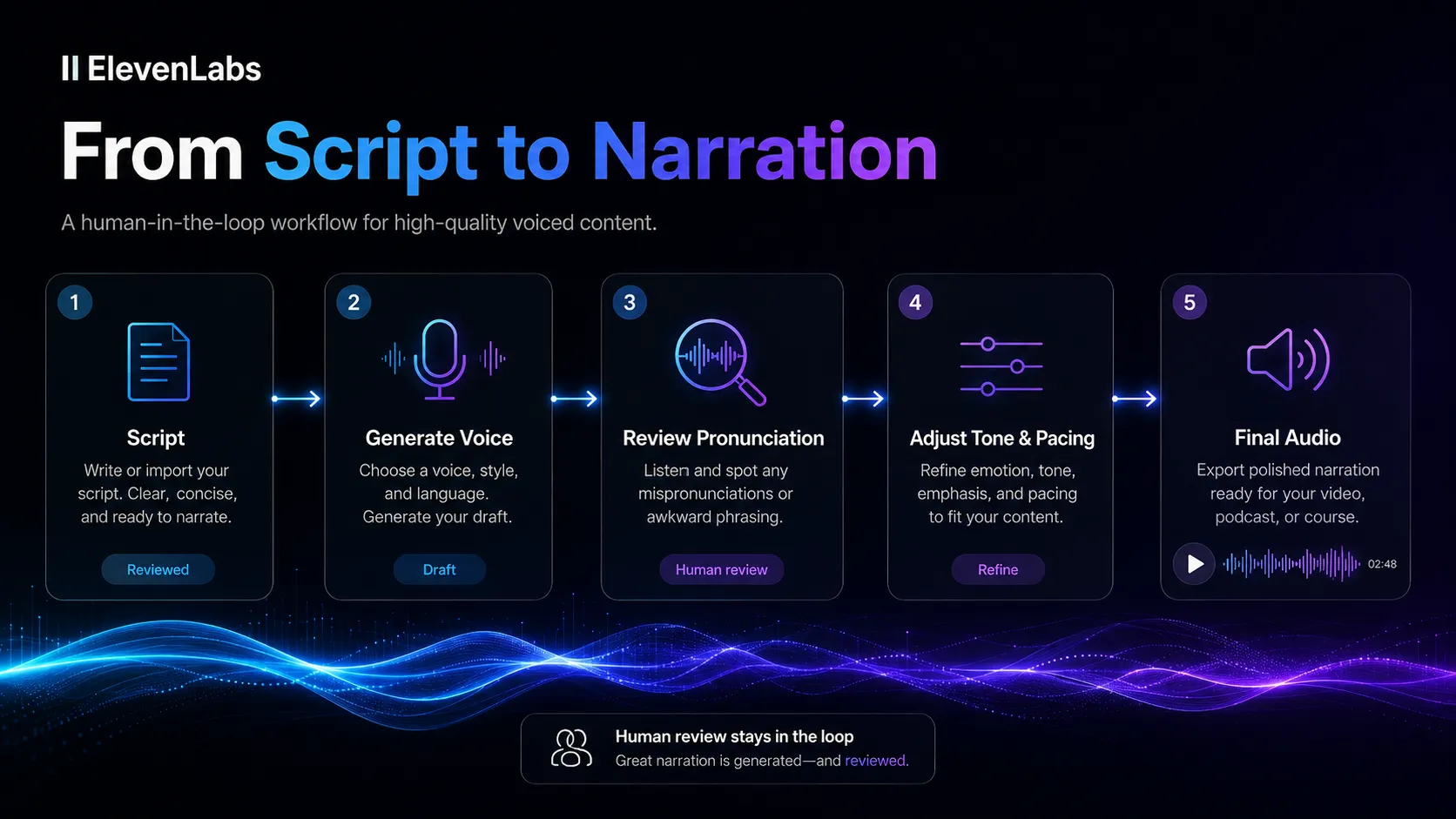
The practical way to judge ElevenLabs is to place it between writing and publishing.
A creator workflow often looks like this:
- Draft a script in ChatGPT, Claude, Notion, Google Docs, or a CMS.
- Edit the script for spoken rhythm and factual accuracy.
- Generate voice in ElevenLabs.
- Listen through the output.
- Regenerate weak sections if needed.
- Edit the audio into a video, podcast, lesson, or app experience.
- Publish only after final review.
That is where ElevenLabs earns its place. It does not remove script work. It does not remove editing. It does not remove approval. It removes a large part of the voice generation bottleneck.
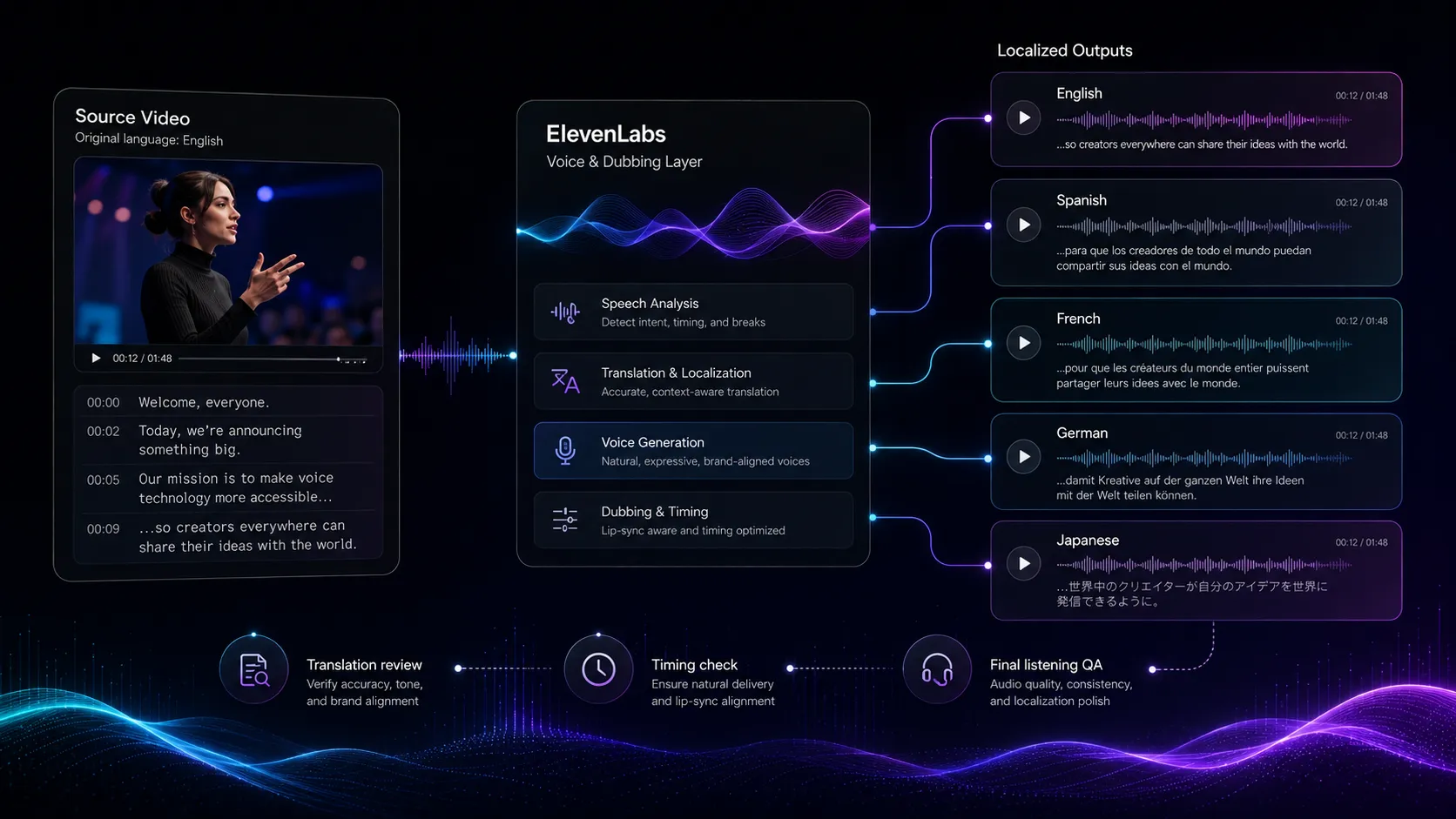
Dubbing follows the same logic. The tool can help produce localized audio, but localization is not just translation. Timing, tone, cultural fit, and final listening still matter.
For developers, the question is different. ElevenLabs becomes audio infrastructure. You are not just asking whether the voice sounds good. You are asking about latency, API cost, fallback behavior, model choice, monitoring, and whether a voice experience improves the product.
Where ElevenLabs fits in an AI stack
The right way to think about ElevenLabs is as the AI audio and voice production layer, not as a full creator stack.
It belongs after writing and before editing or publishing. ChatGPT or Claude can help shape the script. ElevenLabs generates the spoken version. Descript, CapCut, Premiere, Final Cut, a podcast editor, or a course platform handles the next layer. Canva AI can help with visual assets. YouTube, podcast hosting, an LMS, or an app handles distribution.
For a simple creator stack, that might look like:
- ChatGPT or Claude for scripting
- ElevenLabs for narration
- Descript for editing and captions
- Canva AI for thumbnails and visual assets
- YouTube or podcast hosting for publishing
For a business stack, it may sit behind a knowledge base, support workflow, CRM, app interface, or internal training process.
This is where buyers sometimes get confused. ElevenLabs replaces part of the voice recording and audio generation layer. It does not replace your editorial judgment, rights management, translation review, production editor, or publishing system.
What ElevenLabs does well
ElevenLabs is strongest when audio quality matters enough that basic TTS feels cheap.
The official product scope is now broader than many buyers expect. ElevenLabs covers text-to-speech, speech-to-text, voice cloning, dubbing, sound effects, music, voice agents, and API workflows. You may not need every module, but the breadth matters if your audio workflow grows.
The multilingual angle is another reason to take it seriously. Official pages describe text-to-speech in over 70 languages and voice cloning support across 32+ languages. That matters for creators, publishers, apps, and training teams that want one content asset to travel across markets.
The API path also gives ElevenLabs a different role from a casual web voice tool. Developers can use it as infrastructure inside products, support systems, learning apps, or agent workflows.
The safer way to use it is to make review part of the workflow. Generate, listen, revise, approve, and then publish. Do not skip the listening step just because the first output sounds impressive.
Where ElevenLabs falls short
The weak point is not feature count. The weak point is that the workflow can become serious faster than the buyer expects.
Voice cloning is the clearest example. The output can be useful, but permission has to come first. That is true for your own voice, a client voice, an employee voice, a creator voice, or any brand representative. A good clone without the right approval is still a bad workflow.
Credit usage is another source of friction. Regenerations, long scripts, multilingual versions, dubbing, API use, and higher-volume production can change the real cost quickly. A plan that looks fine for testing may feel tight once a channel or team starts using it weekly.
ElevenLabs also does not solve the whole audio pipeline. You still need script planning, editing, captioning, synchronization, publishing, analytics, and final review. If those are your main bottlenecks, a production editor may be a better first subscription.
Pricing judgment
The practical pricing question is this: how often will you generate audio, and how much review or regeneration will that create?
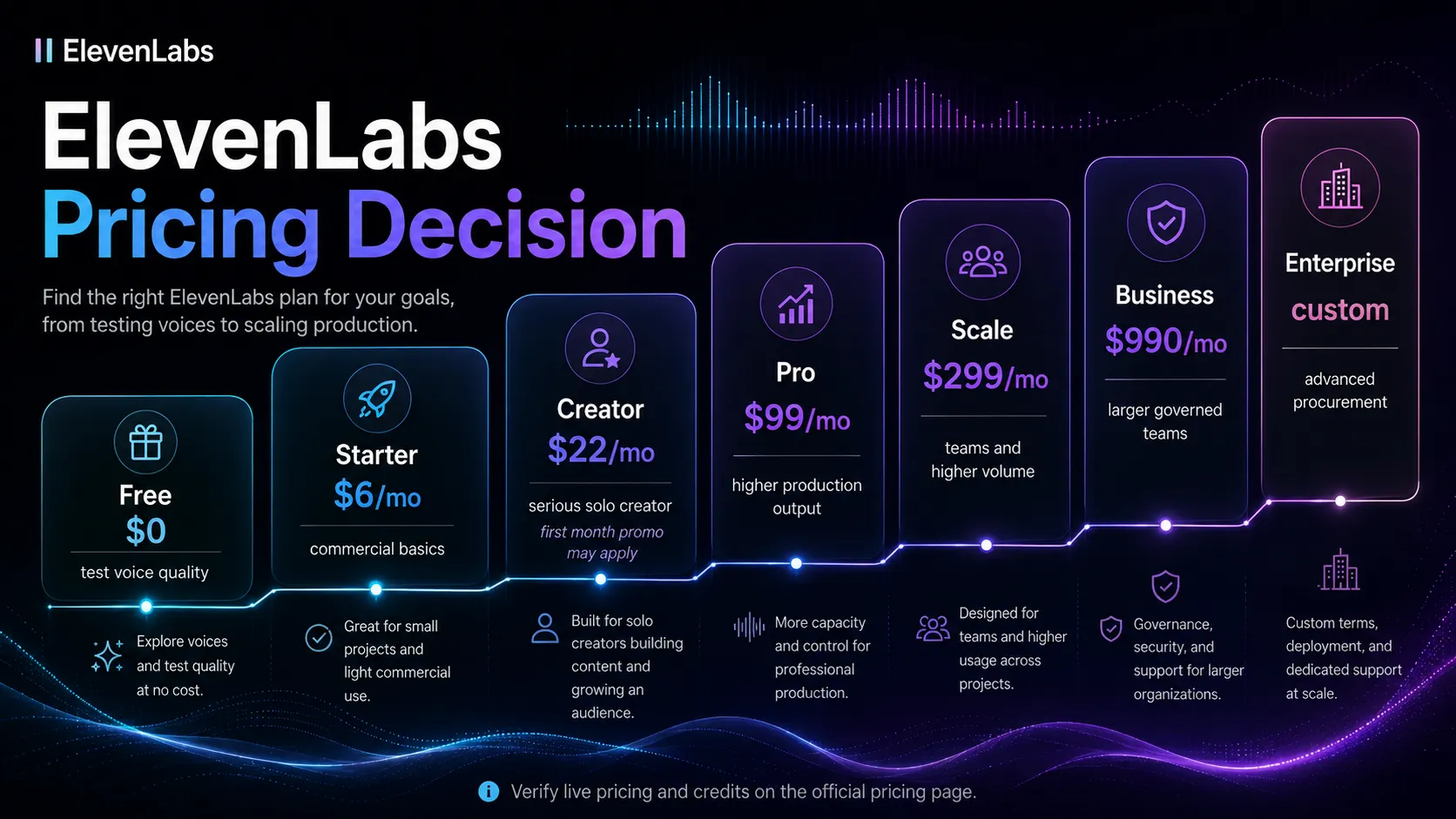
During this review pass, the official pricing page listed Free at $0 per month with 10k credits per month. Starter was listed at $6 per month with commercial license, instant voice cloning, Dubbing Studio, and 30k credits. Creator showed a first-month promotional price and 121k credits, with professional voice cloning. Pro was $99 per month with 600k credits. Scale was $299 per month with 1.8M credits and 3 seats. Business was $990 per month with 6M credits and 10 seats. Enterprise was custom.
That makes the free plan the safest starting point for most buyers. Use it to test voice fit, pacing, pronunciation, and the production process. Move to paid only when you need commercial rights, cloning, higher credits, better audio output, seats, API volume, or real production throughput.
The main pricing trap is treating credits like an abstract number. They are your real production budget. If you regenerate often, test many voices, create multilingual versions, or run voice through an app, you need to estimate usage before the plan choice feels obvious.
Best alternatives to compare
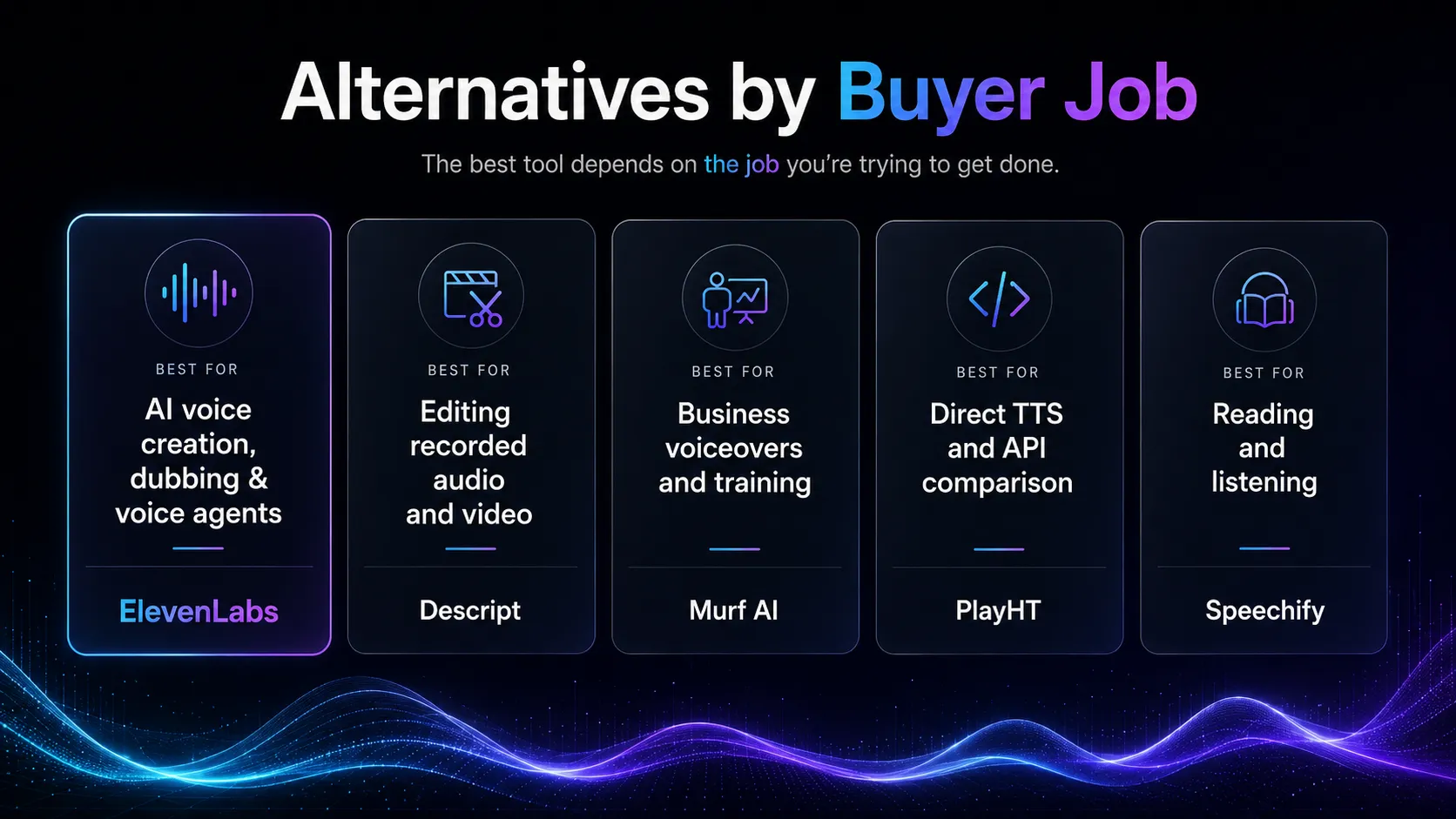
Compare Descript if your main job is editing recorded content. Descript is stronger for transcript-first editing, podcast cleanup, captions, screen recordings, and clip repurposing. ElevenLabs is stronger when the core job is generating new voice assets.
Compare Murf AI if you want business voiceover production for presentations, training, marketing, and guided narration workflows. It may feel simpler for some teams that do not need the broader developer and agent path.
Compare PlayHT if you want a direct text-to-speech and voice generation comparison. This is the cleaner category check when voice quality, model options, API needs, and commercial output matter.
Compare Speechify if the real use case is reading and listening rather than production. It is often a different buyer job, but it may be the better fit for personal productivity and document listening.
The safer comparison is not tool name versus tool name. It is job versus job: generate voice, edit audio, localize video, clone a voice, create a voice agent, or listen to content.
Final decision
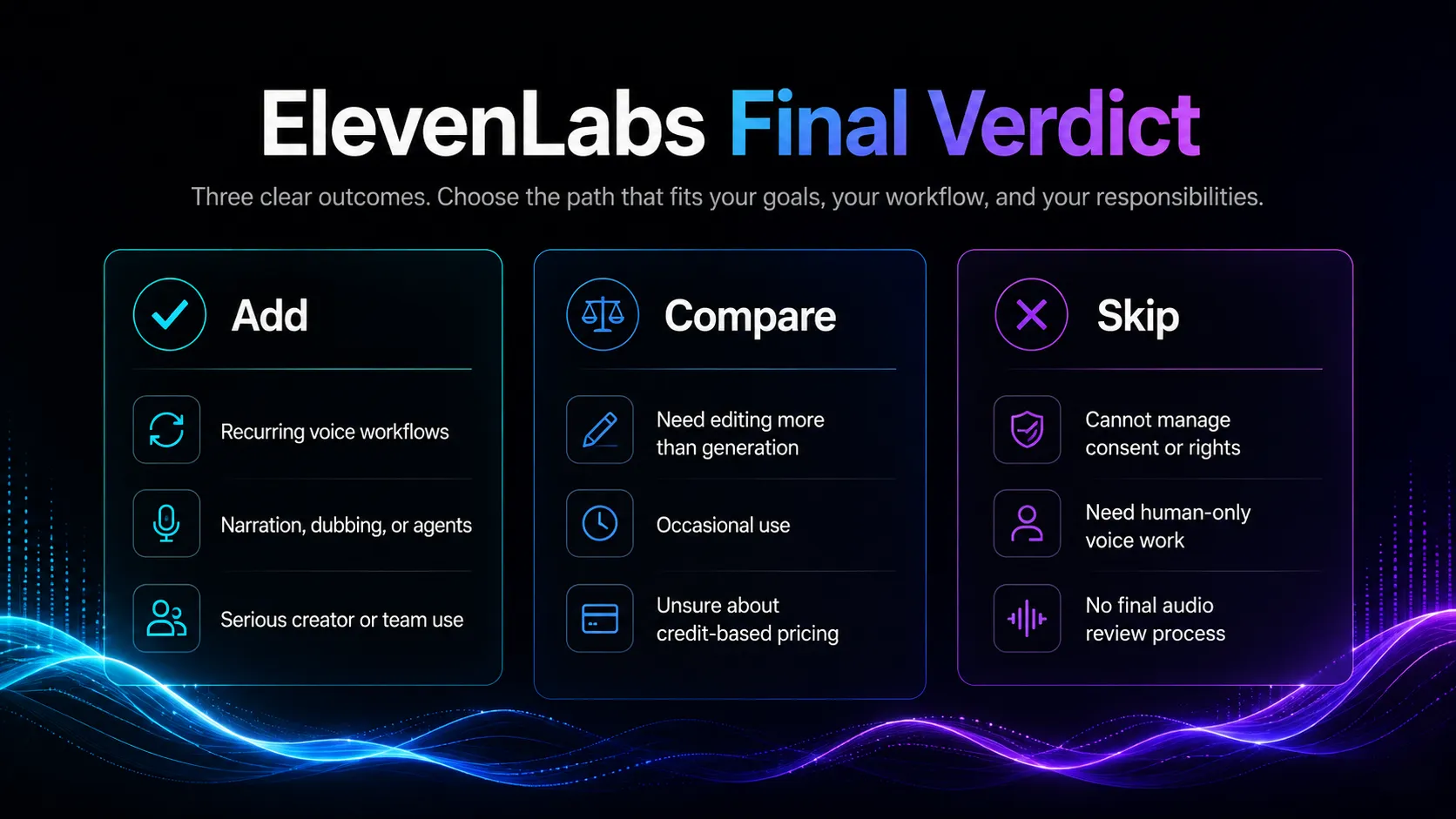
Add ElevenLabs to your stack if voice is a recurring production layer.
That means YouTube narration, podcasts, audio articles, audiobooks, training content, multilingual demos, app voice, or agent workflows happen often enough that better voice quality and faster generation create real leverage.
Compare it first if you mainly need editing, if your workflow is occasional, or if you are unsure whether credit-based pricing will fit your production volume.
Skip it for now if you cannot manage consent, licensing, disclosure, client approval, or final listening review. AI voice is powerful, but it is still a rights-sensitive asset.
My final take: ElevenLabs is an add-first tool for serious audio workflows. It is not a magic replacement for a complete production system, and that is the point. Treat it as the voice layer, connect it to the rest of your stack, and keep human review in the loop.
Frequently asked questions
Is ElevenLabs worth it for YouTube creators?
Does ElevenLabs have a free plan?
Can I use ElevenLabs voices commercially?
Is ElevenLabs better than Descript?
What is the biggest risk with ElevenLabs?
Where ElevenLabs fits in a stack
AI audio and voice production layer
Does not replace
- – Script writing and fact checking
- – Human voice direction for sensitive creative work
- – Timeline video editing and podcast assembly
- – Legal review, consent documentation, and brand approval
- – Final listening QA before publishing
Head-to-head comparisons
Top alternatives to consider
If ElevenLabs is not the right fit, these are the most common alternatives.
Descript is the better comparison when the buyer mainly needs transcript-based audio and video editing, captions, podcast cleanup, and clip assembly. ElevenLabs is stronger as a voice generation layer.
Murf AI is a direct voiceover alternative for business narration, training videos, and simpler production workflows where teams want a more guided voiceover experience.
PlayHT is a direct text-to-speech comparison for buyers evaluating realistic AI voices, developer workflows, model quality, and commercial voice generation.
Review methodology
This review is based on current official ElevenLabs product pages, pricing, documentation, safety and voice pages, the TopAIStacks ElevenLabs task context, existing File Library review context, and editorial stack-fit analysis.
No private paid account benchmark, audio quality test, cloned voice test, or production deployment was conducted for this review. Recommendations reflect public information and buyer-fit analysis.
Not covered: Private audio benchmark testing · Voice clone creation · Client project deployment · Enterprise contract review