 M
M Midjourney
Midjourney is an AI image generator best for designers, creatives, and marketing teams who need high-quality, artistically consistent visuals from text prompts. It has no free plan, and buyers who need photo-realistic product shots or strict brand control should evaluate alternatives first.
Quick answer
Midjourney is an AI image generator best for designers, creatives, and marketing teams who need high-quality, artistically consistent visuals from text prompts. It has no free plan, and buyers who need photo-realistic product shots or strict brand control should evaluate alternatives first.
Midjourney has no free plan or trial as of 2026 — the minimum commitment is $10/month. Images are public by default unless you pay for the Pro or Mega tier which include Stealth Mode. The tool is optimized for artistic and creative output; teams needing precise brand asset control, product photography accuracy, or API access should verify current plan capabilities and review Midjourney's terms before purchase.
What is Midjourney?
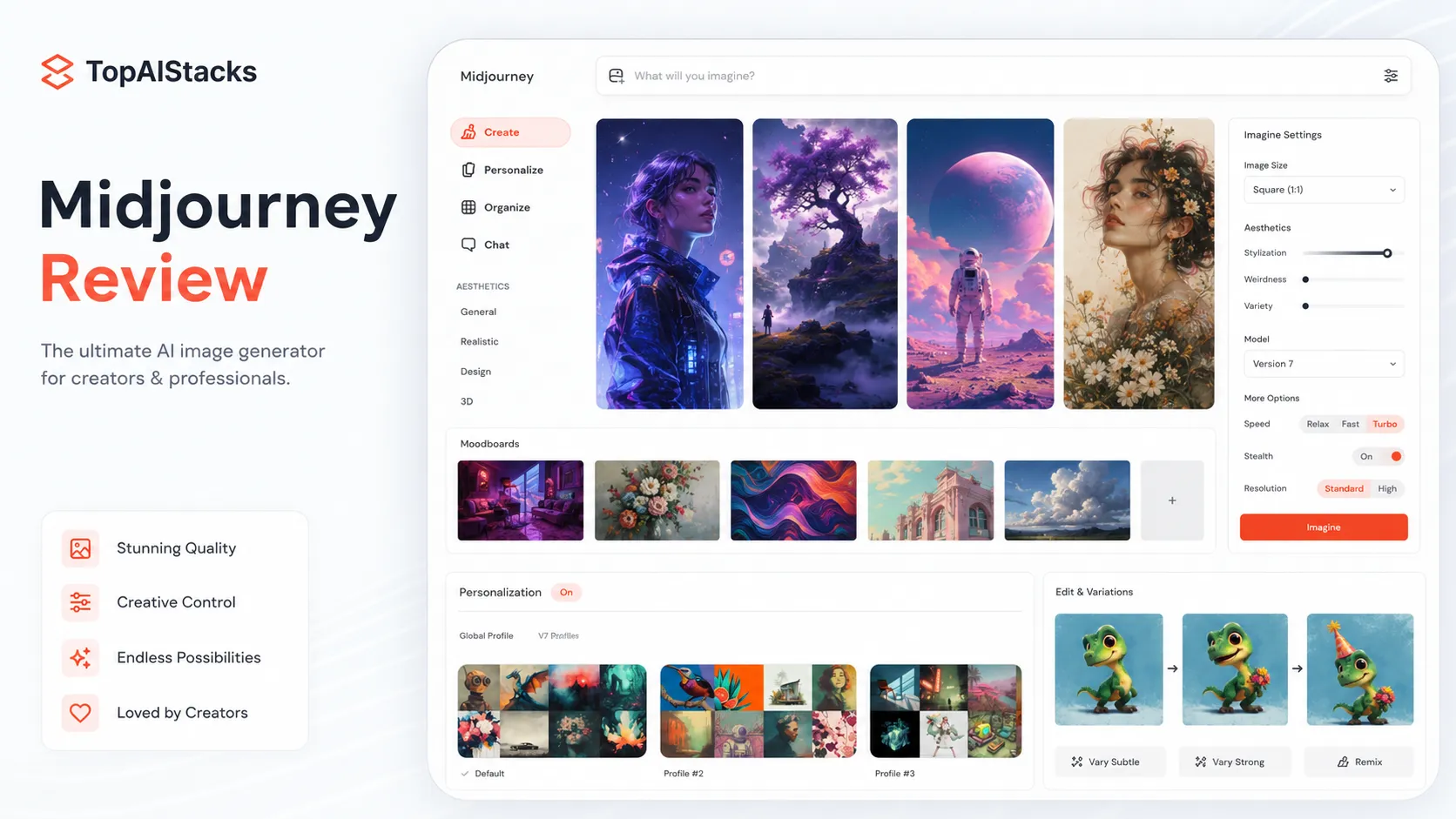
Midjourney converts text prompts into high-quality images using its own proprietary generative AI model. Originally Discord-only, it now also runs through a dedicated web interface at midjourney.com. The tool is known for producing images with strong artistic coherence, cinematic aesthetics, and consistent style — qualities that distinguish it from more prompt-literal alternatives. Generation is GPU-time based, and plans vary by fast-hour allocation, with higher tiers adding Relax Mode for slower unlimited generations and Stealth Mode for private outputs. Commercial usage rights are included across all plans, with a revenue threshold requiring Pro or Mega for companies earning over $1M annually.
Who Midjourney fits best
Midjourney fits best for freelance designers, creative directors, and marketing teams who need visually distinctive AI-generated imagery for concept work, campaigns, and editorial use where artistic quality and stylistic consistency matter more than prompt literalism or platform integration.
- ✓Designers and illustrators generating concept art, mood boards, and visual references
- ✓Marketing and social media teams producing campaign imagery at scale
- ✓Creative agencies needing high-volume stylized visuals without hiring illustrators
- ✓Content creators building distinctive visual brands with consistent aesthetic output
Not ideal for
- •Teams needing precise product photography or exact brand asset replication
- •Businesses requiring API access on lower-tier plans — verify current API availability and plan requirements
- •Users who want a no-commitment free trial before purchasing
- •Teams outside the Discord or web interface workflow who need deep tool integrations
Main use cases
Concept art and visual ideation
Creative teams use Midjourney to generate concept art, mood boards, and visual references at the start of a design project, replacing or supplementing hours of manual sketching. The output requires human art direction and editing before use in final deliverables.
Marketing and campaign imagery
Marketing teams generate stylized imagery for social media, ads, and editorial content without commissioning illustrators for every asset. Teams with revenue above $1M should verify commercial licensing requirements on the Pro or Mega tier before using outputs in paid work.
Social media visual content
Content creators use Midjourney to produce consistent, on-brand imagery for social channels using style references and prompt patterns. Images require review, cropping, and post-processing in a tool like Canva AI or Photoshop before publishing.
Product and brand visual exploration
Designers use Midjourney to rapidly explore visual directions for packaging, brand identity, and product concepts before committing to production. For exact brand asset replication or product photography, dedicated design tools and human review remain essential.
Where Midjourney fits in the AI stack
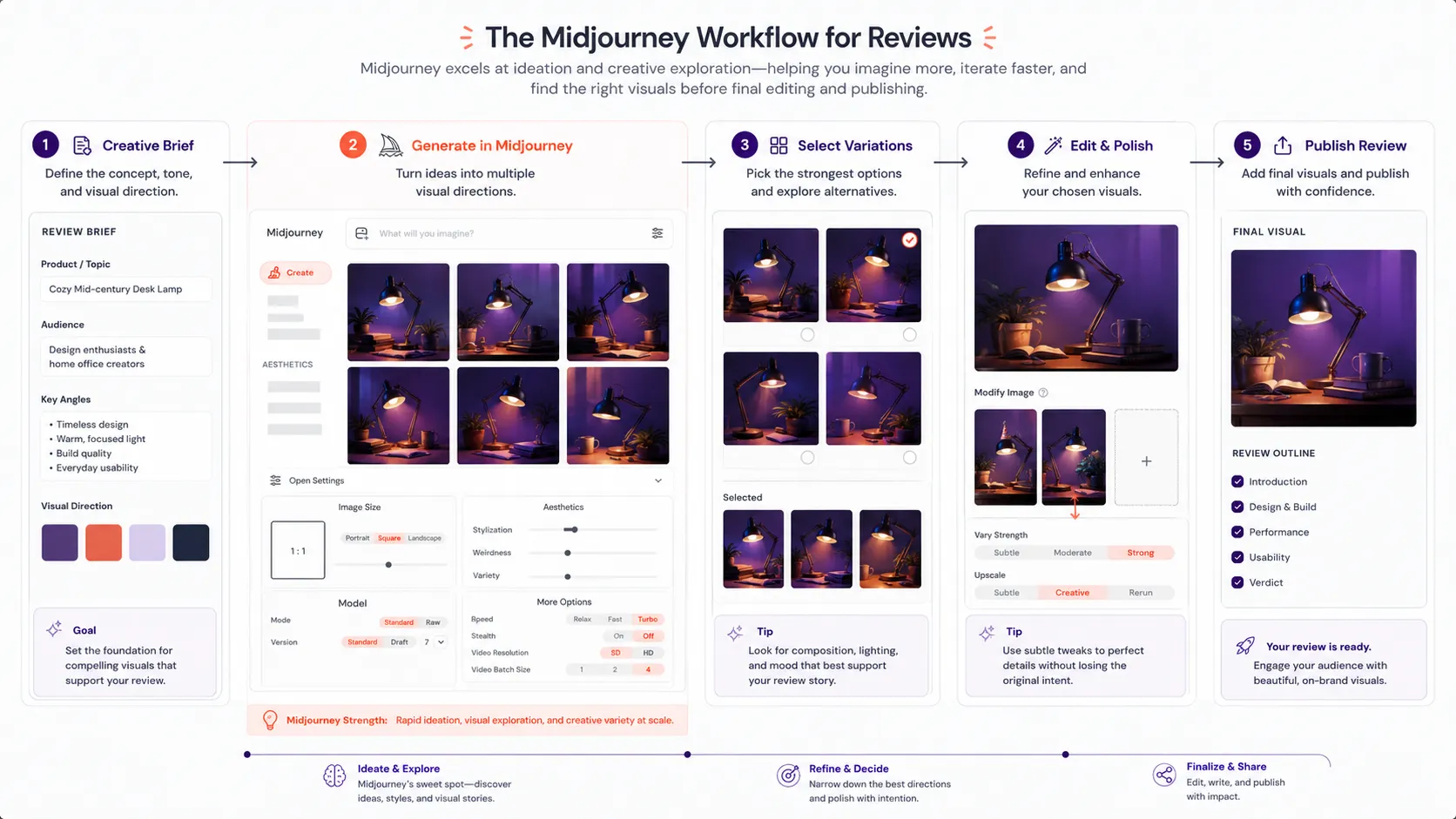
Midjourney operates as the AI image generation layer in a creative or marketing stack, handling the high-volume production of artistically consistent visuals from text prompts. It does not replace editing tools, brand systems, or publishing workflows — it feeds them. The output quality is high, but images still require human review, editing, and brand alignment before production use.
Stack role
AI image generation layer
Best paired with
Canva AI, ChatGPT, Claude
Strongest layer
Visual ideation and concept art + Campaign and editorial imagery
| Stack layer | Fit | What to know |
|---|---|---|
| Visual ideation and concept art | strong | Midjourney's strongest use case — fast, high-quality visual concept generation from text prompts. |
| Campaign and editorial imagery | strong | Effective for stylized marketing visuals; requires post-processing and rights review for paid media. |
| Brand asset production | medium | Useful for visual exploration, but exact brand replication and consistency require additional editing tools. |
| Product photography | weak | Not suited for accurate product shots requiring controlled lighting, exact colors, or real-world fidelity. |
| Workflow automation and integration | weak | API access exists but is plan-restricted; Midjourney is primarily a manual prompt-driven tool. |
| Writing and content drafting | weak | Image-only tool — pair with ChatGPT or Claude for prompt writing and creative brief development. |
Best stack combinations
Creative agencies and freelance designers
Midjourney + Canva AI + ChatGPT
ChatGPT develops creative briefs and prompts; Midjourney generates imagery; Canva AI handles layout, resizing, and brand-aligned composition.
Social media content teams
Midjourney + Canva AI + Claude
Claude writes prompt libraries and content plans; Midjourney generates visuals; Canva AI prepares platform-ready formats for publishing.
Marketing teams running visual campaigns
Midjourney + Adobe Express + ChatGPT
ChatGPT generates prompt variations; Midjourney produces campaign imagery; Adobe Express adds typography and brand elements for final assets.
What Midjourney can replace
- · Some stock image search and licensing for editorial and campaign imagery
- · Manual concept-art exploration and early-stage visual ideation tasks
- · Initial mood board creation using stock photography and illustration references
What it still needs
- · Canva AI or Photoshop: Post-processing, cropping, text overlay, and brand-aligned layout work
- · Human art director: Brand direction, quality review, and approval before production use
- · Usage rights review: Verify commercial licensing terms against your plan and revenue before publishing
- · Social media scheduler or CMS: Publishing workflow for distributing generated assets across channels
Add it to your stack if
- · Your team regularly commissions illustrators or buys stock imagery for creative and marketing work
- · You need high-volume, artistically consistent visuals from text prompts without a large design team
- · Stylistic quality and aesthetic coherence matter more than pixel-perfect prompt accuracy
Skip it if
- · You need a free plan or trial before committing — Midjourney has neither as of 2026
- · Your primary need is accurate product photography or strict brand asset replication
- · Your company earns over $1M annually and you are not prepared to subscribe to the Pro or Mega tier
Choose your next step
Pricing
→Compare Midjourney's four plans — Basic, Standard, Pro, Mega — with GPU-hour limits and commercial licensing requirements.
Alternatives
→Compare Midjourney with DALL-E 3, Adobe Firefly, and Stable Diffusion across pricing, output style, and commercial rights.
Compare options
→See how Midjourney compares to DALL-E 3 on artistic quality, prompt accuracy, pricing, and licensing.
Stack fit
→See how Midjourney fits into a broader AI creative and social media stack with editing and publishing tools.
Review
→See whether Midjourney's image quality and pricing are worth it for your creative workflow.
Pricing summary
This is a profile-level summary. Use the pricing page for deeper plan checks.
Starting path
Paid only
Free plan
No
Free trial
No
Midjourney offers four paid tiers with no free plan. Basic starts at $10/month for a limited GPU-hour allocation. Standard at $30/month adds Relax Mode for unlimited slower generations. Pro at $60/month increases fast hours and adds Stealth Mode for private outputs. Mega at $120/month suits high-volume professional use. Annual billing saves approximately 20% across all tiers. Companies with annual revenue above $1M must use Pro or Mega for commercial work. Verify current plan details, GPU-hour allocations, and commercial licensing terms on the official pricing page before subscribing.
Best starting path: Standard at $30/month is the most practical plan for regular users — it adds Relax Mode for unlimited slower generations, which significantly improves value for creatives who generate images daily. Basic at $10/month runs out of fast hours quickly for heavy use.
Related stack page
Top alternatives
See all →Direct alternatives

OpenAI's image generator embedded in ChatGPT — stronger prompt accuracy and simpler licensing, weaker on artistic style.

Adobe's commercially-safe generator with Creative Cloud integration — better for teams needing verified commercial licensing and ecosystem fit.
Open-source alternative with full local control and no subscription cost — higher technical setup barrier but no usage restrictions.
Adjacent tools in the same stack
Design and layout tool that consumes Midjourney outputs — complementary, not a replacement for image generation.

Used alongside Midjourney for prompt engineering and creative brief development, not for image generation itself.
Related comparisons
FAQ
What is Midjourney best for?
Midjourney is best for generating high-quality, artistically consistent imagery from text prompts — concept art, mood boards, campaign visuals, and editorial imagery. It excels at stylistic coherence and cinematic quality, making it the preferred tool for designers and creative teams who prioritize visual output over prompt-literal accuracy.
Is Midjourney enough as a full AI creative stack?
No. Midjourney covers the image generation layer only. Most workflows still need a design tool like Canva AI or Photoshop for layout and post-processing, a writing assistant like ChatGPT or Claude for prompt development, and a publishing or scheduling tool to distribute assets.
What tools should I pair with Midjourney?
Canva AI for resizing, layout, and brand-aligned composition. ChatGPT or Claude for writing prompts, creative briefs, and building prompt libraries. Adobe Express or Photoshop for adding typography and finishing production assets. A social media scheduler for distributing final content.
What is the best alternative to Midjourney?
DALL-E 3 (via ChatGPT) is the most accessible alternative — stronger prompt accuracy, simpler licensing, and no separate subscription. Adobe Firefly suits teams inside Creative Cloud who need commercially verified outputs. Stable Diffusion offers full local control with no subscription cost but requires technical setup.
Does Midjourney have a free plan or free trial?
No. Midjourney removed its free trial and has no ongoing free tier as of 2026. The cheapest entry point is the Basic plan at $10/month. Buyers who want to test AI image generation before committing should try the free tiers of DALL-E 3 via ChatGPT or Adobe Firefly first.
Who should not use Midjourney?
Teams that need product photography accuracy, exact brand asset replication, or a free trial before committing. Companies earning over $1M annually need the Pro or Mega plan for commercial use — verify licensing terms before purchasing a lower tier for paid campaign work.
How TopAIStacks evaluates Midjourney
Plan names and pricing ($10/$30/$60/$120/mo) corroborated across multiple independent sources reviewed in April–May 2026 and consistent with the official pricing page structure. Annual discount of 20% confirmed across sources. Free plan and free trial status confirmed as absent since 2023. Commercial licensing revenue threshold ($1M) confirmed via multiple sources. Platform access (web and Discord) confirmed from official and third-party sources. No hands-on testing claimed. Pricing fields use cautious buyer-safe wording given the possibility of plan changes. Stack role, workflow fit, and alternative classification based on product category analysis and publicly documented feature scope.
Last checked: May 2026 · Source confidence: medium