
Semrush Review
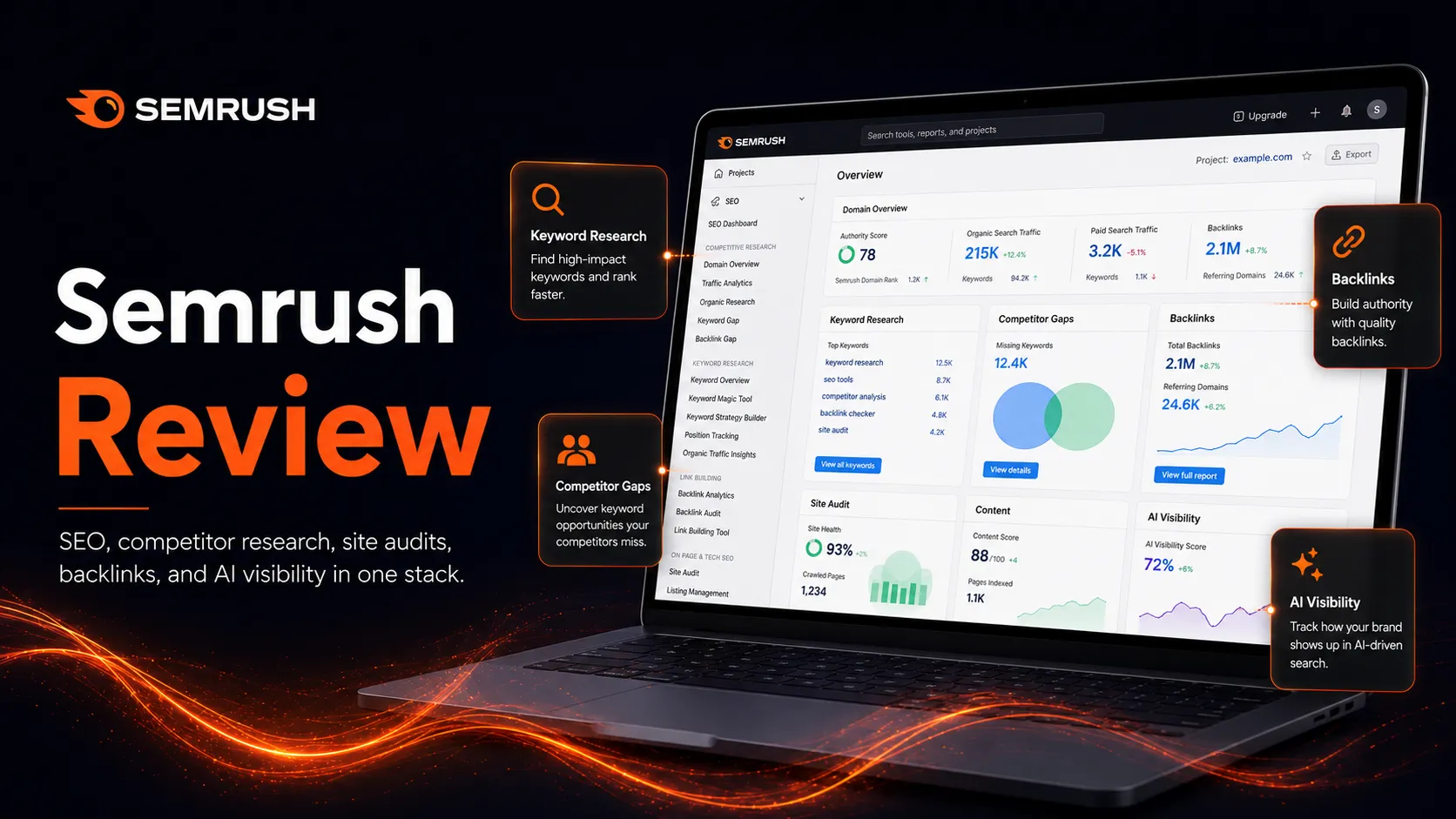
A practical Semrush review for SEO teams weighing SEO Toolkit, Semrush One, AI visibility, competitors, and real stack fit.
A strong SEO and AI visibility platform for serious marketers, with pricing and complexity as the main tradeoffs.
Use it if…
- ✓ You make SEO decisions often enough that keyword, competitor, backlink, and audit data can change your publishing or optimization plan.
- ✓ You manage client or stakeholder reporting and need a broad platform instead of disconnected spreadsheets and point tools.
- ✓ You want to compare classic search visibility with emerging AI visibility signals from one platform.
- ✓ Your site or client portfolio has enough revenue potential to justify a premium SEO subscription.
Skip it if…
- – You only publish occasionally and need basic keyword suggestions rather than a full research environment.
- – You mainly need content optimization inside an editor and would be better served by a focused tool like Surfer SEO.
- – You are not ready to review and act on technical SEO, backlinks, competitor gaps, and reporting data.
- – Your budget is tight and the paid plan would create pressure before your SEO workflow is mature.
Review scorecard
Scored by workflow fit, ease of use, value, and stack compatibility. Weights reflect importance for typical buyers.
| Criteria | Score | ||
|---|---|---|---|
| Search intelligence depth | 9.3 | ||
| AI visibility readiness | 8.7 | ||
| Workflow fit for agencies and teams | 8.9 | ||
| Pricing and plan clarity | 7.5 | ||
| Ease of adoption | 8.0 | ||
| Alternative pressure | 8.4 | ||
| Weighted overall | 8.6 / 10 | ||
On this page
Quick verdict
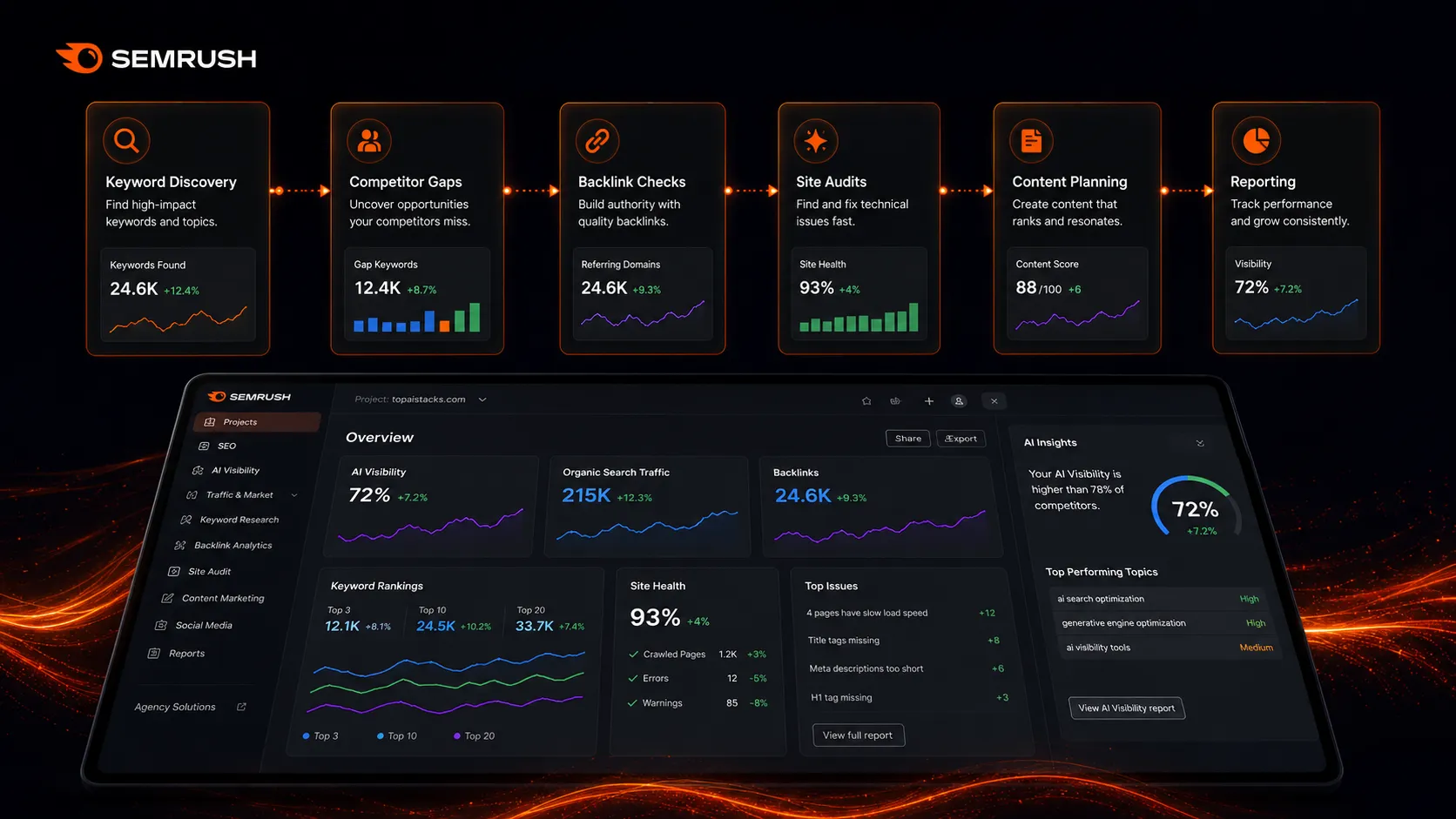
Semrush is easiest to misjudge if you review it as only a keyword tool. The practical question is whether your SEO work is serious enough to need search intelligence in one place: keyword discovery, competitor gaps, backlink context, audits, tracking, reporting, and now AI visibility.
For agencies, in-house SEO teams, and revenue-driven affiliate sites, Semrush can justify its place because it changes what you prioritize. For a small blogger who only wants three keyword ideas before writing a post, it can feel expensive fast. My practical take: treat Semrush as the search intelligence layer of the stack, not as a simple content writing assistant.
Who should use Semrush
Semrush fits teams that make SEO decisions repeatedly. A freelancer doing one blog post per month has a different problem from an agency trying to explain why one client is losing visibility, where competitors are gaining, and which content gaps deserve budget next month. Semrush is built more for the second situation.
It also makes sense for affiliate site owners and content operators who need to choose topics carefully. If a content plan is based only on intuition, Semrush may feel like too much. But if every article competes against real domains, backlink profiles, SERP features, and commercial keyword gaps, the tool becomes more useful.
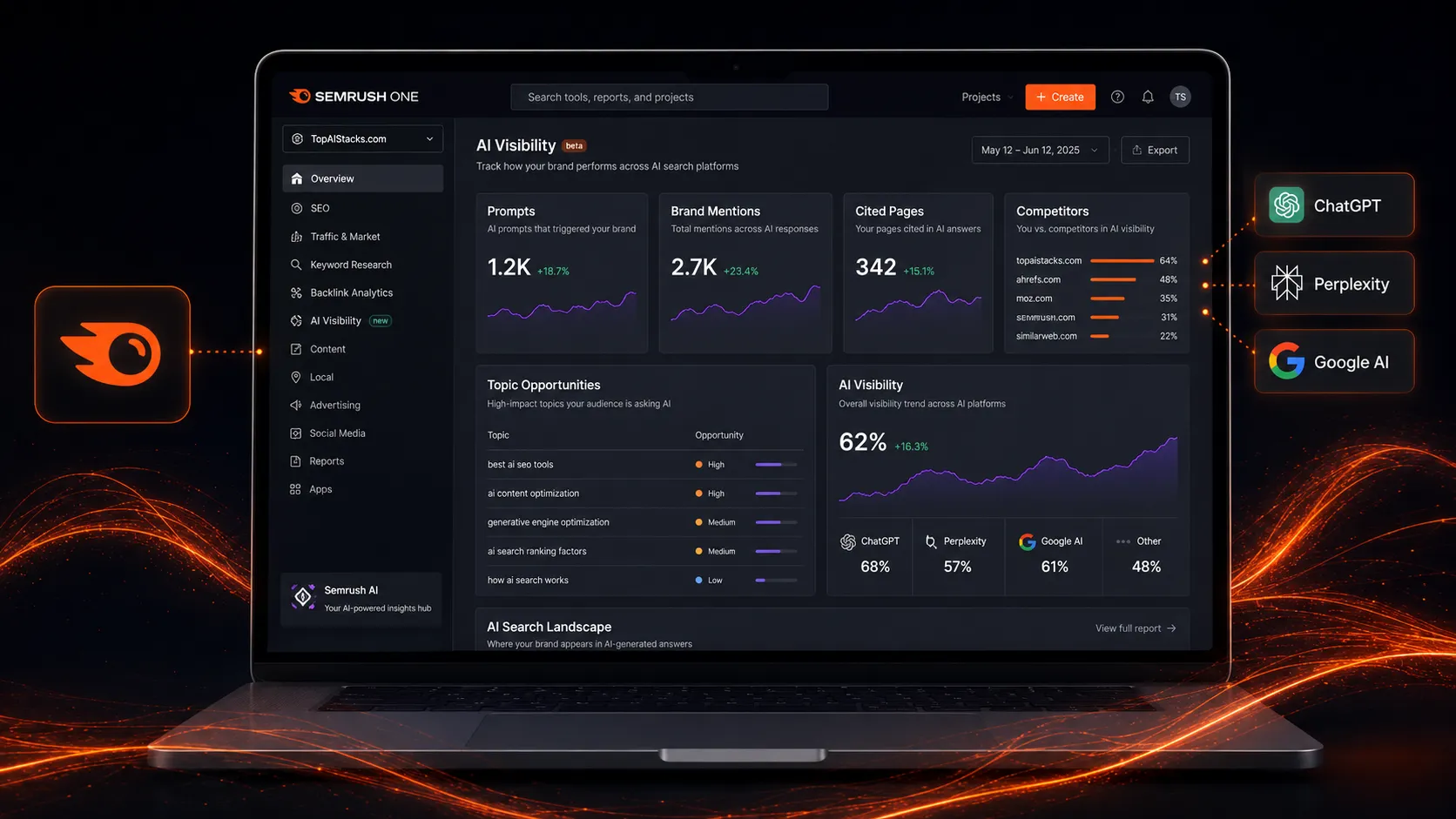
The newer buyer is the brand team asking a different question: not only “Where do we rank in Google?” but “Where do we appear when AI systems answer questions in our category?” That is where Semrush One becomes more relevant than the old way of thinking about Semrush as a classic SEO subscription.
Who should skip Semrush
Skip Semrush if you only need lightweight on-page advice. A tool like Surfer SEO, Frase, or even a simpler content brief workflow may be a cleaner fit if your main job is optimizing one article at a time.
Also skip it if you are not ready to act on the data. Semrush can show keyword gaps, backlink opportunities, technical issues, and competitor movement, but those signals only matter if someone turns them into content updates, technical fixes, internal links, outreach, or reporting decisions. If the data will just sit in a dashboard, the subscription is hard to defend.
The other reason to pause is pricing. Semrush can be reasonable when it supports revenue or client work. It is less compelling when the tool cost creates pressure before your site or workflow is mature.
Real workflow fit
The strongest Semrush workflow starts with a market question, not a feature menu. Which competitors are growing? Which topics are they winning? Which keywords do we miss? Which pages need updating? Which technical issues are holding the site back? Which backlinks or citations are shaping authority?
That is where Semrush feels more like a research operating system. It helps you move from “we should write more content” to “these are the gaps, these are the pages, these are the competitors, and this is the likely order of work.”
The AI visibility angle matters because discovery is no longer only a blue-link ranking problem. Buyers may ask ChatGPT, Gemini, Perplexity, or Google AI experiences for recommendations, and those answers often depend on brand clarity, topical authority, cited pages, and third-party signals. Semrush does not remove the need for SEO judgment, but it gives teams more observability around that new layer.
Where Semrush fits in an AI stack
The right way to think about Semrush is as the SEO research and AI visibility intelligence layer, not as a replacement for Google Search Console, Google Analytics, a CMS, or human SEO judgment. It helps answer what to work on; it does not implement the work for you.
In a practical stack, Semrush pairs well with Google Search Console for first-party search data, Google Analytics for behavior and conversion data, Screaming Frog for deeper technical crawls, Surfer SEO for on-page content optimization, and ChatGPT or Claude for turning research into drafts, briefs, or analysis summaries. WordPress or another CMS still handles publishing.
What Semrush does well
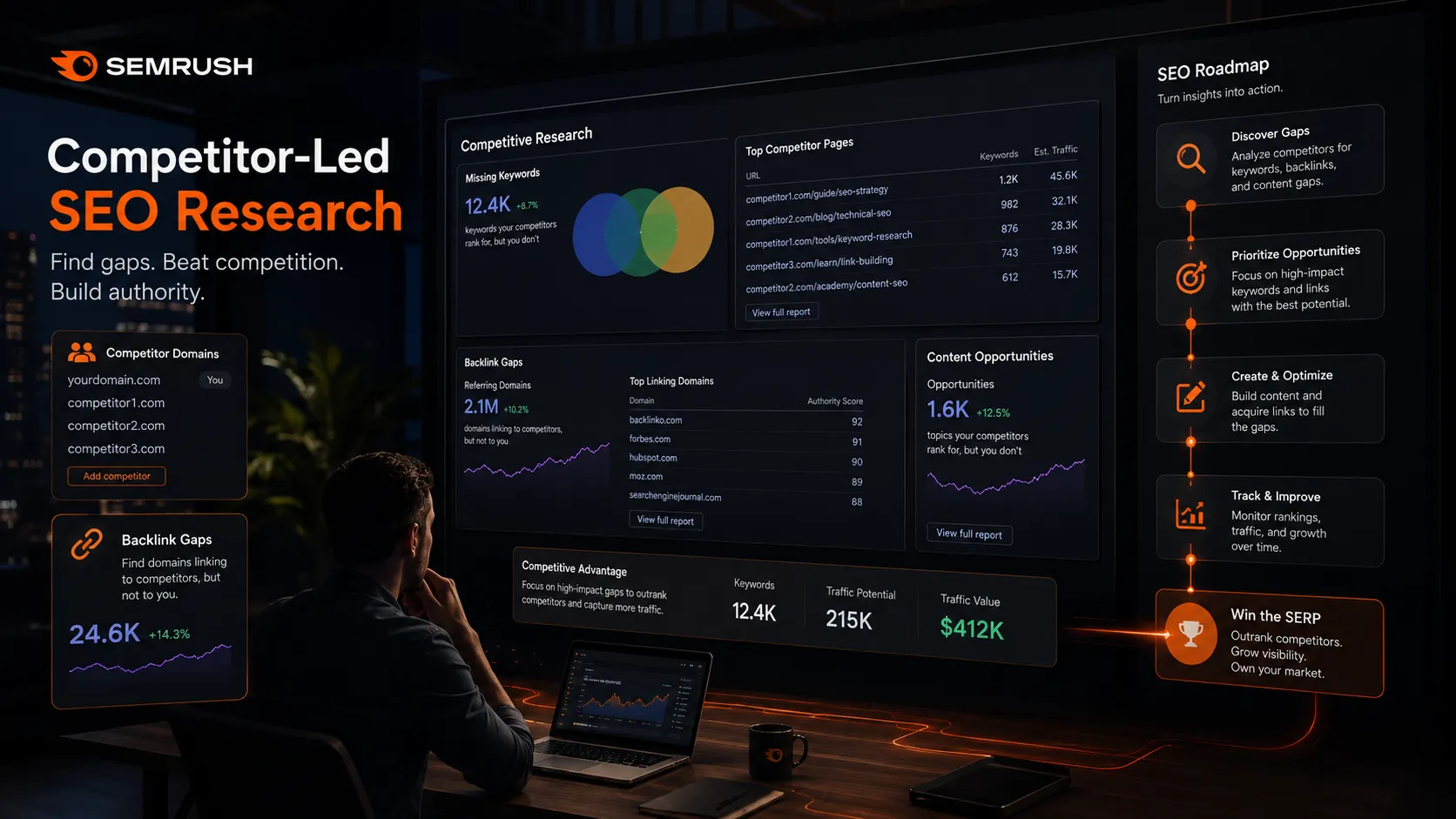
First, Semrush is strong at competitor-led research. A lot of SEO work becomes clearer when you stop asking “What should we write?” and start asking “Where are competitors already getting traffic, links, and topic coverage?” That is the job Semrush is good at.
Second, Semrush brings several SEO jobs into one workspace. Keyword research, rank tracking, backlink checks, site audits, content ideas, competitor research, and reporting are not identical jobs, but they often feed the same decision. Having them near each other reduces tool-switching and makes it easier to explain the work to a client or team.
Third, Semrush has adapted to AI search faster than many older SEO platforms. That does not mean AI visibility metrics should be treated like a mature ranking report. It means Semrush is trying to connect the old search world with the new discovery layer where AI answers, citations, brand mentions, and topic coverage all matter.
Where Semrush falls short
The biggest weakness is cost. Semrush is not priced like a casual creator tool. If you are not using it to make recurring SEO decisions, the subscription can feel heavy.
The second weakness is complexity. The platform has many surfaces, and the difference between SEO Toolkit, Semrush One, AI Visibility Toolkit, extra users, add-ons, and enterprise paths can confuse buyers. That does not make the product bad, but it does mean plan choice deserves more attention than a quick “start trial” click.
The third limitation is that Semrush data is still directional. Search volume, traffic estimates, keyword difficulty, AI visibility, and competitor intelligence help you make better decisions, but they are not the same as first-party conversion data. You still need Google Search Console, analytics, and business judgment.
Finally, AI visibility itself is still evolving. It is worth monitoring, especially for brands in competitive categories, but buyers should avoid treating any AI search dashboard as a guaranteed shortcut to citations or recommendations.
Pricing judgment
Based on current public Semrush resources, buyers now need to separate the classic SEO Toolkit path from the newer Semrush One path. Official Semrush knowledge base resources list SEO Toolkit Pro, Guru, and Business plans, while Semrush One adds AI visibility-oriented plans such as Starter, Pro+, and Advanced. The public pricing page also promotes a seven-day free trial with cancellation available.
The practical question is not “Is Semrush expensive?” It is “Will Semrush change enough decisions to pay for itself?” Pay for it when the tool becomes part of a weekly workflow: competitor research, content planning, site audits, rank tracking, backlink analysis, or client reporting. Stay free or compare alternatives if you only need a few checks per month.
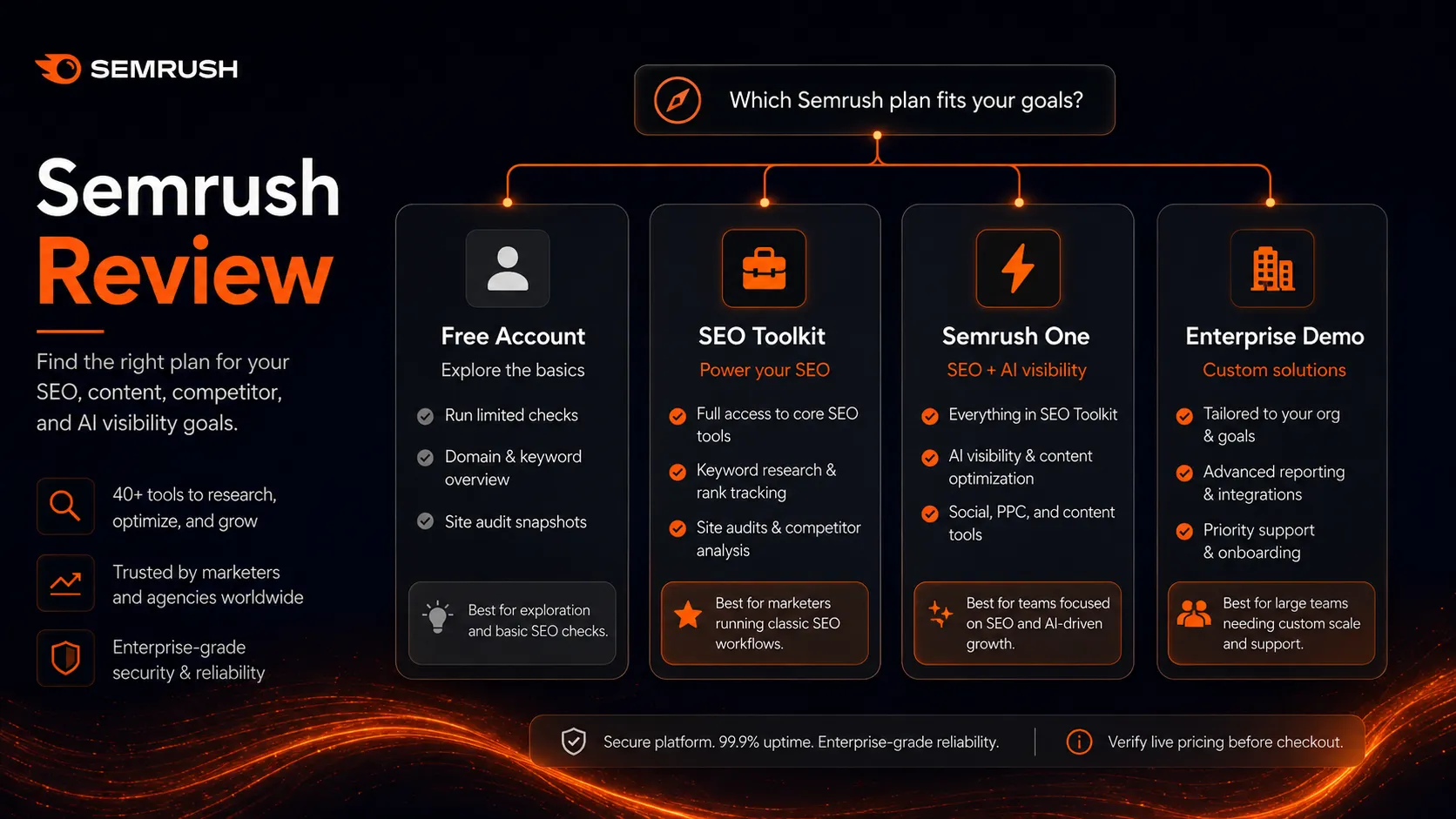
For many smaller sites, the safer move is to start with the free account or trial, define two or three repeatable workflows, and only then choose a paid plan. Verify current pricing on the official pricing page.
Best alternatives to compare
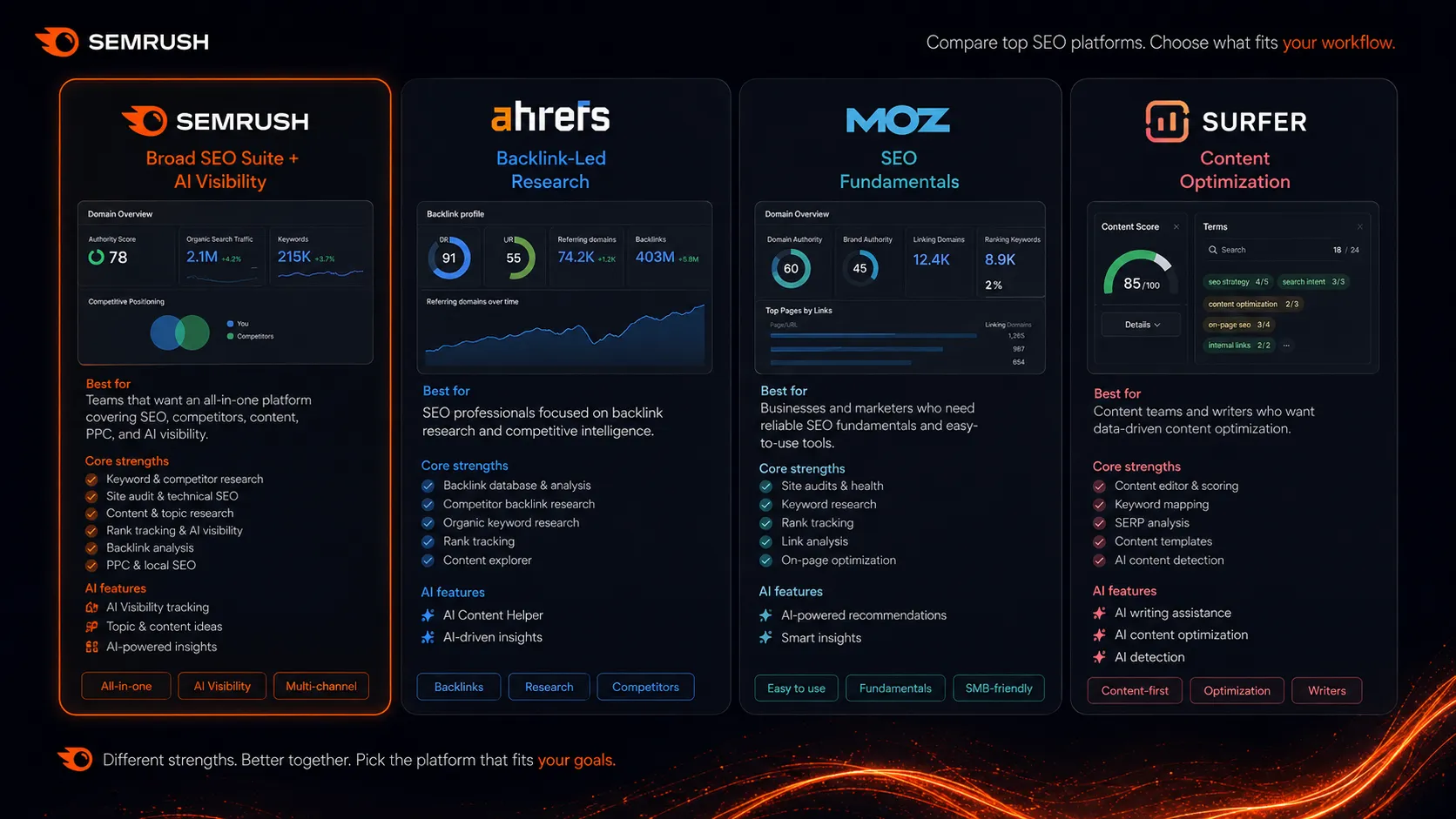
Ahrefs is the closest direct comparison. Compare Ahrefs first if backlink research, organic competitor analysis, and your team’s existing SEO workflow matter more than Semrush’s broader marketing and AI visibility direction.
Moz is worth comparing if you want SEO fundamentals with a different interface and plan feel. It is not usually the most aggressive choice for deep competitive research, but it can be a calmer fit for teams that do not need the full Semrush suite.
Surfer SEO is an adjacent tool, not a full Semrush replacement. It makes more sense when the job is content optimization, briefs, and on-page guidance. Semrush helps decide what to pursue; Surfer can help shape how an individual page is optimized.
Final decision
Add Semrush to your stack if SEO is already a recurring business function and you need keyword research, competitor intelligence, backlinks, audits, reporting, and AI visibility context to make better decisions.
Compare Ahrefs first if your SEO work is backlink-led, your team already prefers Ahrefs’ research model, or you mainly want organic search intelligence without Semrush’s broader marketing suite.
Skip Semrush for now if your current workflow is still occasional blogging, light keyword checks, or basic on-page optimization that does not yet justify a premium SEO and visibility platform.
Frequently asked questions
Is Semrush worth it in 2026?
Does Semrush have a free plan?
What is the difference between Semrush SEO Toolkit and Semrush One?
Who should choose Semrush instead of Ahrefs?
Is Semrush good for beginners?
Does Semrush replace Google Search Console?
Where Semrush fits in a stack
SEO research and AI visibility intelligence layer
Does not replace
- – Google Search Console and Google Analytics as first-party performance sources
- – Human SEO judgment and prioritization
- – A CMS publishing workflow
- – Technical implementation by developers or SEO specialists
- – Dedicated content editing and brand review
Pairs well with
Head-to-head comparisons
Top alternatives to consider
If Semrush is not the right fit, these are the most common alternatives.
Ahrefs is the closest direct alternative for SEO teams that care heavily about backlink research, competitor analysis, and organic search data. Compare it first if your workflow is backlink-led or you prefer Ahrefs' research model.
Moz is a direct alternative for buyers who want SEO fundamentals, rank tracking, and domain metrics with a different learning curve and pricing feel. It can be easier to evaluate for smaller teams that do not need Semrush's wider marketing suite.
Surfer SEO is not a full Semrush replacement. It is better compared as a content optimization layer when the buyer mainly wants briefs, on-page guidance, and content scoring rather than broad market intelligence.
Review methodology
Editorial review based on current public product pages, official pricing and knowledge base resources, current Semrush product positioning, public YouTube coverage, third-party review patterns, and workflow-fit analysis.
This review is based on public product information and current research, not direct hands-on testing inside a paid Semrush account.
Not covered: Hands-on benchmark testing · Enterprise contract terms · Private account limit testing · Accuracy testing against first-party analytics data