Jasper Review
A practical Jasper review for marketing teams: pricing, brand voice fit, workflow strengths, limits, and alternatives before you buy.
Jasper is strong for marketing teams that need brand-controlled campaign content, but its pricing and structure are harder to justify for casual writers.
Use it if…
- ✓ Your team publishes campaign content often enough that brand consistency and workflow structure matter.
- ✓ You need a controlled marketing workspace rather than an open-ended chatbot alone.
- ✓ You can feed Jasper clear briefs, brand examples, audience context, product facts, and review rules.
- ✓ You are comparing Pro against Business with a real team rollout or client workflow in mind.
Skip it if…
- – You only need occasional blog drafts, captions, or brainstorming help.
- – Your team has no shared brand voice, brief format, or approval process yet.
- – You need a dedicated SEO optimizer, research assistant, grammar checker, or publishing system first.
- – The monthly or annual cost cannot be tied to real campaign volume or team time saved.
Review scorecard
Scored by workflow fit, ease of use, value, and stack compatibility. Weights reflect importance for typical buyers.
| Criteria | Score | ||
|---|---|---|---|
| Marketing workflow fit | 8.8 | ||
| Brand voice and governance | 8.6 | ||
| Writing and campaign utility | 8.2 | ||
| Pricing accessibility | 6.8 | ||
| Stack compatibility | 8.0 | ||
| Buyer clarity | 7.5 | ||
| Weighted overall | 8.1 / 10 | ||
On this page
Quick verdict
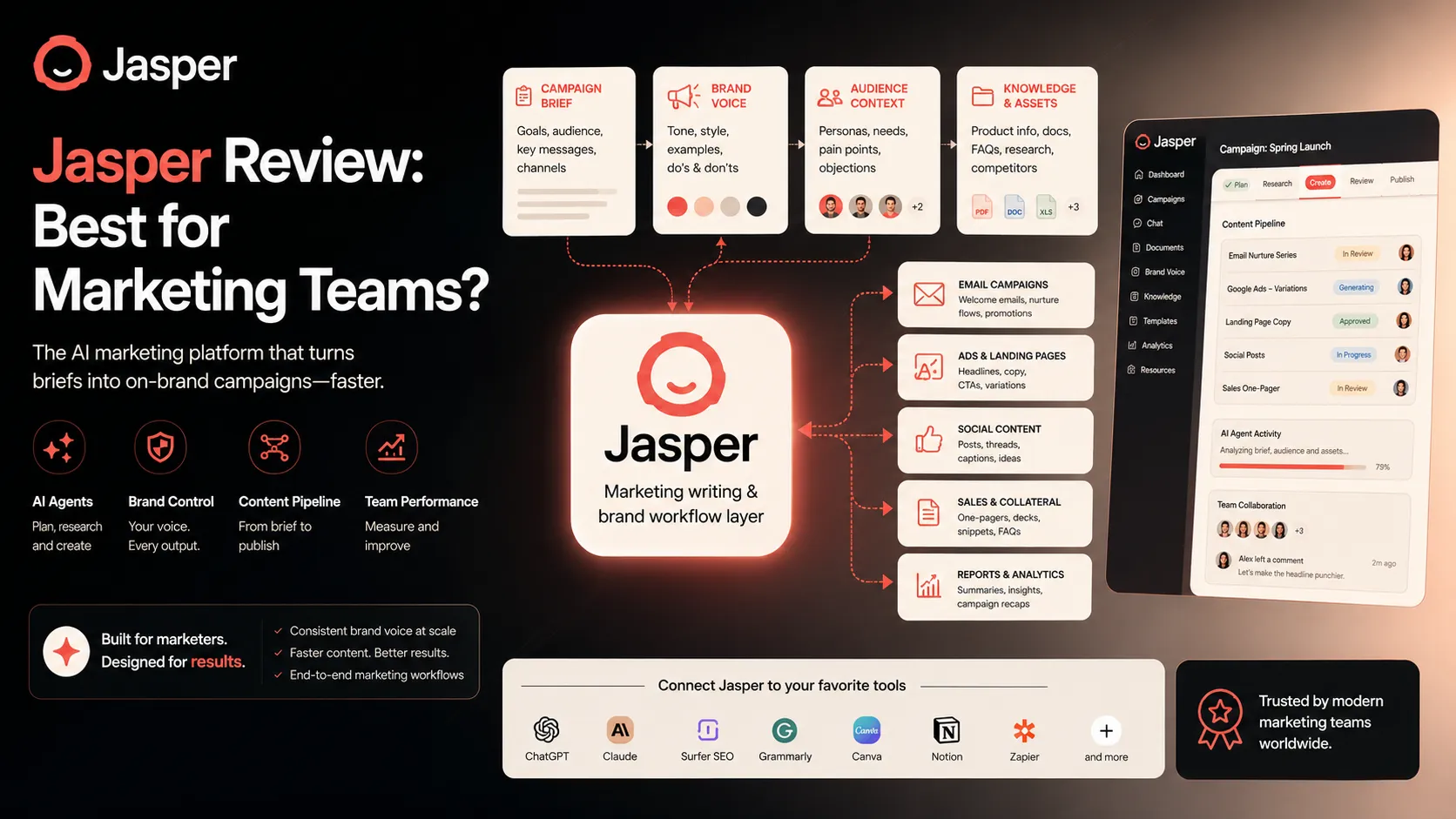
Jasper is best judged as a marketing workflow tool, not as a cheap AI writer. That distinction matters because the public product direction has moved toward agents, content pipelines, brand control, and team execution. If you are only looking for a few blog ideas, the product will probably feel expensive. If your team turns briefs into campaign assets every week, the value argument becomes more realistic.
My practical verdict: Jasper is worth considering for marketing teams, agencies, and brand teams that need consistent campaign copy across channels. It is less attractive for solo creators who can already get enough drafting help from ChatGPT, Claude, Rytr, or Writesonic.
The friction point is simple. Jasper asks you to think like a team before you pay like a team. If your brand voice, source material, approval process, and campaign workflow are messy, Jasper will not magically fix them. It will make the gaps more visible.
This review is based on public product information, official Jasper pricing and help pages, the existing TopAIStacks Jasper profile, third-party review context, and editorial stack-fit analysis. No private paid workspace or campaign deployment was conducted. Verify current plan limits and pricing before buying.
Who should use Jasper
Picture a marketing team preparing a product launch. The same positioning has to become sales emails, paid ad variants, landing page sections, social posts, partner blurbs, and internal messaging. A general AI assistant can help with pieces of that work, but the process gets scattered quickly.
Jasper fits the team that wants that work inside a more controlled writing system. The strongest use case is not one isolated draft. It is recurring campaign production with shared brand voice, audience context, knowledge inputs, and review checkpoints.
Use Jasper if your team already has real marketing inputs. That means briefs, product facts, brand examples, audience definitions, campaign goals, and someone responsible for final review. The tool becomes more valuable when those inputs exist. It becomes weaker when you ask it to invent strategy from a vague prompt.
Who should skip Jasper
If your writing workflow is occasional, Jasper may be too much tool for the job.
A solo blogger who needs two outlines per month, a freelancer who wants quick captions, or a founder who only needs rough landing page ideas should compare lighter options first. ChatGPT and Claude are more flexible for open-ended work. Rytr is easier to justify for budget copy. Writesonic may feel more natural if you want a broader AI writing suite.
Skip Jasper if your team has not documented its voice yet. Brand Voice is useful only when there is something real to learn from. If every campaign starts from scratch, the first job is not buying a premium AI workspace. The first job is creating better inputs.
It is also not the first tool I would add for pure SEO research, grammar polish, design production, analytics, or CMS publishing. Jasper can support parts of those workflows, but those are separate stack layers.
Jasper pros and cons
Pros
- Strong fit for brand-aware marketing and campaign content workflows.
- More structured than a general chatbot for team writing operations.
- Brand Voice and Jasper IQ are useful for consistent messaging.
- Good fit for agencies and teams with repeatable briefs.
- Pairs well with SEO, editing, design, and publishing tools.
- Clear Pro trial path for testing before a paid commitment.
Cons
- Pricing is hard to justify for occasional solo writing.
- Business features can become necessary for larger teams.
- Brand workflow value depends on clean inputs and ownership.
- Still needs human review for facts, claims, and approvals.
- SEO, analytics, design, and CMS work need separate tools.
Real workflow fit
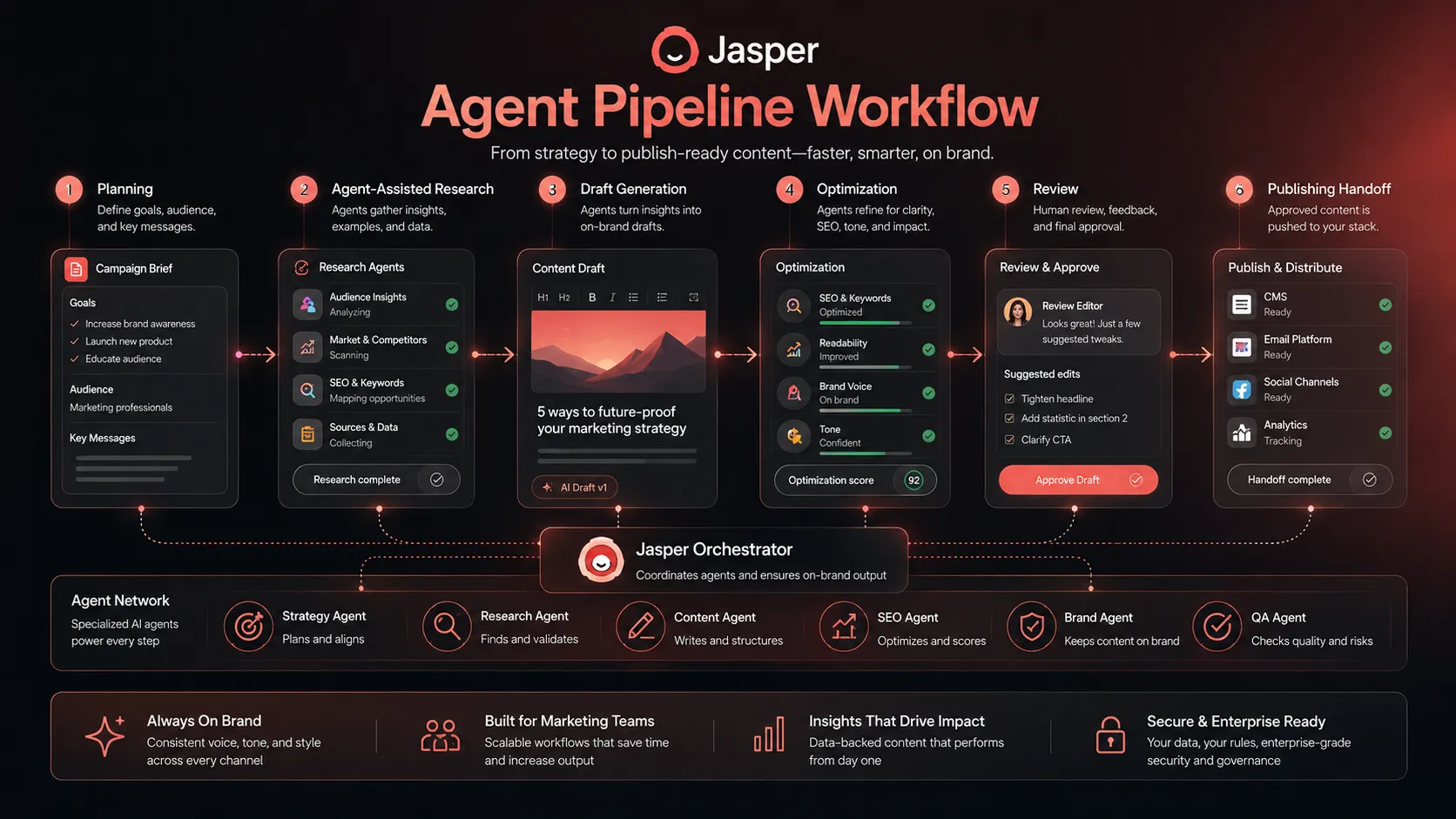
The best Jasper workflow starts before a draft appears. Someone defines the campaign angle, the audience, the offer, the product facts, the brand voice, and the review process. Jasper then helps turn that structure into usable marketing assets.
That is the part many buyers underestimate. Jasper is not just competing with another blank chat box. It is competing with the messy internal process of moving from brief to draft to approved campaign content.
The fit is strong for campaign copy, product messaging, repurposing, social variations, email drafts, paid ad angles, and client content workflows. It is medium for SEO drafts because search intent and SERP analysis still need dedicated support. It is weak for final approval because claims, legal risk, brand judgment, and customer promises still need human ownership.
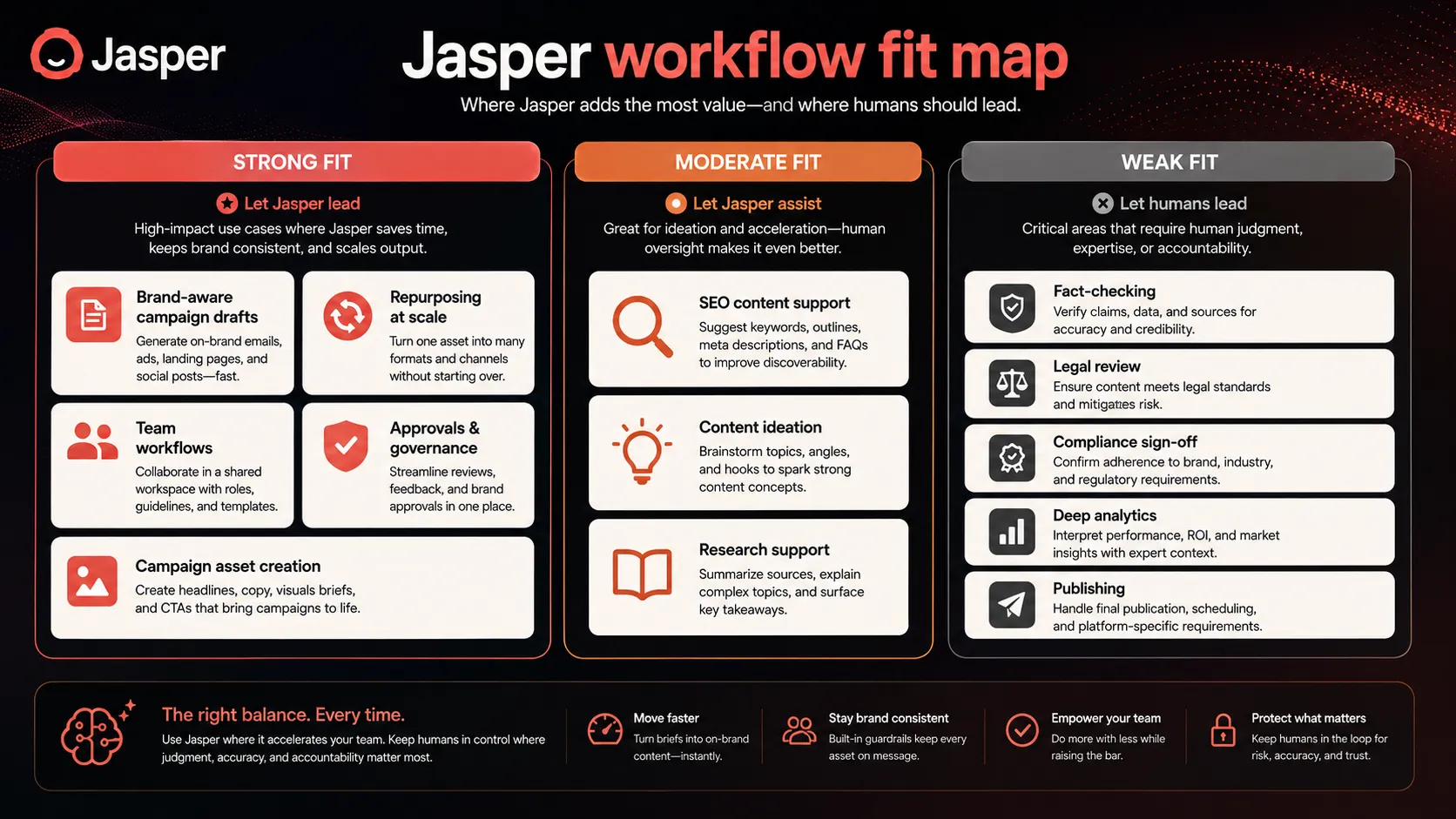
Jasper’s current platform direction also puts more weight on agents and pipelines. That matters if your team wants repeatable campaign workflows. It matters less if your work is just one-off writing help.
Where Jasper fits in an AI stack
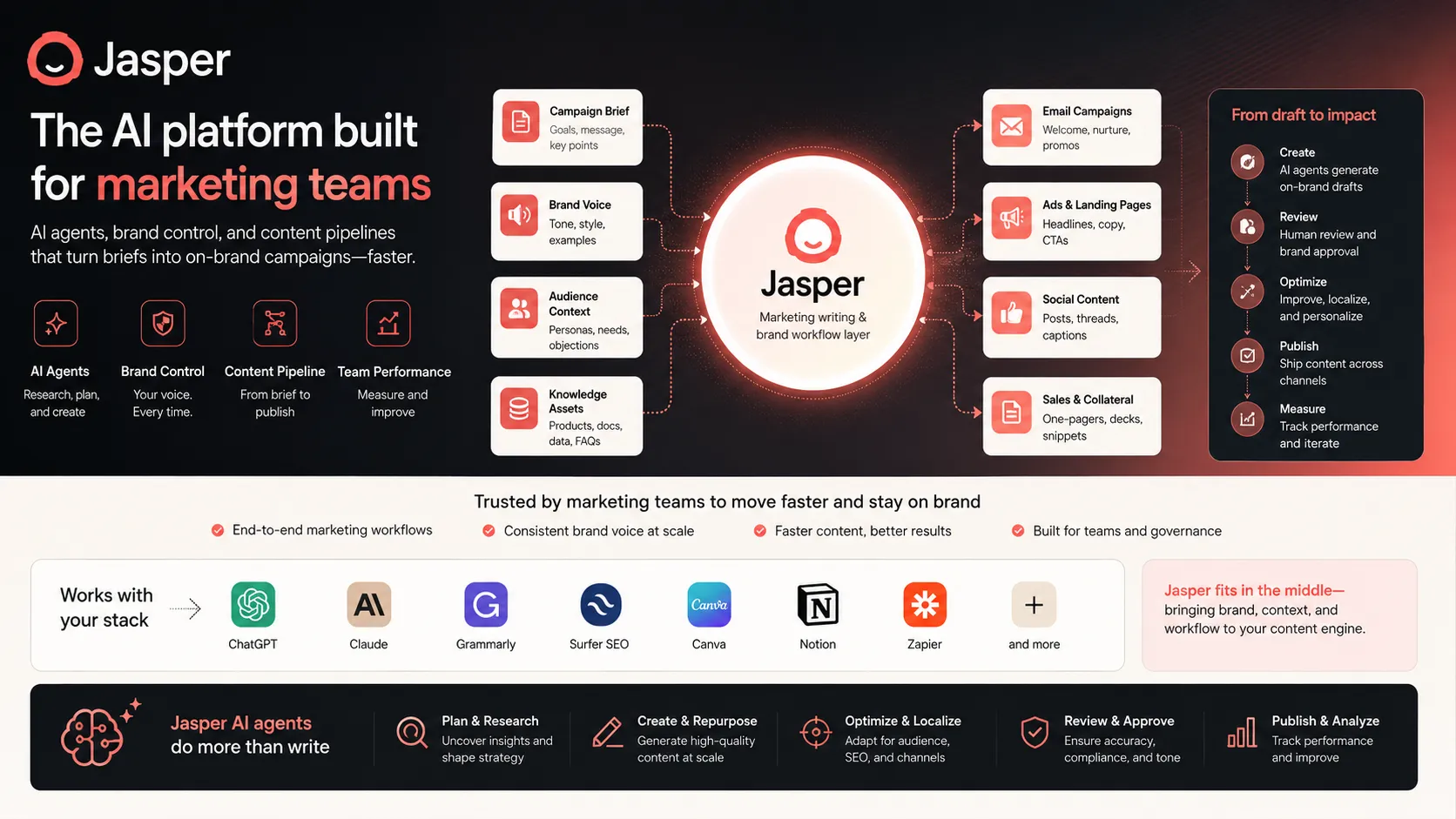
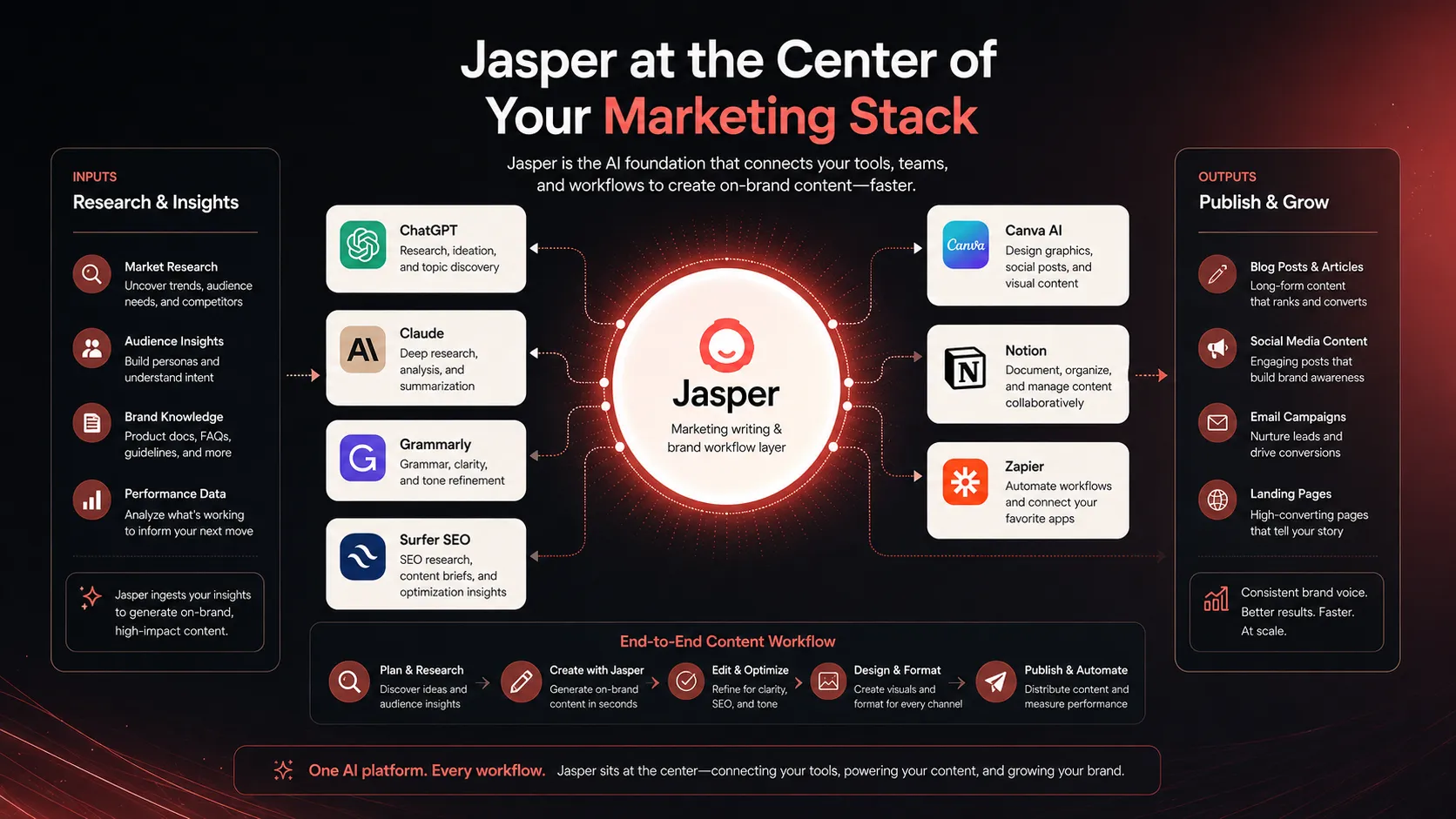
The right way to think about Jasper is as the marketing writing and brand workflow layer, not as the entire content operation.
In a practical stack, ChatGPT or Claude can still handle broad ideation, reasoning, source review, and long document analysis. Grammarly can handle final clarity polish. Surfer SEO or Frase can guide search intent and optimization. Canva AI can turn messaging into campaign visuals. Notion or another workspace can hold briefs. WordPress or another CMS handles publishing.
Jasper sits between those layers. It can replace scattered campaign prompts, basic copy templates, and some first-draft writing. It does not replace strategy, source-of-truth data, SEO research, compliance review, design, analytics, or publishing.
What Jasper does well
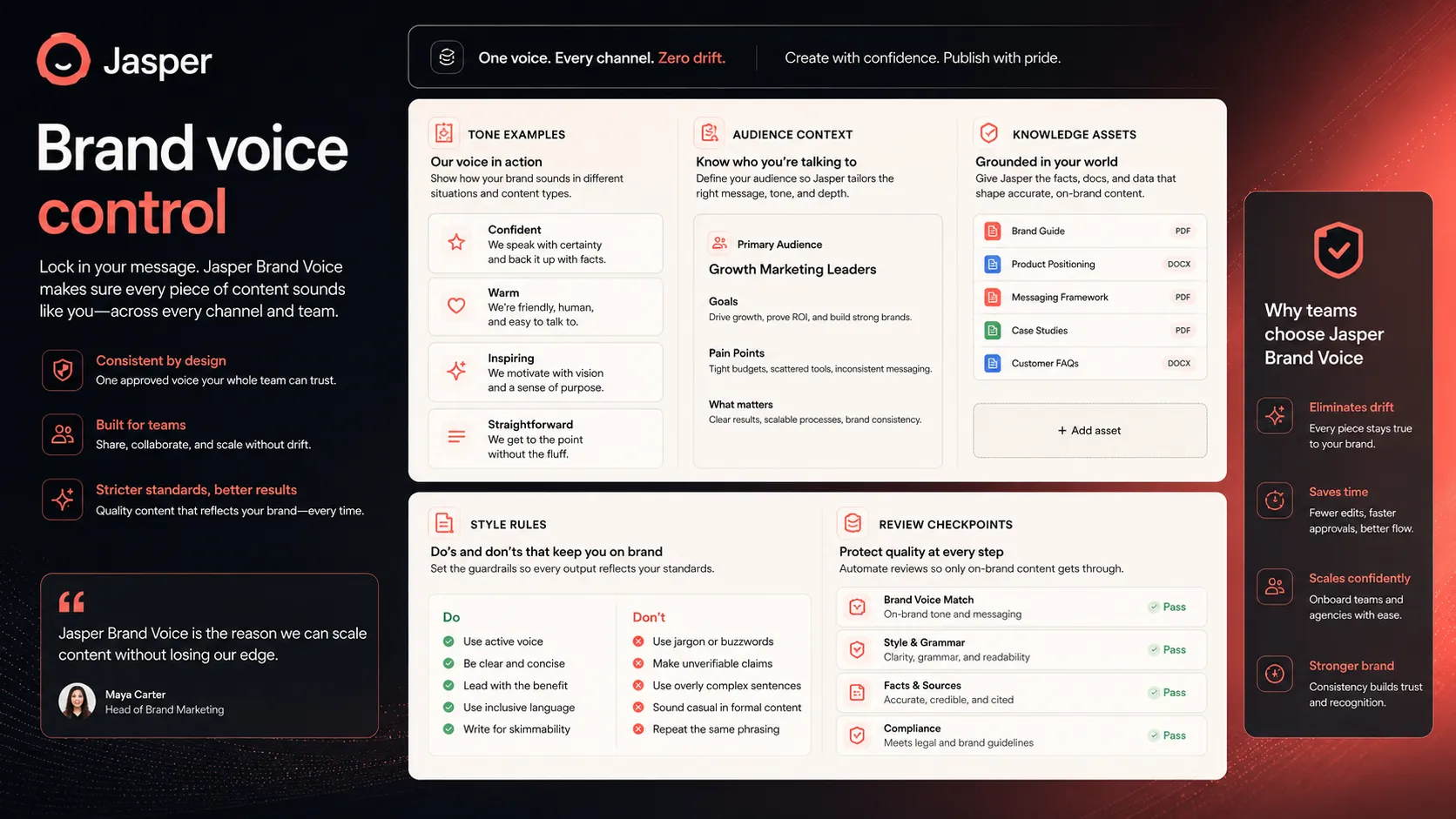
Jasper is strongest when brand consistency is a real business problem. If one person writes the email, another writes paid ads, a third writes the landing page, and an agency writes the social copy, brand drift becomes expensive. Jasper’s Brand Voice and context features are meant to reduce that drift.
This does not remove editing. It changes where editing happens. Instead of correcting tone from scratch every time, a team can push more guidance into the workspace and review from a more consistent starting point.
Jasper also does well when a campaign needs controlled variation. One message often needs many versions: a sales angle, a short paid ad, a landing page section, a LinkedIn post, an email subject line, and a partner blurb. Jasper is more compelling when those assets share one brief and one approval path.
Where Jasper falls short
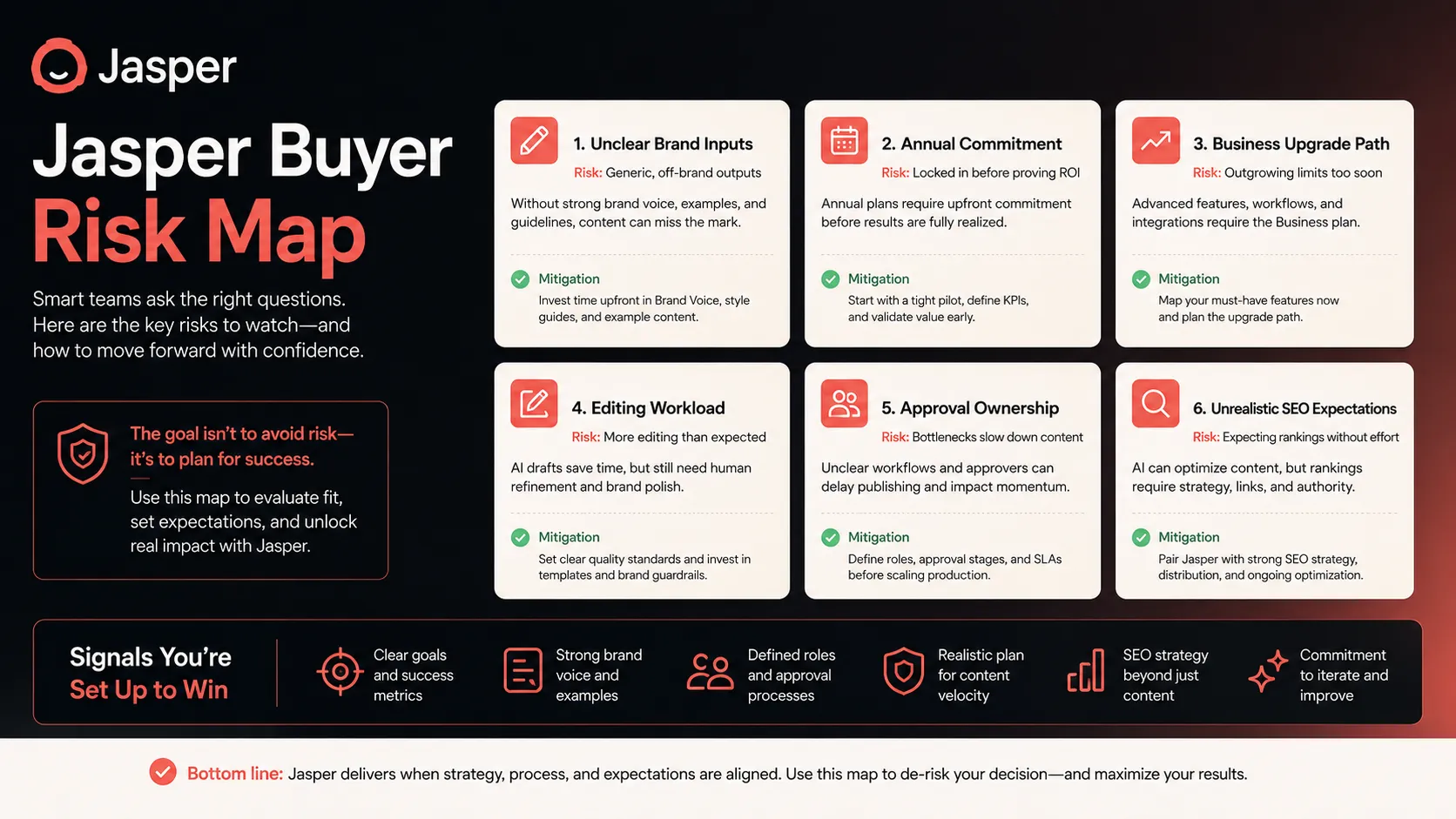
The part that does not get talked about enough is input quality. Jasper looks much better when the team already has strong source material. Without that, it can still produce polished language, but polished language is not the same as correct positioning.
This is where I would be careful. If your team cannot agree on the audience, the offer, the claims, the product facts, or the review owner, Jasper may simply make inconsistent work faster. The output might sound more finished than the strategy actually is.
The other limitation is plan fit. The Pro plan is the self-serve entry point. The moment you need multiple seats, unlimited brand controls, advanced agents, API access, SSO, governance, or stronger support, Business becomes part of the conversation. That is reasonable for larger teams, but it changes the buying decision.
Pricing judgment
Jasper’s pricing should be judged against team usage, not against the cheapest AI writer on the market.
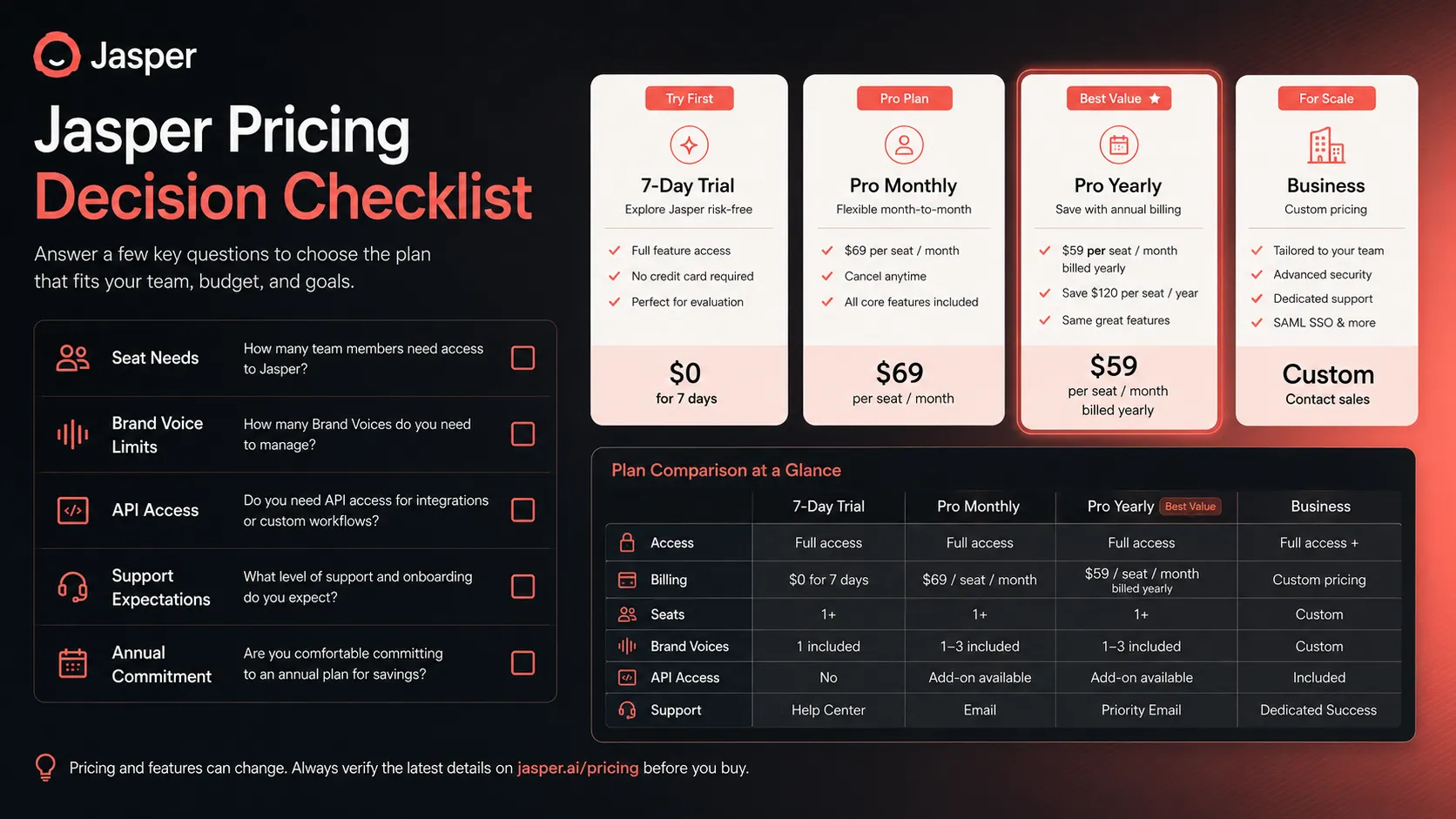
The public pricing page lists Pro at $69 per seat per month, or $59 per seat per month when billed yearly. Jasper also promotes a 7-day Pro trial. Business is custom pricing and is the path for larger team needs such as advanced agents, no-code agent building, Jasper Grid, unlimited IQ customization, API access, governance, account management, and priority support.
The practical question is whether your workflow can justify that. Pay for Jasper when your team produces enough campaign content that brand control, shared context, and workflow structure save real time. Compare alternatives first if your use case is still vague. Stay with a lighter assistant if the work is occasional.
Also verify the annual commitment, seat needs, cancellation policy, Business terms, nonprofit discount eligibility, and current Brand Voice limits before checkout. The trial is useful, but seven days is short for evaluating a real team workflow.
Best alternatives to compare
The best Jasper alternative depends on the job you are actually trying to solve.
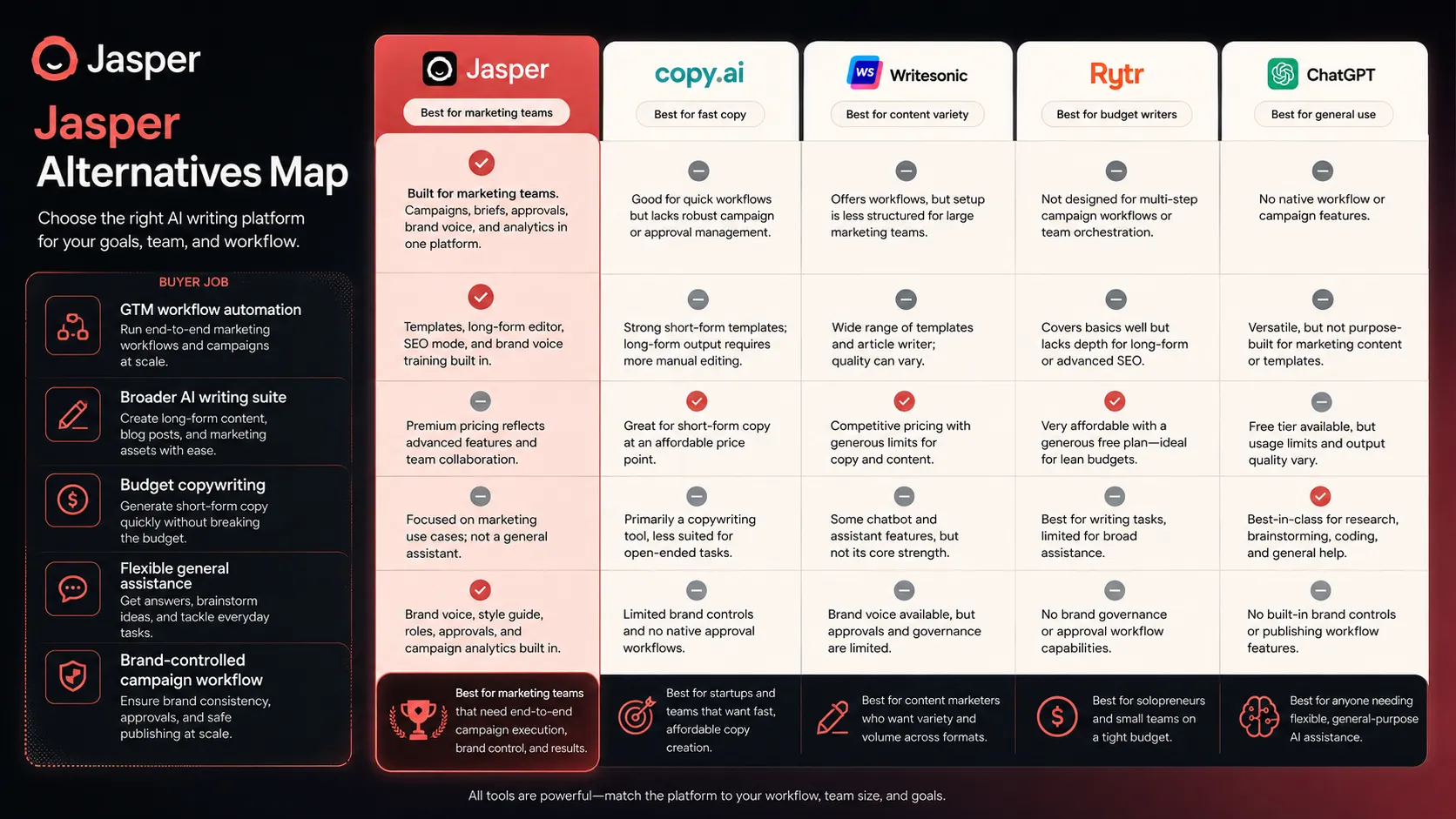
Compare Copy.ai if the question is GTM workflow automation and sales process support. Compare Writesonic if you want a broader AI writing suite with a more general content path. Compare Rytr if budget matters more than brand workflow depth. Compare ChatGPT or Claude if you mostly need flexible brainstorming, draft expansion, document review, and reasoning.
This is where buyers often compare the wrong thing. Jasper may not win a pure price comparison. Its stronger argument is structure for marketing teams that publish across channels and need brand consistency.
Final decision
Jasper deserves a serious look if marketing content is already a team workflow for you. It is strongest when your organization has recurring briefs, brand rules, audience context, product knowledge, and review ownership.
I would not add it just because the demo looks polished. The better test is whether Jasper can reduce a repeated bottleneck in your actual campaign process. If it cannot, a cheaper writing assistant will probably feel more practical.
Add it to your stack if brand-controlled marketing drafts and campaign workflows happen every week.
Compare it first if you are deciding between Jasper, Copy.ai, Writesonic, Rytr, ChatGPT, or Claude for overlapping writing jobs.
Skip it for now if your content process is still too undefined to benefit from a premium workflow layer.
Frequently asked questions
Is Jasper worth it in 2026?
Does Jasper have a free plan?
How much does Jasper cost?
Is Jasper better than ChatGPT for writing?
What is Jasper best used for?
What is the best Jasper alternative?
Where Jasper fits in a stack
Marketing writing and brand workflow layer
Does not replace
- – Marketing strategy and positioning work
- – Product fact source of truth
- – SEO research and optimization platform
- – Human editor, legal reviewer, or brand owner
- – CMS, design tool, analytics platform, or approval system
Head-to-head comparisons
jasper vs copy ai →
Compare Jasper and Copy.ai when the decision is brand-led marketing content versus GTM workflow automation.
jasper vs writesonic →
Compare Jasper and Writesonic when you want to separate team brand control from a broader AI writing suite.
jasper vs rytr →
Compare Jasper and Rytr when premium workflow depth and budget-first writing are pulling the decision apart.
Top alternatives to consider
If Jasper is not the right fit, these are the most common alternatives.
Copy.ai is the closest comparison when the buyer cares about GTM workflows, sales content, and revenue process automation rather than brand-led marketing content alone.
Writesonic is a better comparison when the buyer wants a broader AI writing suite with a more general content creation path.
Rytr is a cleaner comparison for freelancers and budget-first users who mainly need lightweight copy instead of a premium marketing workspace.
Review methodology
This review is based on current public Jasper product pages, pricing pages, help center documentation, the existing TopAIStacks Jasper profile, third-party review context, and editorial stack-fit analysis.
No private paid workspace, client deployment, or live Jasper campaign workflow was tested for this review. Recommendations reflect public product information and buyer-fit analysis.
Not covered: Hands-on output quality benchmark testing · Private campaign deployment · Enterprise contract negotiation · Internal ROI measurement